Canidae · DOG
Bichon Frise
🌟 You may have met one
Before the French Kennel Club adopted the breed standard on 1933-03-05, this dog went by two parallel names - Teneriffe and Bichon. FCI president Madame Nizet de Leemans coined a new name from the dog's own "curly coat" trait, merging them into Bichon Frise.
Overview
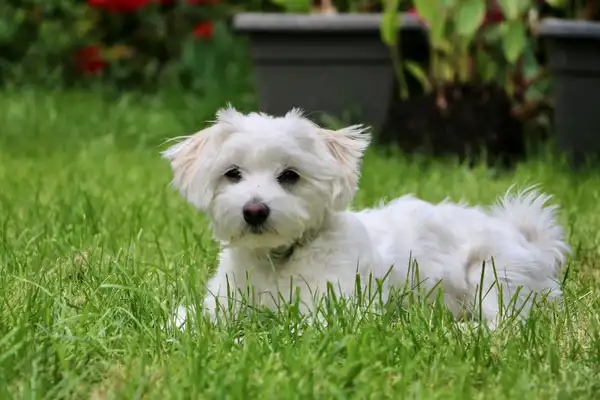
The Bichon Frise (比熊犬) is a small dog breed weighing 5–8 kg with a 14–15-year lifespan. White, fluffy, and cotton-candy adorable. Cheerful and social - great with children and older adults, and a natural fit for apartment and family life. Sheds very little.
Feeding
Small-breed formulas designed to reduce tear staining.
Exercise
About 30 minutes of daily walking is enough.
Grooming
Regular grooming trims required; wipe tear stains often.
Health
Prone to tear stains, skin allergies, and patellar luxation.
Gallery
A closer look at the Bichon Frise
From origins and personality to daily care and health — helping you judge whether this little companion is really the one for you.
Origin & history
Origin & history
The Bichon Frise belongs to the Bichon family - a group descended from the Barbet (a French water dog) crossed with small white Mediterranean lap dogs. There are four branches: the Bichon Maltais (Maltese), the Bichon Bolognais (Bolognese), the Bichon Havanais (Havanese), and the Bichon Teneriffe (today's Bichon Frise). The word "Bichon" is a shortening of "Barbichon" - literally "little Barbet." [1][3][4] Early sources agree that in the 14th century Spanish sailors brought these small white dogs to Tenerife in the Canary Islands, where the breed stabilized. Italian sailors then "rediscovered" them and brought them back to mainland Europe, where they were quickly embraced by Italian nobility. [2][4] The Bichon's first golden age in France came in the Renaissance court of Francois I (1515-1547), but its true divine status arrived under Henri III (1574-1589) - the king carried his beloved dogs around in a tray hung from his neck, arguably the most doting canine ownership in European royal history. [2][3] After a brief revival under Napoleon III, the breed abruptly "fell from grace" at the end of the 19th century and became a street performer's dog - accompanying organ-grinders, tumbling in circuses and market fairs, guiding blind beggars. Those street years are exactly what proved its intelligence and adaptability, and after WWI a small circle of French and Belgian enthusiasts rescued the breed. [2][5]
Looks & breed standard
Looks & breed standard
The AKC standard is precise: the Bichon stands 9.5-11.5 in at the shoulder (about 24-29 cm) and weighs 12-18 lb (about 5.4-8.2 kg), slightly longer than tall, with a tail that curves naturally over the back rather than standing straight up. [5] The secret behind the cotton-candy look isn't hair length - it's the double coat: a soft, dense undercoat plus a coarse, springy curly outercoat. Together the two layers make the coat "stand off" the body instead of lying flat - trimmed into the classic powder-puff, it feels like velvet and springs back when pressed. [5] The head has three signature details: a pair of dark round eyes, a black-pigmented "halo" ringing each eye, and a black nose - all three combine to amplify that "bright and curious" expression. Any deficiency loses points in the AKC ring. [5] Color is predominantly pure white; small buff, cream, or apricot shading is allowed around the ears, muzzle, or body, but if non-white color exceeds 10% of the coat, it's a disqualification. [3][5]
Personality in depth
Personality in depth
The official Bichon label is "the smiling dog." The BFCA sums it up as "gentle mannered, sensitive, playful and affectionate," and Petplan calls them outright "born people pleasers" - naturally social, delighted to make you happy. [5][6] Its street-performer past left two enduring behavioral legacies: first, it learns fast and loves to perform (any breed that survived working the streets had to have both brains and stamina); second, it treats people as the center of its whole world, which is why it socializes easily with children, other dogs, and cats - the textbook apartment-friendly, family-friendly small dog. [2][5][6] The flip side of that closeness is separation anxiety - very common in Bichons. Petplan explicitly warns that this breed shouldn't be alone for long stretches, or it will bark, scratch, or chew furniture in protest. [6] The other contrast is "a small dog with a big dog's energy" - Petplan describes Bichons as having "twice their size in liveliness," needing 30 minutes of walking plus indoor play a day to burn off. [6] For training, Bichons are smart but sensitive - only positive reinforcement works. Traditional pressure-based training makes them shut down. Housetraining is one of their slower skills. [6]
Daily care
Daily care
The Bichon is called a "hypoallergenic-leaning" dog - not because it doesn't produce dander or saliva protein, but because its double curly coat traps shed hairs inside itself instead of releasing them onto the couch, which makes it more tolerable for people with mild dog allergies. [5] The direct consequence is that grooming costs run higher than most short-coats: **daily brushing is mandatory** (skip it and shed hairs mat inside the coat, forming felt-like clumps that can only be shaved off), plus a **professional groom every 6-8 weeks** at 25-45 pounds in the UK or 200-400 RMB in China - roughly 8-10 grooms a year. [5][6] The face has two daily jobs: cleaning tear stains (they show up dramatically against white fur - wipe daily under the eyes with saline or dedicated pet wipes), and cleaning the ear canal (drop ears with dense hair are hotspots for ear mites and fungal infection). [5][6] Bathe about every 3-4 weeks and rinse thoroughly - the BFCA specifically flags shampoo residue as a common trigger for Bichon skin allergy flares. [7]
Health & lifespan
Health & lifespan
The BFCA (Bichon Frise Club of America) health survey from 2006/7 lists the breed's ten most common issues, ranked by prevalence: 1. Skin allergies (atopy - a shared tendency across white breeds) - the most common; usually manageable; 2. Bladder infections and stones (calcium oxalate especially) - straining, blood in urine, and frequent urination are the early signs; 3. Orthopedic (patellar luxation, Legg-Calve-Perthes disease of the femoral head, disc degeneration) - the BFCA recommends OFA/PennHIP screening for breeding stock; 4. Dental disease (gingivitis, early tooth loss) - daily brushing plus annual professional cleaning required; 5. Eye disease (cataracts, glaucoma, dry eye); 6. Cardiac (patent ductus arteriosus, a congenital defect); 7. Cancer (lower incidence than average, no breed-specific type); 8. Metabolic (Cushing's, diabetes, pancreatitis); 9. Liver and spleen (including portosystemic shunt); 10. Ear (infections, deafness). [7][8]
Petplan claims data flag diabetes as a high-incidence Bichon condition alongside Cushing's - long-term steroid use for allergy control can trigger diabetes, creating a vicious cycle. [6] Recommended DNA screens include vWD I (von Willebrand's), degenerative myelopathy (DM), and CDDY/IVDD disc-risk. [8]
Average lifespan is 14-15 years, and healthy individuals routinely reach 16-18. Overseas records include dogs past 19. [5][8][9]
Fit for your space
Fit for your space
The Bichon consistently sits near the top of AKC's apartment-friendly rankings, thanks to three structural advantages: (1) it weighs only 5.4-8.2 kg - small enough to fit in an airline carrier or a condo elevator; (2) exercise needs are moderate - one 30-minute walk plus 20 minutes of indoor fetch is enough per day, unlike Huskies or Border Collies who exhaust anyone stuck at home with them; (3) minimal shedding and almost no doggy odor make it kind to city hygiene. [5][6] But "apartment-friendly" doesn't mean "leave alone." The Bichon has two contrast points: it's an **alert barker** by nature (it did evolve as a watchdog, after all) - doorbells and hallway footsteps trigger loud barking, so "quiet" cues need to be trained early; and its **separation anxiety runs deep** - the ideal owner is home most of the time (remote workers, retirees, dual-parent households). Full-time office workers should not raise a Bichon alone; consider a second dog or pet daycare. [6] On climate: Bichons handle cold better than heat - the double coat insulates well in winter, but in summer you need A/C, a shave-down of the undercoat, and no midday walks. Heatstroke is a real risk during southern-Chinese summers.
References
This is an educational overview — for specific health and care advice, please consult the authoritative sources below and your veterinarian.
- [1] Bichon Frise 起源 - Barbara Stubbs《The Complete Bichon Frise》(BFCA 官方)Official
- [2] Bichon Frise 综合指南 - Mediterranean lapdog、Henry III、街头岁月 (Breed Bible)Review
- [3] Bichon Frise 命名与 AKC 注册史 - 1934 FCI 定名、1973 AKC 承认 (Bruning)Official
- [4] Cornerstone Kennels - Bichon Origination(1300s 意大利水手、1955 首入美国)Review
- [5] Bichon Frise 完整指南 - 尺寸、外观、性格、健康 (Sidewalk Dog)Review
- [6] Bichon Frise 健康与保险索赔数据(糖尿病、库欣、韧带断裂)(Petplan UK)保险
- [7] BFCA 2006/7 年比熊健康调查 - 十大问题排序 (Bichon Frise Club of America)Study
- [8] Bichon Frisé 遗传易感疾病 - vWD I、DM、CDDY/IVDD (Basepaws)Study
- [9] Bichon Frise 寿命 14–19 岁与养护指南 (PuppySimply, 2026)Review