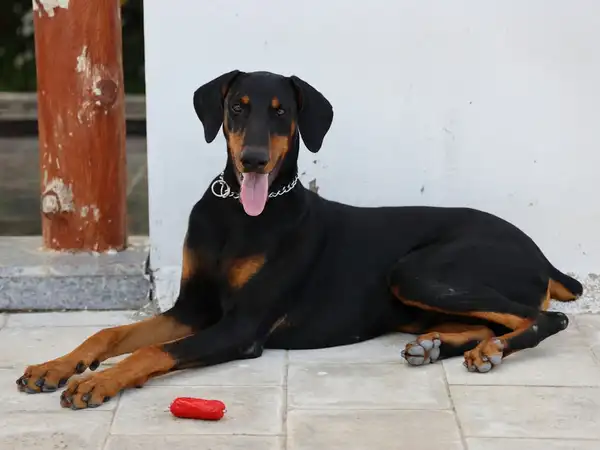
Canidae · DOG
Boxer
🌟 You may have met one
Native to Germany, Boxers transitioned from fighting dogs to military and police dogs around 1900. During WWI the German army used them to carry messages and locate the wounded — only after that did they spread across Europe and America as family dogs.
Overview
The Boxer (拳师犬) is a large dog breed weighing 25–32 kg with a 10–12-year lifespan. A muscular working dog whose name comes from the way it stands on its hind legs like a boxer. Full of energy and warmly devoted to family, the breed needs plenty of exercise and training.
Feeding
A large-breed formula with calories kept in check.
Exercise
About 1.5 hours of vigorous activity every day.
Grooming
Short coat brushed once a week.
Health
Heart disease, cancers, and hip issues are common concerns.
Gallery
A closer look at the Boxer
From origins and personality to daily care and health — helping you judge whether this little companion is really the one for you.
Origin & history
Origin & history
The Boxer is a **German breed** whose direct ancestor is the now-extinct **Bullenbeisser** (literally "bull biter"), a large gripping hound used from the Middle Ages onward in Germany to hunt wild boar, bear, and deer, holding prey in a vice-like grip until the huntsman arrived. [1][2] As industrialization shrank large-game hunting in the 19th century, the Bullenbeisser lost its role. In the 1880s and 90s, **Munich-based dog fanciers** began crossing Bullenbeissers with **Bulldogs** imported from England — aiming to preserve the Bullenbeisser's power and bite while adding the Bulldog's short-headed structure and family-friendly temperament. The modern Boxer took shape from this breeding program. [1][3]
**In 1895 the Deutscher Boxer Klub was founded in Munich** — the world's first Boxer club — and in **1902** it published the breed's first standard, still the reference for the FCI and AKC today. **The name "Boxer"** has never been definitively traced. The most popular explanation is that the breed uses its front paws to bat at opponents in play and combat, mimicking a boxer's motion; another theory says "Boxl" was a regional nickname for the Bullenbeisser. [1]
**In 1904 the AKC officially recognized the Boxer** (Working Group), and the UK Kennel Club followed in 1939. What truly internationalized the breed were the two World Wars — **the German army used Boxers as military dogs** for messenger work, pack carrying, guarding, and locating the wounded, and their intelligence, endurance, and loyalty impressed Allied soldiers. **After WWII, American servicemen brought Boxers home in large numbers**, propelling the breed onto America's most popular family dog lists. [2][3] Boxers ranked in the AKC's top five throughout the 1940s and 50s and remain steadily in the top 20 today.
Looks & breed standard
Looks & breed standard
The AKC breed standard positions the Boxer as a **medium-to-large working dog**: **males 22.5–25 in (57–63 cm) at the shoulder, weighing 65–80 lb (30–36 kg)**; **females 21–23.5 in (53–60 cm), 50–65 lb (23–29 kg)**. The overall structure is officially described as "square-built, muscular, and compact" — body length roughly equal to shoulder height, powerful hindquarters, and a deep, broad chest. [4][5]
The head is the Boxer's most recognizable feature — **moderately brachycephalic**: a **square skull with about a 1:1 ratio between the forehead and muzzle, plus an undershot jaw** as required by the standard. (This is a legacy of the breed's origin as a gripping dog — the undershot jaw allowed the dog to breathe through its nose while holding prey.) The muzzle is longer than that of the French Bulldog or Pug, so BOAS risk is lower but not absent. **Ears** are large and drop naturally, or (historically) cropped to stand upright — most European and North American countries now ban cropping. **Tails** were traditionally docked but are also banned in many countries today.
**AKC official colors**: **Fawn (light tan to deep red-brown)**, **Brindle (fawn base with black stripes)**, and **White (about 10%)** — every Boxer wears the standard **black mask** on its face. **White Boxers** carry a genetically higher rate of deafness (roughly 20–30%) and were historically deemed "non-showable," excluded from breeding programs. They still make excellent family pets, though their reduced pigmentation raises skin cancer risk, so sun protection is important. [4]
Personality in depth
Personality in depth
The Boxer's nickname is **"Eternal Puppy"** — mental maturity doesn't fully arrive until age three or four, making it one of the slowest-maturing large breeds. This lifelong childlike exuberance, paired with a heavily muscled body, gives the Boxer a personality profile all its own. [4][5]
The AKC officially calls the Boxer "fun-loving, bright, active, and loyal." With **family**, Boxers are highly attached and richly expressive — they lean in, greet by jumping up, and slot their heads into your knees. They are emotional "giant babies." With **children**, the Boxer is widely regarded as **one of the best family dogs** — patient and naturally protective. During WWI, German soldier families reportedly nicknamed them "nurse dogs" for the way they'd lie by a sick child's bed for hours. With **strangers**, Boxers are alert and territorial — a natural guard dog — but usually of the **"bark, don't bite"** type, whose imposing look and voice deter most intruders. [5]
**With other dogs**, same-sex adult Boxers can spark friction (especially intact males), so early socialization is essential. **With small pets**, high excitement and jumping mean cohabitation requires care but is achievable. **Training-wise**, Boxers are smart but short on attention span — they need **varied, engaging, positive-reinforcement** training, and repetitive drills bore them into refusal. They excel as family dogs, running partners, and agility, carting, or dog-sport competitors.
Daily care
Daily care
The Boxer is a **high-energy breed** — the AKC states plainly that it "requires substantial daily exercise": **90–120 minutes of moderate-to-vigorous activity per day** is the baseline, ideally split into a morning and evening block of brisk walking or jogging, plus tug-of-war, ball chase, and agility work. [4][6] An under-exercised Boxer protests through destruction, jumping, barking, and mouthing — the main reason for the breed's "hard to raise" reputation.
**Brushing** once or twice a week is enough — a rubber curry mitt or short-bristle brush handles the coat easily. **Shedding** is moderate, picking up during spring and fall coat blows. **Bathing** every 4–6 weeks; **tooth brushing** three times a week (brachycephalic dogs have crowded teeth and high rates of periodontal disease); **face-fold cleaning** with a damp wipe daily — saliva and food debris collect around the mouth and chin.
**Temperature vigilance** is a Boxer daily requirement. As a moderately brachycephalic short-coated dog, it **tolerates neither heat nor cold well**: at above 82°F (28°C) in summer, outdoor time must be cut, water carried at all times, and midday walks avoided; below 41°F (5°C) in winter, a coat is needed. **BOAS warning signs** — if a Boxer on a walk shows heavy panting, blue tongue, drooling, or suddenly refuses to move, it may be heat stress or an acute BOAS episode. Cool with water immediately and call a vet. [4][7]
Health & lifespan
Health & lifespan
The Boxer's health profile is **exceptionally complex** among large breeds — several deadly hereditary diseases are heavily concentrated in the breed, holding average lifespan to just 10–12 years.
**First is ARVC (Boxer Cardiomyopathy / Arrhythmogenic Right Ventricular Cardiomyopathy)** — a **breed-specific heart disease** and one of the most distinctive genetic conditions in canine medicine. **Cornell University** identified the **STRN gene mutation** as the primary cause; inheritance is autosomal dominant with incomplete penetrance (carriers may not develop disease). Symptoms include exercise-induced fainting, arrhythmia, and sudden death, with onset ranging from 6 months to 10 years. **A 24-hour Holter monitor** is the gold-standard diagnostic, and the AKC parent club recommends **an annual Holter for adult Boxers**. [4][7][8] **DCM (dilated cardiomyopathy)** is another cardiac subtype in Boxers.
**Second is a very high cancer rate** — the Boxer has **one of the highest lifetime cancer risks of any breed** (about 40%): **lymphoma**, **mast cell tumors**, and **brain tumors (especially glioma)** all rank near the top of Boxer disease frequency. [7][8] The **Boxer Cancer Foundation** was established specifically to fund breed cancer research.
**Third is DM (Degenerative Myelopathy)** — a progressive hind-limb paralysis of older dogs caused by the **SOD1A mutation**, and the Boxer is one of the most affected breeds. Embark and OFA both offer DM genetic screening. [7][8] Additional concerns include **SAS (Subvalvular Aortic Stenosis)**, a congenital heart defect; **BOAS**; **hip dysplasia** (OFA data show the Boxer HD rate at roughly 12–15%); **hypothyroidism**; and **Boxer Ulcerative Colitis**. [7] Reputable breeders screen for at least five conditions — **STRN, DM, hips, cardiac ultrasound, thyroid**. Insisting on these reports is the minimum bar for buying a Boxer puppy.
Fit for your space
Fit for your space
The Boxer's household match is a **high bar** — it exemplifies the "hard-to-raise family dog," needing an owner who checks four boxes: **space, time, physical strength, and patience**. [3][5] For **space**, the Boxer is **not suited to small apartments** — 60 cm at the shoulder + 30 kg + high energy means indoor play space must be generous, ideally a house or duplex with a small yard. For **time**, the breed needs 2+ hours of active engagement and exercise daily; leaving it alone for over 6 hours regularly leads to serious separation anxiety and destructive behavior.
On **physical strength**, a Boxer's leaping enthusiasm and raw power can easily drag a lighter owner along on the leash — at least one adult in the household must be able to physically manage the dog outdoors. On **patience**, "Eternal Puppy" means it's a big goofball until age three or four: knocking over furniture, getting into trouble, jumping on strangers, bolting when unrestrained. Owners must commit to consistent training through those years and accept the "still a teenager" temperament.
On **climate**, the Boxer **tolerates neither heat** (short skull + short coat) **nor cold** — the ideal living range is 15–22°C (59–72°F). Both summer and winter demand climate control indoors and strict outdoor time management. **Not suited for**: first-time owners, elderly owners, homes with very young children, homes empty for long stretches, or budget-tight households (Boxer health issues can push lifetime vet costs to 2–3× that of a typical dog). **Well suited for**: middle-aged owners with a yard, families with older children (8+), runners and hikers, and owners who welcome a highly active companion.
References
This is an educational overview — for specific health and care advice, please consult the authoritative sources below and your veterinarian.
- Wikipedia — Boxer (dog)(Bullenbeisser 起源、1895 Munich 俱乐部、AKC 1904 承认、军犬历史)综合百科
- Britannica — Boxer: origin, description, temperament百科全书
- AKC — Boxer 品种档案(Working Group、Fun-loving/Bright/Active/Loyal)AKC 官方
- AKC — Official Standard of the Boxer品种标准
- American Boxer Club(AKC 家长俱乐部,ARVC 与癌症研究倡导)犬种俱乐部
- PetMD — Boxer: Care, Nutrition and Common Conditions宠物医学网站
- UFAW — Boxer Genetic Welfare Problems(ARVC、SAS、癌症、BOAS 综述)动物福利综述
- Meurs et al. 2010 — A missense mutation in the striatin gene (STRN) associated with ARVC in Boxer dogs(康奈尔 STRN 突变研究)学术论文
- Parker et al. 2017 — Genomic analyses reveal the influence of geographic origin on canine breed formation学术论文