Canidae · DOG
Rottweiler
🌟 You may have met one
Roman legions used Rottweilers to drive cattle and guard payroll on the march. The name comes from the German town of Rottweil — a former Roman garrison site.
Overview
The Rottweiler (罗威纳犬) is a giant dog breed weighing 35–60 kg with a 9–10-year lifespan. An ancient guardian breed with dense muscle and unmistakable presence. Gentle with family, watchful with strangers — early socialisation and training are essential.
Feeding
Large-breed formula with joint-support ingredients.
Exercise
1–1.5 hours of daily exercise.
Grooming
Short coat, brushed once a week.
Health
Watch for hip issues, cardiac disease, and osteosarcoma risk.
Gallery
A closer look at the Rottweiler
From origins and personality to daily care and health — helping you judge whether this little companion is really the one for you.
Origin & history
Origin & history
The Rottweiler is **one of Europe's oldest surviving guardian breeds**, with roots reaching back to **Roman legionary drover mastiffs** — around **AD 73–74** the emperor Vespasian established garrisons in southern Germany, and the legions used sturdy mastiff-type dogs to drive cattle alongside the marching column, feeding the troops and guarding the camp at night[1][2]. **The town of Rottweil** takes its name from Roman ruins — **"das Rote Wil"** ("the red villa") — after the red-tiled Roman roofs; when the legions withdrew around **AD 260**, their drover dogs stayed and interbred with local herders, forming the early Rottweil type[1][2]. **In the Middle Ages**, Rottweil grew into the largest cattle market in southern Germany, and local butchers and merchants used the dogs to drive cattle to market, guard beef being carried home, and even carry the day's takings in a purse tied to the collar — earning the nickname **"Rottweiler Metzgerhund" (Rottweil butcher's dog)**[1][2]. **The 19th-century industrial revolution** was the breed's darkest hour: **rail transport replaced cattle drives**, the 1836 German ban on cattle-driving dogs erased their core job, and the 1882 Stuttgart show recorded just **one** Rottweiler — the breed was on the brink[1][2]. **In 1901** the "International Club for Leonberger and Rottweiler Dogs" published the **first Rottweiler standard**; **1907** saw the Deutscher Rottweiler-Klub (DRK), which merged in 1921 into the **Allgemeiner Deutscher Rottweiler-Klub (ADRK)**, the first official stud book following in **1924** — the Rottweiler was rebooted as a working, police, and guard dog[1][2]. **In 1907** German police adopted them as one of the country's first four service breeds; the **AKC recognised the breed in 1931** (registration No. 105, Stina v. Felsenmeer)[1][2]. During WWII the German army used Rottweilers as messengers, sentries, and casualty haulers. **In the 1990s**, Rottweilers became one of America's most-registered breeds (peaking above 100,000 registrations in 1993), but overproduction eroded quality and led to social backlash; registrations have since stabilised around 8,000–15,000 a year[1][2].[1][2]
Looks & breed standard
Looks & breed standard
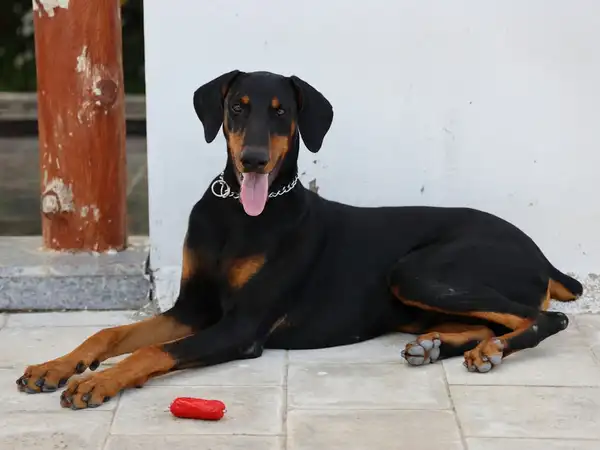
**AKC/FCI standard**: **males 24–27 in (61–69 cm) and 95–135 lb (43–61 kg)**; females 22–25 in (56–63 cm) and 80–100 lb (36–45 kg) — a medium-large-to-large working dog (AKC Working Group / FCI Group 2, Section 2.1)[3]. **Proportions**: **body slightly longer than tall (10:9)**, heavy-boned and densely muscled; the AKC calls it "substance and power"[3]. **Head**: **broad medium-length skull** — wide between the ears, extremely well-muscled cheeks, pronounced stop; muzzle about 60% of skull length; nose bridge straight; jaws with a **powerful bite** — measured bite force around **328 psi**, top-5 among domestic dogs[3]. **Eyes**: medium, almond-shaped, and **dark brown** — light eyes are disqualifying; expression must read "good-natured, alert, self-assured"[3]. **Ears**: medium, triangular, dropping close to the cheek — **the standard forbids cropping** (a key difference from the Doberman)[3]. **Tail**: docking was originally allowed at 3–5 days, but is now banned across most of Europe and the Commonwealth (Germany 1998, UK, Netherlands, Sweden, Australia) — modern European Rottweilers keep their natural tail[3]. **Colour**: **black with rust-to-mahogany markings** (over eyes, on cheeks, muzzle, chest, legs, and under the tail) — no other colour is accepted; long coat or white markings are disqualifying[3]. **Coat**: **short double coat** — coarse, straight outer coat and thin soft undercoat, moderate seasonal shedding twice a year[3]. **Gait**: **the trot** is the ideal — synchronised diagonal drive, showing surprising agility for such a heavy dog[3].[3]
Personality in depth
Personality in depth
**AKC official temperament**: **loyal, loving, confident guardian** — Rottweilers are one of the rare **dual-mode guardians**: soft and cuddly with family, calmly imposing with actual threats[3][4]. The DRK's own words: **"selbstbewusst, ruhig, ausgeglichen" (self-assured, calm, balanced)**[4]. **Intelligence**: **9th on Coren's list** — top-10 for working obedience, on par with Dobermans and Golden Retrievers; a new command sticks in fewer than 15 tries and first-command obedience exceeds 85%[3]. **Behaviour caveat**: their sheer mass and power amplify any training or socialisation gap. AKC data show Rottweilers ranked #2 for fatal-bite involvement between 2010 and 2019 (behind pit-bull-type dogs), but nearly all cases involved **untrained, chained, unsocialised individuals** — a rearing problem, not a breed problem[4][5]. **Trainability**: high, but demands **consistency, patience, and physical strength** — the DRK is explicit: **"the Rottweiler is not for first-time owners."**[4]. **Attachment**: intensely bonded — the **"leaning behaviour"** (pressing their weight against your legs) is a Rottweiler trademark; strangers are observed before greeted, and a well-socialised dog is polite to guests but keeps distance[4]. **Exercise / mental needs**: **1.5–2 hours of moderate-to-high activity daily plus at least one training session a week**; skip the target and you'll see destruction, alarm barking, and hyper-vigilance[4]. **With children**: good under supervision — AKC 4/5, but the size can bowl over a toddler, and unsupervised time with under-5s is a hard no; guests of varied ages and backgrounds require deliberate socialisation[4]. **With other pets**: **same-sex conflict risk is high** (especially two males); cats and small pets read as prey unless raised together from puppyhood[4].[3][4][5]
Daily care
Daily care
**1) Early socialisation (the critical piece)**: **the 8–16-week window**, minimum three novel exposures a week — people of every age, dogs of every colour, sounds (traffic, doorbells, babies), surfaces (grass, tile, metal grates); the AKC recommends **puppy kindergarten + CGC + STAR Puppy**[6]. **2) Training**: **basic obedience from 8 weeks, intermediate from 6 months** — IPO/IGP (Schutzhund), Rally-O, or Obedience classes are ideal; the DRK requires all breeding stock to pass a **BH temperament test**[4][6]. **3) Exercise**: adults need **two 40–60-minute moderate-to-high sessions daily** — brisk walks, jogging (only after 18 months), fetch, agility. **Puppies must avoid long-distance running and high-impact jumping** until growth plates close, protecting hips and elbows[6]. **4) Diet**: **large-breed puppy food until 18–24 months**, then adult; **2–3 meals daily**, no strenuous exercise 1 hour before or after (GDV prevention); adult targets 22–26% protein, 12–16% fat, calcium/phosphorus ratio 1.2:1[6]. **5) Joint protection**: **annual OFA/PennHIP hip and elbow radiographs**; use non-slip flooring; avoid premature high-impact jumping[6]. **6) Cardiac and skeletal monitoring**: from age 5, **annual echocardiogram and cancer bloodwork** — osteosarcoma and heart disease are the leading late-life killers[7]. **7) Coat care**: brush weekly (daily during shedding); bath every 6–8 weeks; **daily brushing and annual dental cleaning** (large breeds are periodontal-disease prone)[6]. **8) Warmth vs. heat**: excellent cold tolerance (double coat plus fat), poor heat tolerance — avoid midday exercise above 30 °C; the black coat and shorter muzzle raise heat-stress risk[6].[4][6][7]
Health & lifespan
Health & lifespan
**1) Osteosarcoma**: Rottweilers have **the highest incidence of any breed** — spaying/neutering before **ages 5–8** significantly raises female risk (delaying gonadectomy past age 4 lowers it). Long bones (fibula, radius, femur) are most affected; **any unexplained lameness lasting more than 2 weeks warrants an X-ray**. Early diagnosis + amputation + chemo can add 12–24 months of quality life[7][8]. **2) Elbow dysplasia**: **OFA data 40.3%** — top-5 for the disease, with breed-specific odds ratios of 36.1 for fragmented coronoid process, 27.4 for ununited anconeal process, and 174 for OCD versus the average dog. It's the leading cause of puppy lameness — screen at 12 months[7][8]. **3) Hip dysplasia**: **OFA 20.3%** — lower than the elbow but still on the high side for a large breed; screen with OFA/PennHIP at age 2[7][8]. **4) DCM and subaortic stenosis (SAS)**: DCM is 3–4× more common than in the average dog; SAS is the top congenital cardiac defect in Rottweiler puppies[7]. **5) GDV**: lifetime risk about 20% — **prophylactic gastropexy at spay/neuter** cuts GDV mortality from 30% to under 5%[7]. **6) Hypothyroidism**: high mid-life incidence[7]. **7) Rottweiler-specific distal sensorimotor polyneuropathy**: a hereditary late-onset progressive limb weakness peculiar to the breed[7]. **8) Parvovirus susceptibility**: Rottweiler puppies show unusually high vaccine-response failure — stick to the strict 6/9/12/16-week protocol[7]. **9) Cataracts, entropion, ectropion**: mid-life onset[7]. **10) Lifespan**: **9–10 years** — **short by large-breed standards** (below Golden Retrievers at 11–12, Labradors at 10–12, Dobermans at 10–13), pulled down by osteosarcoma and cardiac disease combined[7][8]. **CHIC recommended screenings**: hip OFA, elbow OFA, cardiac echo, ophthalmic CERF, JLPP DNA (Juvenile Laryngeal Paralysis and Polyneuropathy)[7].[7][8]
Fit for your space
Fit for your space
**1) Home**: **detached home with yard or a large loft** — small apartments do not fit their size or exercise needs; **indoor living only** (short coat + need for family time rules out outdoor housing); non-slip flooring (elbow protection) and puppy gates on stairs are essential[6]. **2) Family fit**: **experienced owners with disciplined training habits and physical strength** are the ideal match; children need supervision (mass and force); singles, couples, and retired households all work; **owners gone 10+ hours a day are a hard no** — separation anxiety turns into destruction and hypervigilance[4][6]. **3) Neighbours**: low-to-moderate barking — quiet in daily life, alert only for real threats; the intimidating look, however, means owners must actively manage neighbour and guest impressions[4]. **4) Climate**: excellent cold tolerance (double coat), poor heat tolerance (black coat, shorter muzzle) — avoid midday exercise above 30 °C, schedule mornings or evenings; not for outdoor tropical living[6]. **5) Vet budget**: **mid-to-high** — $1,500–3,000/year for basics; hip/elbow surgery $5,000–8,000; osteosarcoma treatment (amputation + chemo) $15,000–30,000; pet insurance is essentially mandatory[7][8]. **6) Legal restrictions**: **broad breed-specific legislation** — Ireland, Malta, Romania, Portugal, and parts of Russia require muzzles or mandatory training certificates; parts of Missouri, Colorado, Ontario, Singapore, Hong Kong, and Malaysia impose ownership caps or high registration deposits — **check local law before moving**[4][6]. **7) Insurance discrimination**: several U.S. home-insurance carriers refuse Rottweiler households or charge premiums — a hidden cost to budget for[4]. **8) Cultural presence**: Alexandra Day's beloved children's series ***Good Dog, Carl*** (1985) stars a Rottweiler and reshaped public perception; ***Terminator 3***, ***The Omen***, and other films use Rottweilers for gravitas; former U.S. Vice President **Al Gore**'s Rottweiler "Shiloh" was a White House favourite[4]. Rottweilers are **worth the time, worth the responsibility, and worth the social contract** — but not every household can, or should, take one on.[4][6][7][8]
References
This is an educational overview — for specific health and care advice, please consult the authoritative sources below and your veterinarian.
- American Rottweiler Club (ARC) — History of the Rottweilerweb
- AKC — Rottweiler Breed History & Standardweb
- AKC — Rottweiler Official Breed Standard PDFweb
- Deutscher Rottweiler-Klub (ADRK) — Rassestandardweb
- AVMA — Dog Bite Statistics & Breed Considerationsweb
- VCA Animal Hospitals — Rottweiler Breed Guideweb
- OFA — Rottweiler Statistics: Hip 20.3% / Elbow 40.3%web
- Cooley DM et al. Elbow Dysplasia in Rottweilers & Osteosarcoma Studies — PMCpaper