Felidae · CAT
Devon Rex
🌟 You may have met one
In 1960, in a barn near an abandoned tin mine in Devonshire, England, a feral cat gave birth to a curly kitten named Kirlee — and every Devon Rex alive today descends from that single cat.
Overview
The Devon Rex (德文卷毛猫) is a small cat breed weighing 2–4 kg with a 9–15-year lifespan. Elf-like appearance with a curly short coat, oversized ears and eyes, and a slender body. Extremely outgoing and famously loves climbing on people — earning the nickname 'monkey among cats'. Sheds very little, making it friendlier to allergy sufferers.
Feeding
Fast metabolism — feed high-protein cat food in small, frequent meals.
Exercise
Highly energetic; loves climbing and jumping. A tall cat tree and interactive toys are recommended.
Grooming
The delicate curly coat is best maintained with a warm-water wipe-down; avoid frequent brushing, which flattens the curls. Ears need regular cleaning.
Health
Prone to patellar luxation, HCM and hereditary myopathy. Keep it warm to avoid chills.
Gallery
A closer look at the Devon Rex
From origins and personality to daily care and health — helping you judge whether this little companion is really the one for you.
Origin & history
Origin & history
The Devon Rex was born in Devonshire, England in 1960. Near an abandoned tin mine in Buckfastleigh, a woman named Beryl Cox took in a pregnant feral curly-coated female, and among her litter was a curly little male named **Kirlee** — the **single founder** of the entire Devon Rex breed. Every Devon Rex alive today descends from him.
Ten years earlier, in 1950, Britain had already produced another curly cat, the **Cornish Rex** (Kallibunker, Cornwall), and Beryl Cox initially assumed Kirlee carried the same mutation. In 1963 A.G. Searle and A.C. Jude ran an experimental Kirlee x Cornish Rex mating; every kitten was **straight-coated**, proving that the two are **independent recessive mutations** — and so they were split into separate breeds.
Later molecular studies pinpointed two different genes: - **Cornish Rex**: recessive mutation in the LPAR6 gene - **Devon Rex**: **recessive mutation in KRT71 (keratin 71)** (Gandolfi 2010 *Mamm Genome*), which alters hair keratin structure and produces curly, brittle, sparse fur
The **GCCF** recognized the Devon Rex in 1967, the **CFA** in 1979 and **FIFe** in 1968. Along with the Sphynx (HR/hr hairless gene) and Cornish Rex, the Devon Rex is one of the 'curly and hairless siblings' — all mutations that modify keratin or hair-shaft structure.
Looks & breed standard
Looks & breed standard
The Devon Rex is often described as the pixie cat of the feline world, and the CFA breed standard hammers home *elfin, impish, pixie-like*:
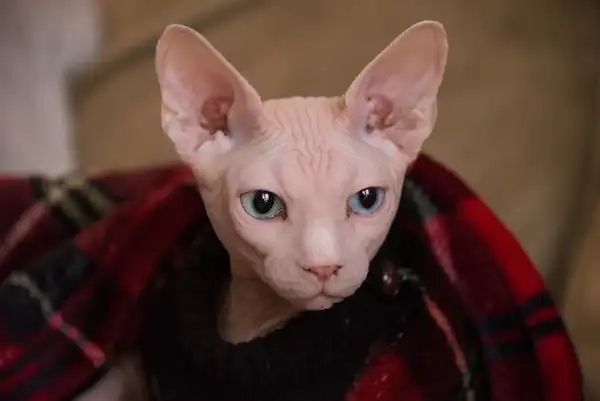
- **Head**: broad, flat triangle, with high cheekbones, a short muzzle and a nose bridge sitting distinctly below the forehead to form a pronounced 'stop' - **Ears**: **enormous and set very low** — wide-based, round-tipped, sitting below the top of the head; the breed's most recognizable feature - **Eyes**: **very large and slightly oblique**, almond-shaped, in vivid colors (gold, green, blue, odd-eyed) - **Body**: slim, tightly muscled, with a narrow chest and light frame; adults 2-4 kg (small, on the petite side) - **Coat**: **wavy, curly, short and sparse** — the texture recalls suede or fine chenille. Belly, neck and areas behind the ears are extremely thin-coated, sometimes bald in patches, and **temporary bald patches during shedding season are normal** and grow back - **Whiskers and eyebrows**: **curly and highly brittle**, so many Devon Rex cats have only short whisker stubs — a breed-standard trait, not a defect
All colors and patterns are accepted. **Watch for confusion with the Cornish Rex**: the Cornish Rex has **only a wavy down layer (no guard or awn hairs)**, feeling more like wavy wool; the Devon Rex has **all three coat layers, but every layer is short and curly**, and feels more like suede.
Personality in depth
Personality in depth
The Devon Rex is one of the **most extroverted pedigreed cat breeds**, ranked alongside the Sphynx, Burmese and Siamese as 'the most dog-like cats'. The CFA breed profile summarizes it as monkey-like, extroverted, follows owner everywhere, dog-like devotion.
**Key behavioral traits**: 1. **Climbs on people**: it will actively leap onto shoulders, heads and backs, treating you as a moving cat tree. This is its most famous behavior — the source of the 'monkey among cats' nickname 2. **Door-greeter and shadow**: runs to the door when you come home, then follows you everywhere (bathroom, kitchen, bedroom) 3. **Food thief extraordinaire**: the Devon Rex is **one of the most notorious food-stealing cat breeds** — it will open cupboards, jump on the dining table and steal from your plate. Its high metabolic rate (thin coat = fast heat loss) drives an interest in food far beyond ordinary cats 4. **Trainable like a dog**: can learn 'sit', 'high-five', 'fetch' and to respond to its name 5. **Voice**: quiet, softer than a Siamese, with a 'quack-quack' timbre rather than a 'meow-meow'
Its tolerance for children, dogs and other cats is very high, making it **one of the top choices for large or multi-pet households**. **The one caveat**: it needs **a lot of company** — over 8 hours alone daily leads to visible anxiety, destruction or overgrooming. **Keep them in pairs or with a dog.**
Daily care
Daily care
With **little coat and a high metabolism**, the Devon Rex has care needs quite different from an ordinary shorthair:
1. **Warmth**: - Short, sparse fur and thin subcutaneous fat mean **it is very cold-sensitive**. Below 20°C it will visibly shiver and seek out heat - In winter, provide a **heated cat bed, blankets and pet clothing** (one of the few cat breeds well-suited to sweaters, since the coat will not tangle) - Avoid keeping it in a north-facing room or in the direct blast of an air conditioner
2. **Cleaning (not grooming)**: - Skin oil production is heavy (the skin is largely exposed) and can build up on the surface - **Wipe down with a warm-water bath every 2-3 weeks** using a low-irritation pet shampoo, or wipe with a damp cloth - Curly fur does not need brushing — brushing actually flattens the curls; use a **soft rubber grooming glove** to remove loose hair
3. **Ear cleaning**: - Devon Rex cats have **the heaviest ear-canal oil production of any domestic cat**; clean the ears 1-2 times a week (uncleaned ears rapidly build up dark brown wax) - Use a pet ear-cleaning solution and cotton balls; never push a swab deep into the canal
4. **Diet**: - **High metabolism = high protein, small frequent meals**: 3-5 meals a day, with cat food above 38% protein - **Theft-proof storage is essential**: all food must be sealed and locked away (this is not optional — it is mandatory)
5. **Nails and teeth**: standard care, same as any cat.
Health & lifespan
Health & lifespan
With an extremely narrow gene pool (single-founder Kirlee plus early Cornish/Sphynx-related outcrosses), the Devon Rex has several breed-specific hereditary diseases:
1. **Hypertrophic cardiomyopathy (HCM)**: moderate-to-high incidence. A **MYBPC3 R820W** mutation (a locus different from those in Ragdolls or Maine Coons) has been reported in the Devon Rex, and testing is available at UC Davis VGL and Langford Vets. **Annual cardiac ultrasound is recommended.**
2. **Patellar luxation**: notably higher incidence than in most other breeds. Wegner 2017 and Loder 2013 both list the Devon Rex as **the most-cited feline breed for patellar luxation**. Mild cases may need no intervention; moderate to severe cases require surgery.
3. **Devon Rex myopathy (DRMD)**: - Also called hereditary myasthenia; **autosomal recessive** - **A core screening item in the CFA/FIFe/GCCF breed health programs** - Symptoms: neck weakness with head-drop, easy tiring on walks, difficulty swallowing; typically appears at 4-7 months of age - UC Davis VGL offers a DRMD genetic test
4. **Malassezia skin infection**: - Because of heavy skin oil production and prolonged skin exposure, Devon Rex (and Sphynx) frequently develop seborrheic dermatitis and Malassezia infection - Åhman 2007 *J Feline Med Surg* documents Devon and Sphynx as **breeds with high *Malassezia pachydermatis* prevalence** - Treatment: antifungal medication plus regular bathing
5. **Coagulopathy**: rare cases of factor IX deficiency (hemophilia B) and vitamin K-dependent coagulation defects have been reported in Devon Rex; run a coagulation panel before any surgery.
6. **Anesthesia risk**: with a low body weight, low fat reserves and undiagnosed HCM in some individuals, **the Devon Rex has a higher anesthesia risk than the average shorthair cat**; a cardiac ultrasound and coagulation screen are mandatory before spay/neuter or any surgery.
Fit for your space
Fit for your space
Living with a Devon Rex is nothing like living with an ordinary cat — it is more like keeping a **small climbing dog**.
**A good match for**: - Warm, temperature-stable indoor environments (>22°C) - Owners with plenty of time at home who welcome high-intensity interaction (remote workers, retirees, large households) - Multi-pet households already keeping a Devon Rex, Sphynx, Burmese, Siamese or dog - Families seeking an interactive, low-shed, internet-famous cat - Owners willing to clean the ears frequently, bathe regularly and lock up food strictly - Households with cat-hair allergies (the Devon Rex has less Fel d 1 and less coat than average, making it **relatively** low-allergen — but **not truly hypoallergenic** — always test-visit before buying)
**Not a match for**: - Owners who live alone and are away for long stretches (>8 hours/day) - Homes without air conditioning or heating, or in cold, damp climates - People who cannot tolerate a cat on the dining table, stealing food or leaping onto shoulders - Households seeking a quiet, independent pet (look at the Persian, Russian Blue or British Shorthair instead) - Buyers unwilling to cover HCM, patellar luxation and DRMD genetic and imaging screening
**Special notes**: - The Devon Rex **must be kept strictly indoors** (thin coat = cold-sensitive; extreme curiosity = escape-prone) - Ask breeders for three reports: **parental HCM ultrasound + DRMD genetic test + patellar grading** - **Do not buy the breed primarily for its 'hypoallergenic' reputation** — individual variation is huge and no allergen-free guarantee is possible
References
This is an educational overview — for specific health and care advice, please consult the authoritative sources below and your veterinarian.
- CFA — Devon Rex Breed Article国际猫协标准
- TICA — Devon Rex Breed Standard国际猫协标准
- GCCF — Devon Rex Breed Standard of Points国际猫协标准
- FIFe — Devon Rex Breed Standard (DRX)国际猫协标准
- Gandolfi et al. 2010 Mamm Genome — KRT71 mutation in Devon Rex学术研究
- Meurs et al. 2007 J Vet Intern Med — MYBPC3 & HCM in cats学术研究
- Ahman & Bergström 2007 J Feline Med Surg — Malassezia in Devon Rex & Sphynx学术研究
- Malik et al. 1993 Aust Vet J — Devon Rex hereditary myopathy (DRMD)学术研究
- UC Davis VGL — Devon Rex genetic testing panel基因检测
- ICatCare — Devon Rex breed profile综合科普