Felidae · CAT
Oriental Shorthair
Overview
The Oriental Shorthair (东方短毛猫) is a medium-sized cat breed weighing 2.5–5 kg with a 12–15-year lifespan. The "colourful cousin" of the Siamese — same big ears and slender build, but available in over 300 colour and pattern combinations. Warm, talkative, and highly interactive.
Feeding
Fast metabolism — small, frequent meals of high-protein cat food.
Exercise
High exercise needs — plenty of playtime and vertical space required.
Grooming
Short coat is low-maintenance; brush once a week.
Health
Prone to HCM, hepatic amyloidosis, and periodontal disease.
Gallery
A closer look at the Oriental Shorthair
From origins and personality to daily care and health — helping you judge whether this little companion is really the one for you.
Origin & history
Origin & history
The Oriental Shorthair is **essentially a "non-pointed Siamese"** — it shares 100% the same body type, personality, and behavioural traits with the Siamese. The only difference is coat colour.
In the 1950s and 60s, British breeders (Baroness von Ullmann, Peter Turner, Betty Roberts, and others) deliberately crossed Siamese with British Shorthair, Russian Blue, and Abyssinian to introduce "non-point" colours into the Siamese frame — including solid black (called Havana Brown as a lineage offshoot), solid white, tortoiseshell, and tabby. In the 1960s the British GCCF recognised these new colours but classified them as separate breeds under contention: Havana Brown, Foreign White, Oriental Spotted Tabby, etc.
In the 1970s, American breeders unified these "non-point Siamese" under the name **Oriental Shorthair**, and the CFA officially recognised it in 1977. In 1985, the CFA unified breed rules for the three related breeds — Siamese, Colorpoint Shorthair, and Oriental Shorthair — so within a single litter, pointed kittens are classified as Siamese and non-pointed kittens as Oriental Shorthair. Genetically, the Oriental Shorthair and Siamese are **the same breed pool, distinguished only by the CS locus** (the temperature-sensitive tyrosinase mutation causing point colouration).
CFA and TICA both accept **over 300 colour + pattern combinations** — the richest palette of any domestic cat breed, earning the Oriental Shorthair the nickname "Ornamental Cat."
Looks & breed standard
Looks & breed standard
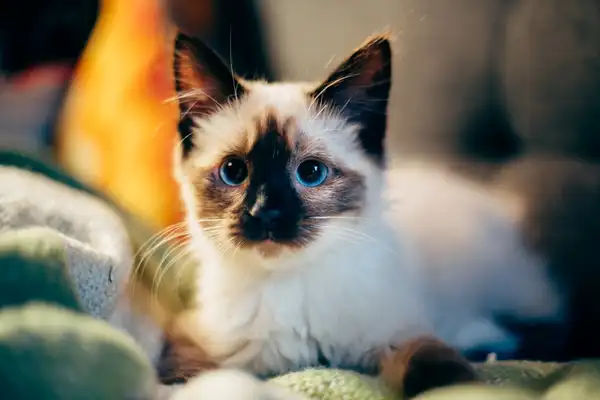
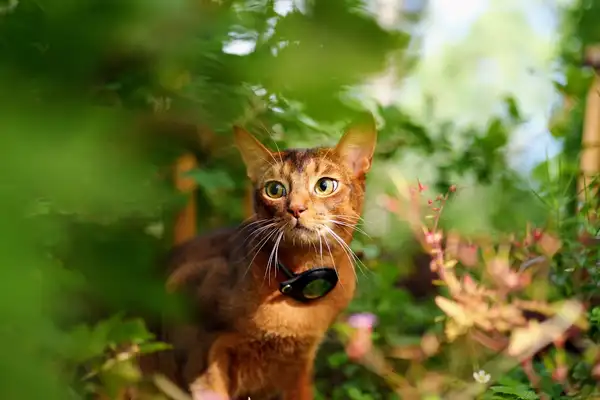
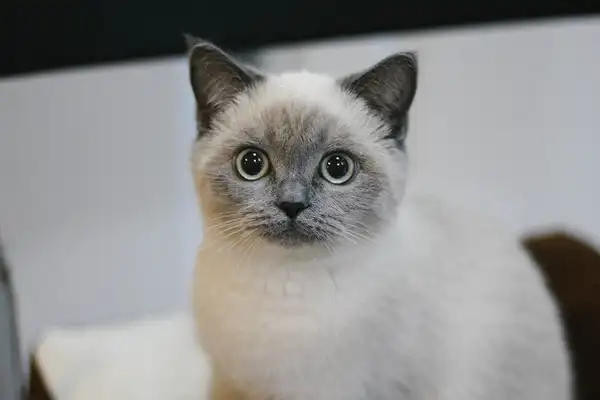
The Oriental Shorthair's body structure is entirely identical to the modern Siamese: - **Head**: A long equilateral triangular wedge (modern show-style Oriental head), even more extreme than the Siamese. In profile, almost perfectly straight (no stop) - **Ears**: Extremely large, low-set, flared like "little airplane wings" — the highest ear-to-body ratio of any domestic cat - **Eyes**: Medium-sized almond eyes; can be green, gold, or blue (blue in white cats) — the key colour difference from the Siamese (Siamese must have blue eyes) - **Body**: Slender, fine-boned, svelte type; 2.5-5 kg; muscular but not stocky - **Legs**: Very long, front legs slightly shorter than hind - **Tail**: Slender and whip-like; the longhair version (Oriental Longhair) has a plumed tail
Breeders jokingly call it "a rack of bones with a purr" — this slender, extreme body type is characteristic, not malnutrition.
**Coat**: - **Oriental Shorthair**: Extremely short, close-lying, glossy fur - **Oriental Longhair**: Semi-long-haired version (slightly longer at tail and neck ruff), listed separately by CFA
The palette includes all solid, tabby, smoke, silver, shaded, bicolor, and parti-colour options — far more than the Siamese's four traditional points.
Personality in depth
Personality in depth
The Oriental Shorthair's personality is nearly identical to the Siamese — **extremely extroverted, talkative, clingy, intelligent**. The CFA breed description sums it up as highly social, extremely vocal, athletic, and intelligent.
**Talkativeness**: The Oriental Shorthair, together with the Siamese and Burmese, forms the domestic cat's "top three chatterboxes," but the Oriental's tone is the most dog-like — brief, continuous, rhythmic. It can "converse" with you all day, and many owners describe it as "nagging all day long." Buyers seeking a quiet home should reconsider.
**Clinginess**: Almost dog-like attachment to family — greets you at the door, sits on your lap, follows you around, sleeps on your pillow. Most Oriental Shorthairs will **bond especially with one person** (a hallmark "one-person cat"), staying friendly but less intimate with other family members.
**Separation anxiety**: Like the Siamese, prolonged solitude leads to noticeable anxiety — over-grooming, food refusal, destructive behaviour. **Both ICatCare and CFA explicitly recommend keeping them in pairs**, or at minimum with another friendly cat or dog.
**Intelligence & Activity**: Trainable to fetch, open doors, and walk on a leash — one of the most dog-like domestic cats. It needs significant daily interaction and mental stimulation, and absolutely cannot be left to its own devices.
Daily care
Daily care
Key day-to-day care points for the Oriental Shorthair:
1. **Companionship**: This is a hard requirement, not a nice-to-have. Homes with less than 6 hours of daily human presence are strongly advised to keep them in pairs.
2. **Grooming**: - Oriental Shorthair: Rubber grooming mitt once a week — shedding is among the lowest of any domestic cat - Oriental Longhair: Pin brush + fine-tooth comb twice a week — still far easier than a Persian or Maine Coon (single-layer silky coat, similar to the Turkish Angora)
3. **Diet**: Fast metabolism + slender body require high-protein (>38%), moderate-fat, low-carb food, in small frequent meals (3-4 per day).
4. **Exercise + Environment**: At least one >180 cm cat tree, multiple high perches, and puzzle feeders. It needs true vertical space.
5. **Teeth**: The Oriental / Siamese line has **the highest incidence of gingivitis, periodontal disease, and tooth resorption (FORL)** among domestic cats — annual professional cleaning + a home brushing habit are essential.
6. **Climate**: Cold-sensitive (slim body, low body fat) — in winter, if room temp is below 20°C, provide a heating pad or cat sweater.
Health & lifespan
Health & lifespan
The Oriental Shorthair **shares nearly all breed health issues with the Siamese**:
1. **Systemic AA amyloidosis**: A disease specific to the Siamese lineage; the liver is the primary target organ (unlike the Abyssinian's kidney target). In middle age, abnormal deposition of serum amyloid A causes chronic hepatic dysfunction. First systematically described by Zuber & Beauchamp 1988 J Am Vet Med Assoc. There is no genetic test at present — only monitoring via liver function and SAA levels.
2. **Hypertrophic cardiomyopathy (HCM)**: Moderate incidence in the Oriental / Siamese line — breeders should perform annual cardiac ultrasound.
3. **Periodontal disease and FORL**: The most universal problem — nearly all middle-aged and older Oriental Shorthairs develop some degree of oral disease. Annual dental cleaning is essential.
4. **Progressive retinal atrophy (PRA)**: The Siamese / Oriental line carries multiple PRA variants, including the CEP290 (rdAc) mutation. Genetic testing available.
5. **Asthma / bronchitis**: Among the highest asthma rates of any domestic cat (estimated 5-10%).
6. **Behavioural / psychological issues**: Psychogenic alopecia, pica (particularly for cloth / plastic), and separation anxiety — these behavioural problems occur significantly more often in the Oriental / Siamese line than in other breeds, tied directly to their high intelligence and demand for companionship.
Fit for your space
Fit for your space
The Oriental Shorthair **does not suit 9-to-5 solo owners**, **does not suit families seeking a quiet pet**, and **does not suit tiny purely-floor-plan apartments**. Its personality is identical to the Siamese — it needs company, needs to talk, needs to play.
**Good fit for**: - Multi-person / multi-child homes (Oriental Shorthairs are relatively resilient and cope well with sustained child interaction) - Multi-pet homes with another friendly cat or dog (nearly a hard requirement) - Home-office workers / retirees / owners home 6+ hours a day - Owners drawn to a "talkative + clingy + high-interaction + 300-colour" pet - Owners with some cat experience who understand "behavioural issue" needs
**Not a fit for**: - Office workers alone at home 10+ hours a day (unless kept in pairs + midday cat-sitter) - Beginners wanting a "quiet, low-maintenance" pet - Households unable to tolerate "a cat nagging all day" - No AC / no heat in cold environments (they are cold-sensitive)
Both ICatCare and CFA recommend **pair adoption** as the ideal way to keep an Oriental Shorthair (especially with another Oriental / Siamese companion).
References
This is an educational overview — for specific health and care advice, please consult the authoritative sources below and your veterinarian.
- CFA — Oriental breed article国际猫协标准
- TICA — Oriental Shorthair Breed Group国际猫协标准
- GCCF — Oriental Shorthair Breed Standard国际猫协标准
- Zuber & Beauchamp 1988 JAVMA — Amyloidosis in Siamese and Oriental cats学术研究
- Menotti-Raymond et al. 2007 Genomics — CEP290 rdAc PRA in cats学术研究
- Bertone et al. 2003 Am J Epidemiol — Feline asthma risk factors学术研究
- UC Davis VGL — Siamese / Oriental Panel基因检测
- ICatCare — Oriental Shorthair breed profile综合科普
- PetMD — Oriental Shorthair care guide综合科普