Felidae · CAT
Burmese
🌟 You may have met one
Every registered Burmese in the world traces back to a single female cat: Wong Mau, brought to San Francisco in 1930 by Dr. Joseph Thompson, a US Navy physician. This makes it the first domestic cat breed with a fully-documented scientific origin.
Overview
The Burmese (缅甸猫) is a medium-sized cat breed weighing 3–5.5 kg with a 16–18-year lifespan. A compact, densely-muscled small cat, often called the "Labrador of the cat world." Extremely people-loving and vocal, always at your heels — a great companion for apartments, seniors, and families with children.
Feeding
A high-protein cat food fed on a fixed schedule and portion.
Exercise
Moderate activity — interactive toys plus owner playtime is enough.
Grooming
Low-maintenance short coat — brush weekly.
Health
Metabolism is stable but the breed is prone to diabetes — weight control is essential. A subset of American lines has skull defects.
Gallery
A closer look at the Burmese
From origins and personality to daily care and health — helping you judge whether this little companion is really the one for you.
Origin & history
Wong Mau, Joseph Thompson in 1930, and the first Burmese cat from Rangoon
Origin & history
Wong Mau, Joseph Thompson in 1930, and the first Burmese cat from Rangoon
The modern Burmese has a well-documented origin: in 1930, US Navy physician Dr. Joseph C. Thompson brought back a dark brown female cat from Southeast Asia (variously said to be Rangoon or Singapore), naming her **Wong Mau**. She looked like a Siamese × dark domestic hybrid. Thompson worked with a group of San Francisco geneticists (Virginia Cobb, Clyde Keeler, Billie Gerst) to backcross Wong Mau with Siamese and then interbreed the offspring, eventually stabilizing the pure dark-brown "sable" phenotype. The CFA formally registered the Burmese in 1938 — making it the first domestic cat breed with a clearly recorded scientific breeding program.
In the 1940s and 1950s the population was so small that breeders leaned heavily on Siamese outcrosses, and the CFA briefly revoked Burmese registration in 1947, restoring it in 1953. Later, the American Burmese (round head, short muzzle) and the European/British Burmese (slightly longer face, more slender build) diverged — today the CFA and GCCF use two entirely separate breed standards.
Wong Mau is thus called the common ancestor of every modern Burmese — every registered pedigree traces back to that single 1930 cat.
Looks & breed standard
Sable brown, gold eyes, and "a brick wrapped in silk"
Looks & breed standard
Sable brown, gold eyes, and "a brick wrapped in silk"
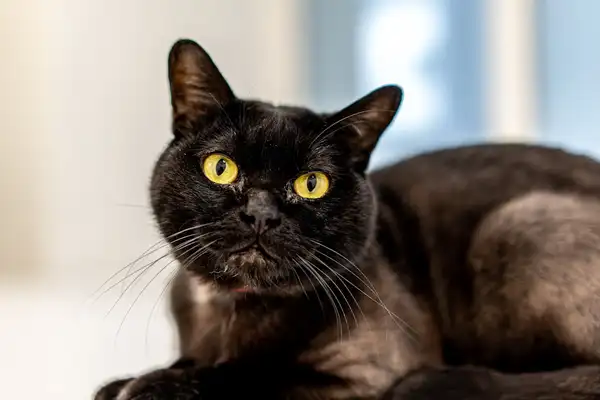
The Burmese's traditional badge is **sable brown** (inherited directly from Wong Mau) — a deep chocolate-brown coat with slightly lighter edges. The CFA recognizes only 4 colors: sable, champagne (light brown), blue, and platinum (silver-gray); the GCCF and FIFe accept red, cream, tortie, and more, for 10 colors total.
Eyes must be gold-to-amber (green or blue is disqualifying) — this is the key differentiator versus Siamese, Oriental Shorthair, and Russian Blue.
Body type is a hallmark of the breed: **compact, heavily muscled, and remarkably dense.** A 4-5 kg adult Burmese picked up feels much heavier than a similarly weighing Siamese or Oriental — breeders famously call this "a brick wrapped in silk." The head is a rounded wedge with a shortened but non-flat nose (between Persian and Siamese). American lines have rounder, shorter heads; European lines retain a longer face.
Personality in depth
"Cat-shaped dog" — extremely people-devoted, vocal, shoulder-riding
Personality in depth
"Cat-shaped dog" — extremely people-devoted, vocal, shoulder-riding
The Burmese is the archetypal **"dog personality"** in domestic cats. ICatCare and CFA both describe it as "people-oriented, extremely affectionate, dog-like." Devotion to family is nearly unconditional — greeting at the door, following you from bedroom to bathroom, sitting on your lap, sleeping on your pillow.
Burmese are more talkative than Siamese but with a softer tone — deep chirps and murmurs rather than sharp meows. Many owners describe them as "softly muttering all day long."
They crave companionship and are not suited to long stretches alone. More than 8 hours of solitude tends to produce anxiety, overgrooming, and refusal to eat. ICatCare explicitly recommends **keeping Burmese in pairs**, or at least alongside another friendly cat or dog. They are also among the domestic cats that live best with dogs.
Burmese retain the Siamese's high intelligence — they can open doors, pull drawers, learn to fetch — and a strong play drive that persists into old age; even a 10-year-old will still chase a wand toy like a kitten.
Daily care
Companionship-first, weight control, and wet-food balance
Daily care
Companionship-first, weight control, and wet-food balance
Priorities for daily Burmese care:
1. **Time at home**: this is a hard requirement, not a plus. Assess honestly whether you have 6-8 hours at home per day — if not, strongly consider getting two Burmese.
2. **Diet control**: Burmese metabolism is more stable than Siamese but appetite is voracious, and this is a **high-risk breed for obesity and diabetes** (see health). Aim for >36% dietary protein without excess fat, feed on a fixed schedule 2-3 times daily, and include at least 30% wet food.
3. **Exercise**: moderate activity — one cat tree plus 2-3 wand toy sessions a day is enough. Burmese release most of their energy through interaction on shoulders and laps.
4. **Grooming**: short coat is very easy — a rubber curry once a week. Shedding is on the low side.
5. **Teeth**: Burmese have generally poor dental health — plan on annual professional cleanings and a home brushing habit.
Health & lifespan
Diabetes, hypokalemia (BFH), and Burmese Head Defect (BHD)
Health & lifespan
Diabetes, hypokalemia (BFH), and Burmese Head Defect (BHD)
The Burmese has three well-defined breed diseases; verify screening records with your breeder before purchase:
1. **Diabetes (Type 2 DM)**: multiple epidemiological studies show Burmese in the UK, Australia, and New Zealand have diabetes incidence roughly 3-4× that of the general cat population (O'Neill 2016 J Feline Med Surg; Rand 1997 J Vet Intern Med). The mechanism combines breed-specific insulin sensitivity decline with weight-management difficulty. Lifetime weight control is the most critical prevention.
2. **Burmese Familial Hypokalemia (BFH)**: a periodic hypokalemic myopathy caused by an autosomal recessive WNK4 mutation. Onset is at 2-6 months, presenting as neck weakness and unsteady gait (Malik 1989 Aust Vet J; Gandolfi 2012 PLoS ONE mapped the gene). UC Davis VGL and Langford Vets both offer BFH genetic testing.
3. **Burmese Head Defect (BHD)**: American "contemporary" Burmese, in the pursuit of an ever-rounder head and shorter nose, developed a severe autosomal recessive craniofacial malformation (Sponenberg 1982 J Hered). Homozygote kittens die at birth. This is one of the most serious ethical controversies in American Burmese breeding; European GCCF-standard Burmese do not have this problem.
Also watch for HCM and gingivitis in middle age.
Fit for your space
Companionship first: ideal for seniors, kids, and multi-cat homes
Fit for your space
Companionship first: ideal for seniors, kids, and multi-cat homes
The Burmese is one of the domestic cats **best suited to seniors, work-from-home owners, and larger households**, thanks to its clinginess, resilience, vocality, and safe interactions with the elderly and children.
**Good fit for**: - Owners with substantial time at home (retired, work-from-home, larger family) - Households that already have a friendly cat or friendly dog (Burmese rarely fight with other cats) - Homes with children — Burmese rank very high among domestic cats for tolerance of handling - Apartments — no large space required, but one cat tree is essential
**Poor fit for**: - Working owners who leave the cat alone 10+ hours a day (unless kept in pairs) - Owners who can't commit to weight control (diabetes risk is real) - Owners who want a "quiet, aloof" pet — Burmese will genuinely mutter beside you all day
ICatCare and CFA both explicitly recommend **adopting Burmese in pairs** as the best approach.
References
This is an educational overview — for specific health and care advice, please consult the authoritative sources below and your veterinarian.
- CFA — Burmese breed article国际猫协标准
- TICA — Burmese Breed Group国际猫协标准
- GCCF — Burmese Breed Standard国际猫协标准
- O'Neill et al. 2016 J Feline Med Surg — Diabetes mellitus in cats学术研究
- Rand et al. 1997 J Vet Intern Med — Burmese and diabetes risk学术研究
- Gandolfi et al. 2012 PLoS ONE — WNK4 mutation causes BFH学术研究
- Sponenberg & Graf-Webster 1982 J Hered — Burmese Head Defect学术研究
- UC Davis VGL — Burmese Panel (BFH, blood type)基因检测
- ICatCare — Burmese breed profile综合科普