Felidae · CAT
Siamese
🌟 You may have met one

The mischievous singing Siamese twins Si and Am in Disney's *Lady and the Tramp* saddled the breed with its "clever and naughty" reputation for good.
Overview
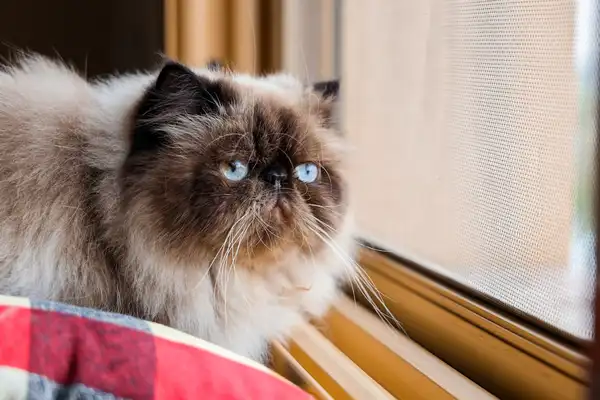
The Siamese (暹罗猫) is a medium-sized cat breed weighing 2.5–5.5 kg with a 12–20-year lifespan. The domestic-cat world's poster child for "talkative." Blue eyes and a colorpoint mask are the classic markers. Very clingy and vocal, and needs plenty of company and interaction.
Feeding
Fast metabolism — small, frequent, high-protein meals.
Exercise
High exercise needs; loves climbing and fetch. Provide a cat tree and interactive toys.
Grooming
Short coat, low shedding — brush weekly.
Health
Prone to strabismus, GI sensitivity, and respiratory issues; watch kidneys in older age.
Gallery
A closer look at the Siamese
From origins and personality to daily care and health — helping you judge whether this little companion is really the one for you.
Origin & history
Origin & history
Records of the Siamese cat go back to Thailand's Ayutthaya Kingdom in the 14th century. The manuscript *Tamra Maew* ("The Cat Book") of that era depicted 17 cats considered auspicious — one of them, the *wichian mat*, is today's Siamese. Traditionally kept by royalty and temple monks as guardian cats, the Siamese was believed to carry the souls of the departed.
In 1878, King Chulalongkorn of Thailand gifted a Siamese cat to Sarah Hood, the wife of the American consul in Bangkok. That cat, named Siam, was then delivered to the White House as a state gift — the first documented Siamese in America.
In 1884 Owen Gould, the British vice-consul in Bangkok, brought a pair of Siamese back to London and exhibited them at the second Crystal Palace cat show, causing a sensation. In the early 20th century the CFA and GCCF successively recognized the Siamese, making it one of the earliest Oriental breeds to be popular in the West.
Looks & breed standard
Looks & breed standard
The Siamese's most iconic look is the **colorpoint** pattern: a light body with darker face, ears, legs, and tail. This pattern is caused by a temperature-sensitive mutation of the TYR gene (the cs allele) — tyrosinase can only synthesize melanin in cooler body regions (face, extremities), while the warmer torso stays pale.
CFA recognizes four official points: **Seal Point** (deep brown, the classic), **Blue Point** (blue-gray), **Chocolate Point** (chocolate brown), and **Lilac Point** (lilac gray). GCCF and TICA recognize additional variants like Red Point, Tortie Point, and Lynx Point.
Body type divides into traditional (Old-style / Applehead — round face, sturdy bone, filled body) and modern show-style (wedge-shaped head, slim long body, large upright ears). TICA has separately registered the traditional type as the Thai breed.
Personality in depth
Personality in depth
The Siamese is one of the most vocal domestic cats. Its voice is low and raspy, called *meezer talk* — frequent and emotionally rich, using different tones to express displeasure, hunger, wanting to be held, or wanting to go outside.
Intelligence is dog-like: a Siamese can be trained to shake, sit, and fetch, and can learn 15–20 words plus its own name. The flip side is heavy dependence on the owner — long stretches alone trigger separation anxiety, showing up as excessive grooming, pica, sustained yowling, or depression.
ICatCare and CFA both recommend keeping Siamese in pairs, or ensuring 4–6 hours of daily companionship. It's highly open with strangers, gets along well with dogs and children — a rare textbook example of the "dog-like cat."
Daily care
Daily care
The Siamese has a fast metabolism and high activity, but adult body weight is light (females 2.5–4 kg, males 3.5–5.5 kg), so resist the urge to overfeed. Small, frequent meals — 3–4 daily — of a high-protein (>40%) formula, avoiding grain-heavy or fatty foods.
Temperature-sensitive: the colorpoint pattern itself is a product of thermoregulation. When ambient temperature drops below 15°C, the extremities and face darken; sustained cold can even darken the torso. Keep the room at 22–26°C to preserve coat vibrancy.
At least 30–45 minutes of high-quality interactive play daily (laser pointers, fetch, wand toys), plus a cat tree that meets its climbing drive. Under-exercised Siamese develop destructive behavior — shredding wallpaper, rummaging through drawers, knocking over cups — all signs of surplus energy.
Health & lifespan
Health & lifespan
The Siamese has been historically associated with **strabismus** (mainly divergent squint), stemming from a congenital anomaly of the visual pathway: uneven distribution at the optic chiasm forces the brain to adjust eye position for binocular vision. Modern breeding has meaningfully reduced strabismus prevalence, but the anatomical difference persists.
More serious is **systemic amyloidosis** — abnormal protein deposits in liver, kidneys, and other organs — a breed-linked hereditary disease shared with Burmese and Oriental Shorthair cats. Onset is typically 1–4 years; Van Der Linde-Sipman et al. 1997 J Vet Intern Med reported the first family cluster.
Additionally, feline asthma and airway allergy incidence is markedly higher in Siamese than in most domestic cats. Avoiding essential oils, diffusers, and dusty litter (opting for low-dust tofu or pine litter) meaningfully reduces symptoms.
Fit for your space
Fit for your space
The Siamese thrives in households where at least one member is home most of the day, willing to play, chat, and provide a companion — either another Siamese or a friendly cross-species partner (a dog or another sociable cat). Empty-nest office workers and frequent business travelers should not keep a solo Siamese.
Space doesn't need to be big — but complex. Multi-tier cat trees, tunnels, and window perches all satisfy the breed's curiosity. Free outdoor access is not recommended — the Siamese's outgoing personality makes it an easy target, and its low vigilance around illness or predators is dangerous.
Keep indoor temperature at 22–26°C and humidity at 40–60% to avoid coat-color changes from prolonged cold and to prevent hot, stuffy conditions from triggering asthma.
References
This is an educational overview — for specific health and care advice, please consult the authoritative sources below and your veterinarian.
- CFA — Siamese Breed Standard官方猫协会
- TICA — Siamese Breed Standard国际猫协标准
- GCCF — Siamese Standard of Points英国猫协标准
- Smithsonian Magazine — Siam, the First Siamese Cat in the White House历史文献
- Lyons et al. 2005 Anim Genet — Tyrosinase mutations and coat color学术研究
- Van Der Linde-Sipman et al. 1997 J Vet Intern Med — Feline systemic amyloidosis学术研究
- ICatCare — Siamese breed profile综合科普
- Trzil 2020 Vet Clin North Am — Feline Asthma review学术研究
- Tamra Maew — Thai Cat Manuscript (Chulalongkorn Univ. archives)历史文献