Felidae · CAT
Abyssinian
🌟 You may have met one
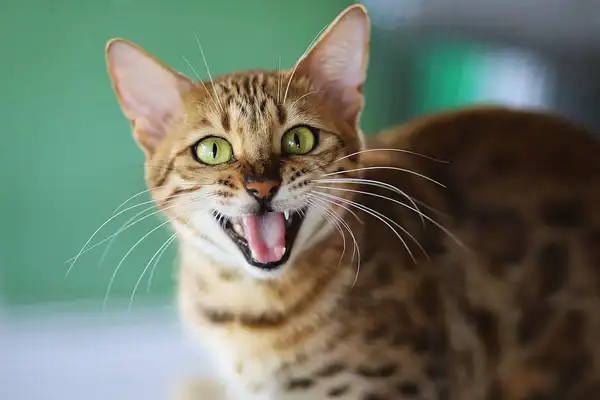
The "sacred cat" figures on ancient Egyptian frescoes — large almond eyes, a long lean body, ruddy fur — are widely believed to be Abyssinian ancestors. This is often called one of the oldest domestic cat breeds.
Overview
The Abyssinian (阿比西尼亚猫) is a medium-sized cat breed weighing 3–5 kg with a 12–15-year lifespan. One of the ancient breeds — wild appearance paired with high energy. Curious and lively, dubbed the "monkey of the cat world" — they almost never sit still.
Feeding
Fast metabolism — feed a high-protein diet in small, frequent meals.
Exercise
High exercise needs. Provide plenty of climbing furniture and interactive toys.
Grooming
Short coat is very low maintenance — brush once a week.
Health
Prone to progressive retinal atrophy (PRA) and renal amyloidosis; genetic testing is recommended.
Gallery
A closer look at the Abyssinian
From origins and personality to daily care and health — helping you judge whether this little companion is really the one for you.
Origin & history
The mother cat Zula, the 1868 UK registry, and Indian Ocean rim genes
Origin & history
The mother cat Zula, the 1868 UK registry, and Indian Ocean rim genes
The traditional Abyssinian origin story starts in 1868: a female cat named Zula was reportedly brought back to Britain from Abyssinia (modern Ethiopia) by a Captain Barrett-Lennard, and shown at the 1871 Crystal Palace cat show in London under the name "Abyssinian" — becoming the nominal founder of the breed. Gordon Stables' 1872 Cats: Their Points and Characteristics offered the first published description; Harrison Weir further defined the breed in his 1889 Our Cats and All About Them. Formal GCCF registration came in 1929 and CFA registration in 1917.
However, in 2008 UC Davis's Lipinski team ran a large mtDNA + microsatellite analysis of gene pools from 22 pedigreed cat breeds worldwide (Genomics), and found that the Abyssinian's genetic signature was closest to **cat populations along the Indian Ocean rim and Southeast Asia**, not to native Ethiopian cats. This aligns with colonial trade routes — the cats most likely came from India via sailor trade lines back to Britain and were later named for Zula's collection point of Abyssinia.
The more precise summary: the Abyssinian is a **breed carefully developed in Victorian Britain**, whose name comes from Zula's collection site, but whose bloodline mainly derives from the Indian Ocean rim's ancient domestic cat pool. It isn't the "oldest breed," but the ticked tabby coat pattern it carries really is one of the oldest coat types in domestic cats.
Looks & breed standard
Ticked tabby, agouti hair shafts, and almond eyes
Looks & breed standard
Ticked tabby, agouti hair shafts, and almond eyes
The Abyssinian's calling card is a full-body **ticked tabby** (also called agouti tabby) coat — every hair carries 2 to 3 alternating light and dark bands, so from a distance the cat looks like a single warm color, but up close the fur resembles that of a wild rabbit or North American cougar. It is the only cat breed required to be ticked tabby; other tabby patterns (classic, mackerel, spotted) are all faults. The agouti gene (Ta allele) later spread from the Abyssinian into the Somali (the longhair Aby), the Ocicat, the Singapura, and other breeds.
CFA recognizes four colors: ruddy (reddish-brown, the classic), red/sorrel (cinnamon), blue, and fawn (light beige); TICA and GCCF also accept chocolate, lilac, and silver variants.
Body type is medium, lean, and compactly muscular (foreign type). Adult males are 4-5 kg, females 3-4 kg. The head is a slightly rounded wedge, with large upright ears, large almond-shaped eyes (gold or green), long limbs, and small oval paws. In motion the cat looks like a miniature cougar.
Personality in depth
The "monkey of the cat world" — a high-IQ, high-energy explorer
Personality in depth
The "monkey of the cat world" — a high-IQ, high-energy explorer
The CFA breed profile sums up the Abyssinian as "highly active, playful, willful and intelligent." It is one of the most active domestic cat breeds — it barely stops. Climbing curtains, perching on top of cabinets, rummaging in drawers, leaping onto the fridge. Enthusiasts jokingly call it the "monkey cat."
Its intelligence is remarkable — it will figure out zippers, jar lids, and simple door latches on its own. It is also one of the few domestic cats that can be trained to fetch, shake, and walk on a leash. Its bond with family is deep, but expressed differently from a Burmese: not by clinging, but by observing and participating. Whatever you're doing, an Aby wants to watch and touch it.
Abyssinians are also **extremely extroverted socially**. Extended solitude leads to anxiety, overeating, or overgrooming. ICatCare explicitly recommends **keeping Abyssinians in pairs**, or at least with another friendly cat or dog.
Daily care
Vertical space, rotating enrichment, and small, high-protein meals
Daily care
Vertical space, rotating enrichment, and small, high-protein meals
Care for the Abyssinian is all about "give it something to do":
1. **Ample vertical space is essential**: cat trees over 180 cm, cat walls, tops of bookshelves — it will find them all. Insufficient space breeds destructive behavior.
2. **Rotate toys and enrichment weekly**: puzzle toys, wand toys, treat balls, cardboard tunnels — swap out 2-3 sets per week to keep novelty fresh.
3. **Small frequent meals + high protein**: fast metabolism, so recommended dietary protein is >38%, split across 3-4 meals a day. Free feeding tends to encourage picky eating.
4. **Grooming**: the short coat is easy — brush 1-2 times weekly with a rubber curry, and shedding is on the low side.
5. **Teeth**: Abyssinians are prone to Feline Odontoclastic Resorptive Lesions (FORL). Schedule an annual oral exam.
Health & lifespan
PRA-b, PK-Def, and hereditary renal amyloidosis
Health & lifespan
PRA-b, PK-Def, and hereditary renal amyloidosis
The Abyssinian has three well-defined breed-specific hereditary diseases, and all responsible breeders test for them:
1. **Progressive Retinal Atrophy PRA-b (rdAc)**: an intronic mutation in CEP290, autosomal recessive. Menotti-Raymond et al. mapped it and developed a genetic test in Genomics 2007. Homozygotes begin losing sight at 1.5-2 years and are essentially blind by age 5.
2. **Pyruvate Kinase Deficiency (PK-Def)**: an autosomal recessive red-cell metabolic disorder in the PKLR gene, with homozygotes showing intermittent hemolytic anemia (Grahn 2012, BMC Vet Res). The same mutation exists in Bengals, Somalis, Savannahs, and other breeds.
3. **Familial Renal Amyloidosis (AA amyloidosis)**: first reported by Boyce 1984 (Vet Pathol). In the Abyssinian, serum amyloid A abnormally deposits in the kidneys under chronic inflammation, leading to chronic renal failure in middle age. There is no genetic test yet — early warning depends on serum SAA and renal function monitoring (van der Linde-Sipman 1997, Vet Q).
The UC Davis VGL Abyssinian panel covers PRA-b, PK-Def, and blood typing.
Fit for your space
Companionship + space + a cat-friend: not for long solitude
Fit for your space
Companionship + space + a cat-friend: not for long solitude
The Abyssinian's need for companionship approaches that of a Bengal or a dog — it is not suited to a nine-to-five owner living alone, not suited to a small apartment with no vertical space, and not suited to a household that stays empty most of the day.
**Ideal owner profile**: - Has another cat or friendly dog (Abys are among the domestic cats that do best with dogs) - At least 1 hour of high-quality daily interaction plus puzzle toys - Rooms with plenty of vertical space, at least one tall cat tree - Comfortable with a cat that climbs everywhere and "participates" in everything
International Cat Care (ICatCare) explicitly recommends adopting Abyssinians in **pairs** or at least alongside another friendly animal.
References
This is an educational overview — for specific health and care advice, please consult the authoritative sources below and your veterinarian.
- CFA — Abyssinian breed article国际猫协标准
- TICA — Abyssinian Breed Group国际猫协标准
- GCCF — Abyssinian Breed Standard国际猫协标准
- Lipinski et al. 2008 Genomics — mtDNA origin of cat breeds学术研究
- Menotti-Raymond et al. 2007 Genomics — CEP290 rdAc PRA in cats学术研究
- Grahn et al. 2012 BMC Vet Res — Feline PK deficiency (PKLR)学术研究
- Boyce et al. 1984 Vet Pathol — Renal amyloidosis in Abyssinian学术研究
- UC Davis VGL — Abyssinian Panel (PRA-b, PK-Def, blood type)基因检测
- ICatCare — Abyssinian breed profile综合科普