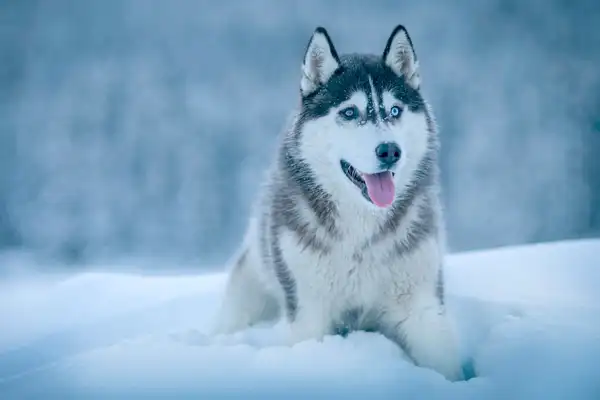
Canidae · DOG
Samoyed
🌟 You may have met one
The name "smiling angel" comes from the Samoyedic peoples of Siberia, who used them to pull sleds, herd reindeer, and cuddle up as living hot-water bottles at night. In the early 1900s Samoyeds even joined polar expeditions to Antarctica.
Overview
The Samoyed (萨摩耶) is a large dog breed weighing 16–30 kg with a 12–14-year lifespan. The "smiling angel" - a snowy fluffball whose grin has warmed hearts everywhere. Warm and people-loving, utterly convinced summer is a personal insult; expect indoor snow drifts during coat blows.
Feeding
Medium- to large-breed formulas. Skip common allergens.
Exercise
At least an hour a day. Avoid midday heat in summer.
Grooming
Thick double coat: brush daily; seasonal shedding is spectacular.
Health
Prone to hip dysplasia, skin issues, and diabetes. Keep the eyes clean.
Gallery
A closer look at the Samoyed
From origins and personality to daily care and health — helping you judge whether this little companion is really the one for you.
Origin & history
Origin & history
The Samoyed takes its name from the Samoyedic peoples of northern Siberia (the modern Nenets are among their descendants). This was a semi-nomadic Arctic people who relied on reindeer for food, fur, and transport - and the Samoyed was their most important partner: originally used to hunt reindeer, later to herd them, to pull sleds, to guard camp, and at night to sleep inside the hide tent, pressed close to their humans for warmth. That last role is the root of the breed's extreme attachment to people. [1][2]
In the late 19th century, British explorers Robert Scott, Ernest Shackleton, and Roald Amundsen used Samoyeds heavily as sled dogs during polar expeditions. That's also when the first Samoyeds were brought back to Britain - zoologist Ernest Kilburn-Scott introduced the breed systematically in 1889 and gave it the name "Samoyed." [1][2]
In 1906 the AKC registered its first Samoyed, a Russian import named Moustan of Argenteau, marking the breed's official start in America. The Samoyed Club of America (SCA) was founded in 1923 as the AKC parent club and continues to lead the breed's health research and genetic-screening efforts today. [3][6]
Looks & breed standard
Looks & breed standard
The AKC places the Samoyed in the Working Group as a medium-sized snow dog: males stand 21-23.5 inches (about 53-60 cm) at the shoulder and weigh 45-65 lb (about 20-30 kg); females stand 19-21 inches (about 48-53 cm) and weigh 35-50 lb (about 16-23 kg). [3][7]
The most defining feature is the double coat: a straight, harsh outer layer that provides support and water resistance, and a soft, dense undercoat that does the actual insulating. A correct coat should look silvery and structured, not fluffy or voluminous, and males carry a more pronounced neck-and-chest "ruff" than females. Only four colors are legal: pure white, white with biscuit, cream, and biscuit. Any other color - especially black or brown - is an outright disqualification, as are blue eyes. [7]
The iconic "Sammy Smile" isn't just cute - the upturned corners of the mouth prevent drool from freezing, an evolutionary adaptation to long-term Arctic life. [2][8]
Important: never shave a Samoyed. The double coat regulates temperature both ways - warmth in winter, insulation from heat in summer. Shave off the outer coat and the undercoat can never regrow properly; both texture and protective function are permanently damaged. [8]
Personality in depth
Personality in depth
The SCA describes the Samoyed as "gentle & friendly" - open with almost everyone, which makes them poor guard dogs. This social dependence is a product of thousands of years of co-living with humans: dogs that slept beside their owners inside a tent survived only if they combined intense human bonding with low aggression. [2][3]
Samoyeds are also very vocal. The AKC rates their volume as "Very Vocal" - barking, howling, and the trademark "rroo rroo" summons are all normal Samoyed communication. A Samoyed short on company or exercise will absolutely serenade the neighborhood at 3 a.m. [3][8]
Trainability is moderate. They're smart enough, but they retain the classic Spitz habit of independent evaluation - first they decide whether the command is worth listening to. Treat-based rewards and short positive-reinforcement sessions work best; punishment-style training makes them shut down and refuse to engage. [3][8]
Daily care
Daily care
Exercise: 60-90 minutes of moderate daily activity. Walks, tug games, and cold-weather runs in snow suit their instincts best. Samoyeds tolerate cold beautifully but poorly tolerate heat - in summer, avoid midday outings, keep water at hand, and mind ground temperature (asphalt in summer noon can hit 55-60°C, enough to burn paw pads). [3][8]
Grooming: this is the cost people underestimate most. Plan for a full brush-through 2-3 times a week normally and daily during coat blows. Females have two blows a year, males one, when the entire undercoat sheds in sheets - an indoor and outdoor "white sandstorm." Most Samoyed owners keep a wide-tooth comb, undercoat rake, and high-velocity dryer on hand. [3][8]
Diet: as the breed has spread through the American South and East Asia, cases of diabetes and skin disease have risen. The SCA notes that diabetes and hypothyroidism have become more common in Samoyeds recently - feed measured meals, skip sugary treats, and check blood glucose and thyroid function annually as adults. [3][6]
Bathing: every 4-6 weeks is enough. Samoyeds have very little body odor (the dry double coat repels sebum), and over-bathing damages the skin barrier. [8]
Health & lifespan
Health & lifespan
Samoyeds are moderately long-lived overall. Both the SCA and AKC report an average lifespan of 12-14 years, with well-cared-for individuals reaching 15-16. [3][6]
Samoyed Hereditary Glomerulopathy (SHG) is the breed's most severe genetic disease and is unique to Samoyeds. Caused by a mutation in the COL4A5 gene on the X chromosome, it reduces type IV collagen synthesis by about 90% and produces abnormal glomerular basement membranes. Males (with only one X chromosome) develop proteinuria at 3 months and typically die of kidney failure at 8-15 months. Females are carriers with slower progression but may still develop chronic kidney disease as adults. The mechanism closely mirrors human Alport syndrome, and Samoyeds are used as an animal model in medical research. COL4A5 DNA testing before breeding is not optional - it is mandatory. [4][5]
Orthopedics: hip dysplasia (HD) is the most common orthopedic issue. OFA data show that about 11% of evaluated Samoyeds are affected. Elbow dysplasia (ED) also warrants attention. The SCA requires OFA or PennHIP evaluation before breeding. [6][8]
Ophthalmology: X-linked progressive retinal atrophy (XLPRA1) and retinal dysplasia / oculoskeletal dysplasia (RD/OSD2) are two Samoyed-specific eye diseases, both testable by DNA. The SCA requires annual eye exams plus these two genetic tests for breeding stock. [3][6]
Other risks: diabetes (higher than the canine average), hypothyroidism, cardiac issues (particularly subvalvular aortic stenosis, SAS), and skin and ear infections in a subset of individuals. [3][6]
Common myths & adoption tips
Common myths & adoption tips
Myth 1: "Samoyeds are hypoallergenic / non-shedding." - Completely wrong. The SCA's own FAQ states plainly that the Samoyed is not a hypoallergenic breed. That massive double coat sheds enormously during coat blows, and both dander and hair can trigger allergies. [8]
Myth 2: "Samoyeds are gentle and always smiling - they must be easy to raise." - They are gentle, but shedding + vocalness + social dependency together make for a much heavier ownership load than most families expect. Under-companioned Samoyeds bark, destroy furniture, and dig. [3][8]
Myth 3: "They can live in southern China / hot climates." - Yes, but with caveats: outings above 25°C need extreme care, and central air conditioning + a dehumidifier + daily brushing become baseline. Skin disease and heat stress are far more common in Samoyeds living in humid southern climates. [3][8]
Myth 4: "They're long-haired dogs, so a summer buzz cut will cool them down." - Absolutely do not shave. Shaving destroys the double-coat structure, making them hotter and more prone to sunburn - and the coat may never grow back correctly. The right summer strategy is diligent undercoat brushing plus indoor cooling. [8]
Adoption tips: prioritize AKC/SCA-registered breeders and demand parents' OFA hip/elbow scores, annual ophthalmic clearance, COL4A5 (SHG) DNA test, XLPRA1 and RD/OSD2 DNA tests - these aren't bonus features but the minimum bar for a responsible breeder. Rescue groups exist too, especially in southern-hemisphere and hot-climate cities where adult Samoyeds are surrendered over shedding or size issues. [3][6]
References
This is an educational overview — for specific health and care advice, please consult the authoritative sources below and your veterinarian.
- [1] Samoyed - American Kennel Club (AKC) MarketplaceOfficial
- [2] Samoyed dog - WikipediaReview
- [3] Samoyed Breed FAQ - Samoyed Club of America (SCA)Official
- [4] Hereditary Nephritis (SHG / X-Linked) - Samoyed Health FoundationStudy
- [5] Samoyed hereditary glomerulopathy: clinical & lab studies - PubMed / Can J Vet Res 1987Study
- [6] Hip Dysplasia in Samoyeds (OFA data ~11%) - Samoyed Health FoundationStudy
- [7] Official Standard of the Samoyed (AKC PDF)Official
- [8] Samoyed Breed Guide - TheWooffyReview