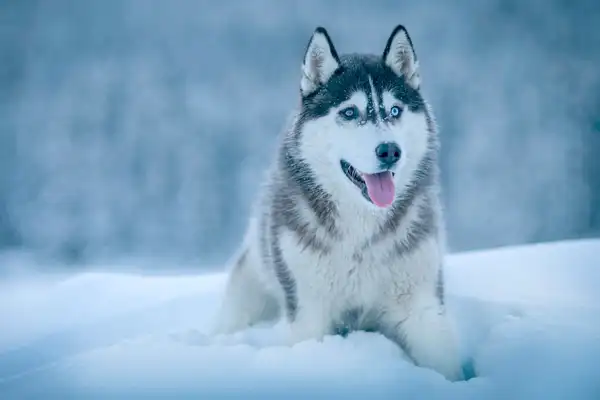
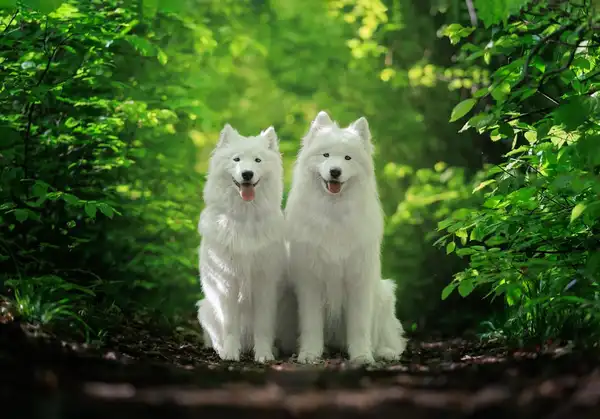
Canidae · DOG
Alaskan Malamute
🌟 You may have met one
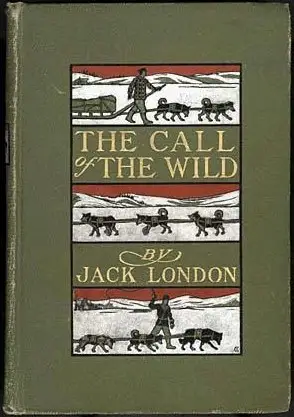
Buck, the star of Jack London's The Call of the Wild, was modeled on the Alaskan Malamute. Alongside the Husky and Samoyed it's one of the "three sled-dog goofballs" - and by far the biggest of the trio.
Overview
The Alaskan Malamute (阿拉斯加雪橇犬) is a large dog breed weighing 34–45 kg with a 10–14-year lifespan. The heavy-lifter of the sled world - steadier and stouter than a Husky. Expects big space and big exercise, sheds like it's snowing indoors, and struggles through southern summers.
Feeding
Large-breed formulas with joint support.
Exercise
1.5-2 hours a day; weight-pulling or steady jogging works best.
Grooming
Thick, long double coat: brush 3-4 times a week.
Health
Prone to hip dysplasia and cataracts. Guard against summer heatstroke.
Gallery
A closer look at the Alaskan Malamute
From origins and personality to daily care and health — helping you judge whether this little companion is really the one for you.
Origin & history
Origin & history
The Alaskan Malamute takes its name from the **Mahlemut** (also spelled Mahlemiut or Malemiut) - an Inupiat (Inuit) tribe that lived along Kotzebue Sound in northwestern Alaska. About 4,000 years ago the tribe crossed the Bering land bridge from Siberia, bringing along the domesticated wolf-dogs that became the modern Malamute's ancestors. Bone-and-ivory carvings from local dig sites, some 20,000 years old, already show a silhouette almost identical to today's Malamute - and DNA analysis confirms it as **one of the oldest domesticated breeds on earth**, closer to the gray wolf than most modern breeds. [2][3][4]
Unlike the Husky - a small, fast sprinter - the Malamute was bred as a **heavy freighting sled dog**: the Mahlemut used it to haul huge chunks of seal and whale meat, tag along on polar bear hunts, and turn into a pack animal in summer, carrying camp gear between hunting grounds. The Mahlemut treated their dogs better than any other Arctic tribe of the era - which is why the Malamute is naturally very affectionate and family-bonded, a distinctly different feel from the more "tool-dog" Canadian Eskimo Dog. [2][3][4]
The 1896 Alaska Gold Rush nearly wiped the breed out: outsiders flooded in and crossbred Malamutes with faster breeds to win races, and purebred numbers collapsed. Fortunately, Kotzebue Sound was remote enough that native villages preserved pure lines. In the 1920s-30s, breeders like Arthur Walden, Eva "Short" Seeley, and Paul Voelker began hunting for pure Malamutes to rebuild the breed - Seeley's **Kotzebue line** (mostly gray-and-white, close to the aboriginal type) became the AKC's founding stock, and the AKC formally recognized the Alaskan Malamute in 1935. [1][2][3]
During WWII the US military drafted large numbers of Malamutes for polar search-and-rescue, transport, and war-dog duty, and many never came home - the population dropped to critical levels again. After the war, the AMCA (Alaskan Malamute Club of America) opened up two additional lines in the 1970s - M'Loot and Hinman-Irwin - to rebuild the gene pool. [1][2] In 1972, the Alaskan Malamute was named the **official state dog of Alaska**. [1]
Buck, the star of Jack London's 1903 novel The Call of the Wild, was modeled on the Alaskan Malamute - and that book was the world's first real introduction to the breed.
Looks & breed standard
Looks & breed standard
The AKC standard defines the Malamute as a **medium-large dog** (not a "giant") - males stand 25 in (about 64 cm) at the shoulder and weigh 85 lb (about 39 kg); females stand 23 in (about 58 cm) and weigh 75 lb (about 34 kg). [1][3] The "giant Malamutes" and "bear-type Malamutes" (100+ lb) marketed in China **are not AKC-standard animals** - they're mostly crossbred with Saint Bernards, Newfoundlands, or similar giants, they carry serious health risks, and legitimate pedigree registries do not recognize them.
The Malamute is easiest to confuse with the Husky. A few tells that will let you spot one at a glance: - **Size**: an adult Malamute is clearly larger than a Husky, with much heavier bone; - **Head**: broader skull, smaller ears, and wider ear-set on the Malamute; - **Eyes**: Malamutes come **only in almond-shaped brown eyes** - blue eyes are a disqualification. Huskies allow blue and heterochromia; - **Tail**: the Malamute carries a well-plumed tail curled up over the back like a feather duster; the Husky has a fox-brush tail carried low or high but not curled; - **Feet**: much larger "snowshoe feet" on the Malamute, with dense hair between the toes for insulation. [1][3]
Colors are limited to gray, black, red, sable, or all-white combinations, and the face must show a **cap** or **mask** - the only permissible solid color is pure white. [1]
Personality in depth
Personality in depth
Think of the Malamute as a **"XL Husky"**: equally people-loving, equally uninterested in guarding, equally howl-happy and rarely barky, equally high-energy - but steadier, more stoic, and more stubborn than a Husky. Key differences: - **Different sled team role**: the Malamute is a natural leader ("lead or be led") who will actively challenge for pack rank; the Husky is more comfortable working as part of the group; - **Harder to train**: extremely smart but fiercely independent - authority-building has to start at 2-3 months old; [3][4] - **More same-sex aggression**: two intact males in the same house is essentially guaranteed conflict. [2][4]
With family, the Malamute is "too much affection" - jumping, body-slamming, licking. At 40 kg of bodyweight, that's a lot of dog for a preschooler alone in a room. Toward strangers it has almost no wariness at all - **it cannot function as a guard dog**. [2][3][4]
Howls and low "woo-woo" rumbles are its signature language; barking is rare. Digging is coded into its DNA (the Mahlemut used it to find den-dwelling prey), so if you have a lawn or garden, expect it to be excavated. [2][4]
The Malamute lands around #50 on Coren's intelligence rankings - about the same tier as the Husky, meaning "low obedience but high adaptability." [4]
Daily care
Daily care
**Exercise**: the AKC and other authorities agree on **2+ hours a day**, ideally with weight-bearing work - sledding, cart-pulling, or backpack hiking are the most fulfilling activities (they honor the breed's instincts). [4][5] Straight-up walking, even for 2 hours, may not fully drain a Malamute - add mental games on top.
**Space**: **absolutely not an apartment dog.** Needs a yard with a 6-foot fence and dig-proof foundation. Deprive it of space and it will "invent work" - excavating the garden, remodeling the couch, jailbreaking the yard. [2][4]
**Grooming**: double coat, with two big "blows" a year (spring and fall). During coat blows you're brushing daily with a proper undercoat rake plus dematting comb; the rest of the year, 2-3 times a week is fine. **Never shave a Malamute.** The undercoat is a two-way climate system (warm in winter, insulating in summer) - shaving does not cool it, and it can permanently damage coat texture. [2][4][5]
**Feeding**: large-breed puppy food until 18-24 months; adults eat 4-6 cups per day split into two meals; protein 26%+ (native working-dog metabolism); avoid soy and corn (Malamutes have sensitive GI tracts); **always use a slow-feeder bowl** (high GDV/bloat risk); **inherited zinc-absorption defect** requires lifelong zinc supplementation - symptoms are symmetrical hair loss. [3][4]
**Cold-hardy vs. heat-sensitive**: extraordinarily cold-hardy (comfortable at -40 C); but **very heat-sensitive** - reduce outdoor time above 15 C, run air-conditioning above 25 C, and above 30 C outdoor exercise is off-limits (heatstroke is the leading cause of Malamute death in summer). **Keeping a Malamute in southern China from June-September is extremely expensive** (round-the-clock A/C, cooling mats, cold packs on hand). [2][3][4]
Health & lifespan
Health & lifespan
Average lifespan is **10-14 years** (median around 12) - a bit shorter than the Husky, mostly because of the larger frame and heavier joint load. The main hereditary conditions:
- **Hip dysplasia (HD)**: breed prevalence **16.1%** (dogmatchup, citing OFA), above the all-breed average; [6] - **Chondrodysplasia (ChD)**: a breed-specific recessive that causes dwarfism and limb deformities. Thanks to widespread genetic screening, current prevalence is down to **0.5%**; pre-breeding DNA testing plus 5-12 week X-ray screening are now standard; [6][7] - **Alaskan Malamute Polyneuropathy (AMPN)**: a breed-specific autosomal recessive that damages peripheral nerves - ataxia and hind-limb weakness typically appear at 6-18 months. A DNA test exists; [6][7][8] - **Day blindness / cone degeneration**: a breed-specific autosomal recessive causing cone-cell degeneration - vision drops in bright light. DNA testing available; [7] - **Hereditary cataracts**: prevalence around **3%**, often needing surgery before adulthood; [6] - **Hypothyroidism**: prevalence **9.1%**, above the all-breed average; [6] - **Thrombopathia (platelet dysfunction)**: a breed-specific coagulation disorder that can cause spontaneous bleeding; [7][8] - **Gastric dilatation-volvulus (GDV / bloat)**: high risk in any large, deep-chested breed; - **Zinc-responsive dermatosis**: the same hereditary zinc-absorption defect Huskies have - lifelong zinc supplementation required.
AMCA CHIC certification requires: **OFA hips + CAER eye exam + thyroid + polyneuropathy DNA + ChD X-ray + day-blindness DNA**. Always ask for the full report before you buy a puppy.
Common myths & adoption tips
Common myths & adoption tips
**Myth 1: "A Malamute is just a bigger Husky."** Wrong. They're both Arctic sled dogs, but their jobs are completely different: the Husky is a short-distance sprinter, the Malamute is a long-distance heavy hauler. Different size, different temperament, different breeding history. The AKC registers them as two separate breeds. [1][2][3]
**Myth 2: "Giant Malamutes are more purebred."** The exact opposite. The AKC standard is 25 in / 85 lb for males and 23 in / 75 lb for females. The "bear-type" or "giant Malamutes" marketed in China (100+ lb) are usually **mixed with Saint Bernard or Newfoundland** - joint disease, heart disease, and shortened lifespan come with the territory. Legitimate AMCA pedigrees do not recognize them. [1][3]
**Myth 3: "A Malamute can guard the house."** Not at all. It's absurdly friendly to strangers - it'll wag at an intruder and try to solicit belly rubs. If you actually need a guardian, look at German Shepherds, Rottweilers, or Malinois. [2][4]
**Myth 4: "You can keep a Malamute in southern China."** Think twice. In Shanghai, Guangzhou, or Shenzhen, summer is 30 C+ with high humidity - heatstroke risk and A/C bills are both brutal, and most southern owners cycle through "under-exercised = destructive" and "heat-stressed" all summer. Northern cities and single-family homes with yards are a much better fit. [2][3][4]
**Adoption tips**: - Choose puppies whose parents have OFA hips of Good or better, CAER eye clearance, and negative DNA on AMPN, ChD, and day blindness; - Watch 6-8 week puppies for energy and bone structure - go for the medium-weight, heavy-boned ones, not "the biggest"; - Eyes must be **brown** (blue is a disqualification); - Domestic pedigreed pups run 8,000-20,000 RMB, show quality 25,000+; avoid breeders selling "gray-wolf lineage" or "giant bear Malamutes"; - **Surrender rates are high** - the summer difficulty, huge shedding, and destruction burn out many owners after 2-3 years. Assess your climate and activity level honestly before committing.
References
This is an educational overview — for specific health and care advice, please consult the authoritative sources below and your veterinarian.
- [1] Alaskan Malamute - AKC 官方品种介绍Official
- [2] About Alaskan Malamutes - Mahlemut 部落起源与 20000 年前骨牙雕刻Encyclopedia
- [3] Alaskan Malamute History - Showsight Magazine (Mahlemiut / AKC 1935 / 二战)Encyclopedia
- [4] Alaskan Malamute Complete Breed Guide (breedbible)Encyclopedia
- [5] The Alaskan Malamute - A Brief History (Kotzebue 血系 / Short Seely)Encyclopedia
- [6] Alaskan Malamute Health Guide - dogmatchup (OFA 16.1% HD / 9.1% 甲减 / 0.5% ChD)Study
- [7] Alaskan Malamute PDSA - HD/甲减/ChD/多神经病/昼盲筛查方案Study
- [8] Alaskan Malamute - a-z-animals (Thrombopathia / Polyneuropathy)Study