Canidae · DOG
Saint Bernard
🌟 You may have met one

The star of the 'Beethoven' movie franchise is a Saint Bernard. The breed's original job was Alpine monastery rescue — specifically finding people buried in avalanches.
Overview
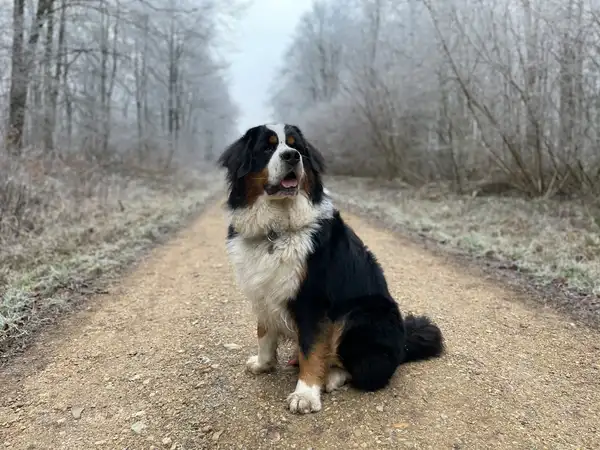
The Saint Bernard (圣伯纳犬) is a giant dog breed weighing 54–82 kg with an 8–10-year lifespan. The Alpine snow-rescue dog — beneath its enormous body sits a genuinely gentle heart. Endlessly patient with kids and family, but the drool volume is legendary.
Feeding
Large-breed formula with joint-support ingredients.
Exercise
About 45–60 minutes daily, avoid heat.
Grooming
Thick long coat, brush 3 times a week and clean the eye corners.
Health
Watch for hip dysplasia, cardiac issues, and gastric torsion (GDV).
Gallery
A closer look at the Saint Bernard
From origins and personality to daily care and health — helping you judge whether this little companion is really the one for you.
Origin & history
Origin & history
The Saint Bernard traces its lineage to the ancient Roman Molosser (mastiff-type) dogs — Roman legions brought them across the Alps into Switzerland. In the 11th century, Saint Bernard of Menthon founded the Great St. Bernard Hospice at 2,469 m elevation on the Great St. Bernard Pass — the primary route across the Alps between Switzerland and Italy — providing shelter for pilgrims and travelers [1][2].
Around the mid-17th century the hospice began using large local dogs for guiding and rescue work — deep-snow capable, keen-nosed, able to locate lost travelers in blizzards and dig people out of avalanches. These dogs were later formally called Saint Bernards. Hospice records from 1707 explicitly mention 'using dogs to search for missing travelers'; around 1800 the hospice at its peak kept 30–50 Saints handling rescues along the whole pass [1][3].
The most famous Saint Bernard was Barry (1800–1814) — over 12 years at the Great St. Bernard Hospice he reportedly rescued more than 40 people (including children buried by avalanche), making him the most thoroughly documented individual rescue dog in history. Barry's preserved body still resides at the Natural History Museum in Bern — he's a Swiss national symbol. After 1815 the hospice named all working dogs 'Barryhund' in his honor [1][2].
A severe winter in the mid-19th century nearly wiped out the hospice population, and the breed was rebuilt through crosses with Newfoundlands — this is also the origin of the modern long-haired Saint Bernard variant (long fur ices up in the Alps and is actually worse for rescue, so working dogs remained short-haired). In 1884 the Swiss St. Bernard Club was founded and issued the first breed standard, the same year the Swiss Kennel Club (SKG) was formed; the AKC recognized the Saint Bernard in 1885 (Working Group); in 1887 an international congress officially fixed the name 'Saint Bernard' (previously called Alpine Mastiff, Barry Dog, etc.) [3][4]. The classic image of a Saint Bernard with a brandy barrel around its neck comes from Edwin Landseer's 1820 painting 'Alpine Mastiffs Reanimating a Distressed Traveler' — hospice monks never actually hung barrels on their rescue dogs. The 1992 film 'Beethoven' turned the Saint Bernard into a global family-dog icon.
Looks & breed standard
Looks & breed standard
The AKC standard classifies the Saint Bernard as a giant working dog: males 27.5–35.5 inches (70–90 cm) at the shoulder, 140–180 lb (63–82 kg); females 25.5–32 inches (65–81 cm), 120–140 lb (54–64 kg) — one of the heaviest breeds in the world, second only to the English Mastiff [4][5].
Head: massive and squared, moderately brachycephalic — not extreme, so BOAS risk is moderate; heavy loose flews (the reason for prodigious drool); deep-set eyes with slight lower-lid ectropion; medium ears set high, dropping and hugging the cheek. Body: very deep chest, powerful hindquarters, long thick tail carried down. History records enormous individuals like Gibson (world's heaviest dog at 130 kg).
Coat comes in two varieties: Smooth — the original monastery working type, double-coated with a short flat outer and dense underlayer; Rough — the modern long-haired variant produced by Newfoundland crossings, with a longer slightly wavy outer coat and pronounced feathering on tail and hindquarters. Actual monastery rescue still favored the smooth type (long fur icing up hurts working ability). Color: red-and-white markings are the standard requirement — white base covers chest, legs, collar, muzzle blaze and tail tip, with body areas in red-brown, dark brown, or brindle; a dark facial mask is common but not required [4].
Personality in depth
Personality in depth
The core temperament is 'steady and gentle' — the AKC officially describes the Saint Bernard as playful, charming, and curious, but what really made it a family-dog star is its innate patience with children. The 'giant dog + rowdy child' pairing painted by 19th-century Landseer or portrayed in 20th-century 'Beethoven' isn't artistic exaggeration — Saint Bernards are among the most kid-tolerant of all giant breeds [4][5].
With family: clingy, leaning, happy to slam 60 kg of body onto your lap; expressive but not a barker — Saints only bark deeply when it truly matters. With children: AKC explicitly says 'wonderful with children' — the monastery legacy hard-wired 'protect the weak' into the breed; a Saint will often approach a crying child on its own to comfort them. With strangers: alert but not hostile — the default is 'observe, then react', not attack. With other dogs: highly social and tolerant — as monastery pack workers, harmony among dogs is their default state [5].
Caveats: mental maturation is slow — full adult mindset only arrives at 2–3 years, and until then the Saint may act like a 60 kg puppy — knocking over furniture, bowling over children, clumsy and adorable. Training must start at 8 weeks — an untrained adult Saint has enough force to drag any owner, and socialization is non-negotiable. Exercise needs are moderate — 45–90 minutes of walking daily is enough; this is not a breed that requires intense workouts.
Daily care
Daily care
The three daily essentials for a Saint Bernard are: split feeding, extensive brushing, and skin-fold cleaning. Split feeding: like the Great Dane, feed 2–3 small meals per day and enforce a one-hour rest window before and after eating — the core practice for preventing GDV (gastric torsion), for which Saints rank in the top three lifetime risk among giants [4][6]. Diet must be a large- or giant-breed formula with balanced calcium/phosphorus and 22–25% protein; strictly avoid human food and free-feeding during puppyhood (bad nutrition during rapid growth causes permanent skeletal damage).
Grooming is task number one: smooth-coats 2–3 times a week, rough-coats 3–5 times; during spring and fall coat-blow, daily brushing is required — shedding is 'five-star' (worst tier); mats form easily behind ears, in armpits, along inner thighs, and at the tail base. Bathing every 6–8 weeks (a full-family workout given the size). Drooling is a constant — those loose flews mean saliva flies during eating, drinking, and excitement, so drool-cloths belong in every room; households sensitive to slobber shouldn't get a Saint.
Eye-corner care is essential — lower-lid ectropion pools tears and invites infection, so wipe the eye corners twice daily with pet wipes. Facial folds and jowls also need cleaning every two days. Exercise: 45–90 minutes of walking plus light play is plenty. Absolutely no jumping, stair-climbing, or long-distance running for puppies — bones don't close until 18 months, and wrong exercise causes lifelong joint damage [4]. Heat tolerance is very poor — above 25°C in summer limit outdoor time, run AC, and skip midday walks.
Health & lifespan
Health & lifespan
The Saint Bernard shares with the Great Dane the label 'short-lived giant duo' — average lifespan is only 8–10 years, and the top killers overlap almost entirely with the Dane. UK KC data put the median lifespan at about 7 years — one of the shortest of any mainstream breed [7][8].
First is GDV — lifetime risk around 21% in Saints, second only to the Great Dane. Prophylactic gastropexy — suturing the stomach wall to the abdominal wall permanently to prevent torsion — is now standard mainstream advice, typically done during spay/neuter or an early surgical event [7].
Second is a cardiac cluster: dilated cardiomyopathy (DCM) is a common cause of sudden death in middle-aged Saints (4–7 years); subvalvular aortic stenosis (SAS) is a congenital heart defect; the AKC parent club recommends annual echocardiographic screening [7][8]. Third is osteosarcoma — large-breed bone cancer with very high incidence in Saints, typically at the distal radius or tibia and usually late-stage at diagnosis. Fourth is lymphoma and other cancers — Saints have a total cancer incidence around 40%, second only to Boxers [7].
Fifth is orthopedic: hip dysplasia (OFA data: ~47%, near the highest of all giants), elbow dysplasia (~15%), and osteochondrosis dissecans (OCD) in puppies. The AKC parent club requires OFA hip and elbow reports from breeders [7]. Sixth is ophthalmic: ectropion (lower-lid), entropion (upper-lid), and cherry eye are all common. Seventh is heat stress: brachycephalic head + double thick coat + massive body = poor heat dissipation, and summer heatstroke deaths in Saints aren't rare [7][8]. Reputable breeders test at least four items — OFA hips/elbows, cardiac echo, CAER eyes, and DCM genetics; verifying these reports is the minimum standard when buying a Saint puppy.
Fit for your space
Fit for your space
The Saint Bernard is a high-bar giant — it needs a family that qualifies on four dimensions: space, climate, time, and budget [3][5].
Space: while indoor activity is minimal (16+ hours of sleep per day), sheer physical size makes small apartments inappropriate — a detached house or large flat with a small yard is best; furniture load-bearing, floor scratch-resistance, and hallway width should all be assessed. Climate: heat tolerance is very poor — Alpine selection makes 5°C to 15°C the sweet spot; southern Chinese cities with humid hot summers are a lifelong ordeal, requiring constant AC and strict outdoor limits, while northern winters are the Saint's best season. Not recommended for tropical zones.
Time: 30 minutes of daily brushing + 15 minutes of eye and fold cleaning + 60 minutes of walking + 20 minutes of training = about two hours daily; households with long unoccupied hours are a bad match (separation anxiety plus destruction is expensive).
Budget: the Saint Bernard is one of the costliest breeds to own — monthly food 800–1500 RMB, annual vet costs (vaccines + deworming + regular checkups) 3,000–5,000 RMB; a single GDV or hip surgery can hit 20,000–50,000 RMB. Total lifetime costs typically run 150,000–250,000 RMB (excluding illness treatment). Lifespan expectation: 8–10 years — deciding to own a Saint means accepting a relatively short companionship. Suitable homes: northern Chinese city or suburban detached house, older children (8+), financially comfortable, willing to accept drool, shedding, and shorter lifespan.
References
This is an educational overview — for specific health and care advice, please consult the authoritative sources below and your veterinarian.
- Wikipedia — St. Bernard (dog)(Great St. Bernard Hospice、Barry、1884 品种标准)综合百科
- Britannica — Saint Bernard: origin, description, temperament百科全书
- AKC — Saint Bernard 品种档案(1885 承认、Working Group)AKC 官方
- AKC — Official Standard of the St. Bernard品种标准
- Saint Bernard Club of America(AKC 家长俱乐部)犬种俱乐部
- PetMD — Saint Bernard: Care, Nutrition and Common Conditions宠物医学网站
- UFAW — St. Bernard Genetic Welfare Problems(GDV、DCM、髋肘、骨肉瘤综述)动物福利综述
- Adams et al. 2010 — Methods and mortality results of a health survey of purebred dogs in the UK(圣伯纳中位寿命 7 岁)学术论文
- Natural History Museum Bern — Barry the Alpine Rescue Dog(Barry 标本与传记)博物馆资料