Canidae · DOG
Bernese Mountain Dog
🌟 You may have met one
The all-purpose Alpine farm dog whose old day job was pulling milk carts down the mountain to the village market. The name 'Bernese' comes from Bern, the Swiss capital.
Overview
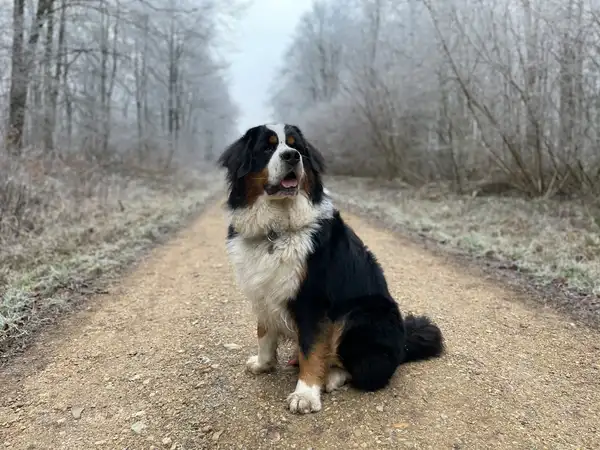
The Bernese Mountain Dog (伯恩山犬) is a giant dog breed weighing 30–55 kg with a 7–10-year lifespan. An Alpine farm dog whose signature tricolor coat is unmistakable. Steady and gentle, wonderful with families — but with a shorter lifespan and low heat tolerance.
Feeding
Large-breed formula with joint support.
Exercise
About one hour daily, avoid heat.
Grooming
Thick long coat, brush 3 times a week.
Health
High cancer risk, hip dysplasia, and heart problems.
Gallery
A closer look at the Bernese Mountain Dog
From origins and personality to daily care and health — helping you judge whether this little companion is really the one for you.
Origin & history
Origin & history
The Bernese Mountain Dog originates from farms in the Canton of Bern in central Switzerland and is one of the four Sennenhund (Swiss mountain dog) breeds — the others being the Greater Swiss Mountain Dog, Appenzeller, and Entlebucher. Its ancestors are generally believed to be crosses between Molosser-type mastiffs brought by Roman legions to the Alps and native farm dogs [1][2].
By the late 19th century, farm mechanization and the influx of other breeds nearly wiped out the Bernese. In 1899, zoology professor Albert Heim in Switzerland began systematically documenting and rescuing the population; the 'Schweizerischer Dürrbach-Klub' was established in 1907 and renamed the Berner Sennenhund Klub in 1910 [3][4]. Heim is regarded as the founder of the modern breed.
The Bernese Mountain Dog was recognized by the AKC in 1937 in the Working Group [5]. Its traditional Swiss farm role was three-in-one: pulling milk carts (Milchwagen) to the village market, herding cattle, and guarding the property — a job description that shaped its blend of stamina and calm [6].
Looks & breed standard
Looks & breed standard
The Bernese is the only long-coated variety among the four Swiss mountain breeds. AKC standard: males 25–27.5 inches (64–70 cm) at the shoulder, 80–115 lb (36–52 kg); females 23–26 inches (58–66 cm), 70–95 lb (32–43 kg) [5][7].
The tricolor pattern is the breed's registered trademark: jet black base, a distinct white 'Swiss cross' on the chest, rich rust markings on the lower legs, above the eyes, on the cheeks and around the vent, plus white on toes and muzzle tip [5]. Any deviation from the tricolor standard is disqualifying at AKC and FCI shows.
The coat is medium-long double coat: outer coat straight or slightly wavy, waterproof and cold-resistant; dense woolly undercoat. This coat system was designed for Alpine winters and makes the Bernese highly susceptible to heatstroke in summer, requiring careful temperature management [7][8].
Personality in depth
Personality in depth
The Bernese temperament is officially described by the AKC as 'good-natured, calm, confident' — the classic 'gentle uncle' among big dogs: not noisy, not confrontational, but deeply devoted once bonded to a family [5][9]. Its patience with children is exceptional, which is why in Swiss farm days it was often trusted to watch over kids.
Toward strangers the Bernese tends to be polite but reserved — a slow-warmer socially. This puts it closer to 'gentle guardian' than other working breeds, and early socialization remains essential — especially getting used to city noise, unfamiliar men, and other dogs [9].
One caveat: the Bernese is intensely loyal but poorly tolerant of solitude. Long alone hours cause anxiety and destructive behavior, so it isn't the right dog for households where nobody is home during the workday [8][9].
Daily care
Daily care
The Bernese needs 30–60 minutes of moderate exercise daily — flat walks, forest hikes, or snow play — never long high-heat runs [7]. In summer, above 25°C shift walks to early morning or evening; keep the interior cool with AC or cooling mats.
Puppy joints are fragile — AKC and UC Davis Vet School recommend that large-breed puppies avoid high-impact exercise (jumping, steep stairs, long-distance running) before 18 months to reduce hip and elbow dysplasia rates [10]. Feed a large-breed puppy formula with controlled calcium/phosphorus and controlled growth rate.
Coat care: brush 2–3 times a week; during coat-blow (spring and fall) daily brushing is required, with dramatic shedding. Regularly check ears and paw-webbing for debris. The Bernese is also known for drooling — milder than a Saint Bernard but plenty enough that a wipe cloth around the house is a good idea.
Health & lifespan
Health & lifespan
The Bernese has one of the shortest lifespans of any AKC-recognized breed. Multiple studies place median lifespan at just 7–8 years, roughly 4–5 years shorter than a Labrador (~12 years). Cancer accounts for 45–60% of Bernese deaths — the highest of any breed [11][12].
The most breed-specific cancer is histiocytic sarcoma / malignant histiocytosis — Bernese incidence is over 200× that of other breeds, most cases arising between 6 and 10 years of age with grim prognosis [12][13]. Lymphoma, mast cell tumors, and osteosarcoma are also elevated.
Non-tumor issues: hip and elbow dysplasia are both markedly higher than average, with OFA reporting ~15–18% hip abnormality rate [14]. Other common problems include SOD1-linked degenerative myelopathy, von Willebrand disease (vWD), progressive retinal atrophy (PRA), GDV, and steroid-responsive meningitis-arteritis (SRMA) in puppies [15].
Responsible breeders should provide OFA hips and elbows, cardiac screening, and DM genetic tests. Before adopting, weigh carefully the 7–8 year lifespan and high cancer risk emotionally and financially.
Fit for your space
Fit for your space
The Bernese Mountain Dog is best suited to detached homes in temperate or high-latitude climates, with a fenced yard for free movement. It doesn't need it 'as cold as possible' but strongly prefers cool climates; keeping one in a hot southern summer requires constant AC.
Apartment life isn't impossible but requires two prerequisites: an elevator or ground-floor unit (large-breed puppy joints can't handle daily stairs), and at least two outdoor walks per day. Barking is infrequent, but body size and shedding are noticeable strains on a small home.
On family structure, the Bernese fits best in households with children and stable at-home members — not the right choice for frequent travel or empty-nest lifestyles.
References
This is an educational overview — for specific health and care advice, please consult the authoritative sources below and your veterinarian.
- AKC — Bernese Mountain Dog Breed Profile官方犬业协会
- FCI Standard No.45 — Bernese Mountain Dog国际犬业标准
- Albert Heim Foundation — 瑞士山地犬品种保育史学术与历史资料
- Berner Sennenhund Club Schweiz 官方历史文档官方俱乐部
- AKC — Bernese Mountain Dog Official Breed StandardAKC 品种标准
- Bernese Mountain Dog Club of America — History全国单犬种俱乐部
- VCA Animal Hospitals — Bernese Mountain Dog Care Guide综合科普
- UFAW — Genetic Welfare Problems of Bernese Mountain Dogs动物福利机构
- Klopfenstein et al. 2016 — Life expectancy and causes of death in Bernese Mountain Dogs (Swiss Med Weekly)学术研究