Canidae · DOG
Weimaraner
🌟 You may have met one
The Weimaraner was once the secret weapon of European nobility - the German Weimaraner Club forbade breeding by non-members and export to foreigners. American sportsman Howard Knight spent ten years earning membership before the club would even sell him two spayed dogs in 1929.
Overview
The Weimaraner (威玛猎犬 / 灰色幽灵) is a large dog breed weighing 25–40 kg with a 10–13-year lifespan. The Grey Ghost - silver-grey short coat with amber or blue-grey eyes is the Weimaraner's fingerprint. Bred in the early 19th century by Grand Duke Karl August of Weimar as an all-purpose gundog for tracking, pointing and retrieving, the breed is intensely intelligent, extraordinarily attached to family, and off-the-charts athletic. It rewards experienced sporting-dog owners and defeats casual ones - daily two-hour workouts and constant human company are non-negotiable.
Feeding
Large-breed food, 2.5-4 cups per day split into 2-3 meals; deep-chested and high GDV risk - no strenuous exercise for one hour after meals.
Exercise
Two or more hours of vigorous exercise plus mental games daily; anything less produces destruction, barking and separation anxiety.
Grooming
Ultra-short coat needs a weekly soft-brush pass; poor cold tolerance means a coat below 10 degrees Celsius.
Health
Screen for GDV (bloat), hip and elbow dysplasia, spinal dysraphism, hyperuricosuria and hypothyroidism.
Gallery
A closer look at the Weimaraner
From origins and personality to daily care and health — helping you judge whether this little companion is really the one for you.
Origin & history
Origin & history
The Weimaraner originated in the early 19th century in the German **Grand Duchy of Saxe-Weimar-Eisenach** - the town of Weimar gives the breed its name. The founder is generally credited as **Grand Duke Karl August (1757-1828)**, who established a dedicated kennel at his court. He crossed local tracking hounds (Leithund), the French Chien Gris de Saint Louis, German Shorthaired Pointers, English Pointers and Bloodhounds to build an all-purpose noble hunting dog - one that could track large game (deer, boar, bear), point at birds and retrieve waterfowl.[1][2]
**1820s-1840s**: the breed stabilised inside the Weimar court, with a distinctive silver or mouse-grey short coat and amber or blue-grey eyes - the coat colour probably arose from a dilute allele at the B locus, and it earned the breed the nickname **Grey Ghost**.[1][2]
**Bloodline lockdown**: **the German Weimaraner Club (Deutscher Weimaraner Klub) was founded in 1897** and explicitly prohibited breeding by non-members and sale to foreigners - for thirty years the bloodline was tightly controlled. The first Weimaraner appeared at a Vienna dog show in 1908.[1][2]
**Arrival in America**: **American sportsman Howard Knight** spent ten years earning membership in the German club and finally imported the first two - **spayed** - dogs in 1929, and only in 1938 was he allowed intact dogs (one male, two females), founding the American line. **The AKC recognised the breed in 1943** in the Sporting Group. Post-war fame came from Grace Kelly and, later, artist William Wegman, whose Weimaraner photographs entered the collection of the Museum of Modern Art in the 1990s.[1][2][3]
**Today**: FCI Standard No. 99, Group 7 Section 1.1; AKC registrations rank the Weimaraner in the top 40 breeds each year.[3][4]
Looks & breed standard
Looks & breed standard
AKC standard: **males 25-27 in (63-69 cm), females 23-25 in (58-63 cm); males 30-40 kg, females 25-35 kg**. The overall silhouette is medium-to-large, smooth, elegant, fast and endurance-built - "noble hunting dog" is the standard's defining phrase.[3][4]
**Signature traits**: - **Silver, mouse or charcoal-grey short coat** - a single, metallic-lustred colour; a small chest or belly patch is tolerated but any larger white area is a disqualification; - **Amber, grey or blue-grey eyes** - puppies are almost universally sky-blue, gradually shifting to amber with age; one of very few AKC sporting breeds where blue eyes are permitted; - **Grey-pink nose** (not black) - consistent with the coat's dilution gene; - **Grey-pink or pink pads** (not black).[3][4]
**Head**: medium length and clean, with a defined brow; ears long and soft, set slightly above eye level, reaching the corner of the mouth when hanging. **Body**: withers slightly higher than the croup; deep chest to the elbow; well-laid-back shoulders; medium-fine bone; a moderate tuck-up.[3][4]
**Tail**: the AKC standard requires a docked tail of about **6 in (15 cm)** on adults; many European countries (UK, Germany, Australia) have banned docking, so undocked tails reach the hock.[3][4]
**Coat variant**: **the Longhaired Weimaraner** is recognised by the FCI as a separate variety, but the AKC does not recognise it, so all AKC show Weimaraners are shorthaired.[3][4]
Personality in depth
Personality in depth
**"Velcro Weimaraner"** - the nickname used by the AKC and the Weimaraner Club of America (WCA) - captures how relentlessly the breed sticks to its people. Attachment depth ranks among the strongest in the Sporting Group; a Weimaraner alone for four hours is anxious and one alone for eight hours is likely to destroy the house, bark endlessly or self-injure. **This is not disobedience - the breed simply was not designed for solitude.**[1][5]
**Energy and drive**: the 19th-century mandate was **all-purpose gundog** - track, point and retrieve - which means the dog needs both physical outlet (running, chasing, swimming) and mental outlet (scent work, decision-making, pointing). The floor is **two hours of vigorous exercise plus 15 minutes of mental exercise daily**; below that the dog self-medicates by dismantling the house, tipping bins, opening doors (yes, actually working handles), and barking.[3][5]
**Intelligence and stubbornness**: ranked 21st on Coren's list - solid intelligence with strong independence. Weimaraners invent their own solutions and find every loophole; **they will learn to open doors, crates and refrigerators** - that isn't a joke, it's in the AKC breed profile. Training must be short, positive and absolutely consistent; harsh corrections destroy trust immediately.[3][5]
**Sociability**: - **Family**: intensely bonded, treats family as hunting partners; - **Strangers**: alert but not aggressive; some adult protectiveness; - **Other dogs**: moderately friendly; occasional same-sex conflict; - **Cats and small pets**: **prey drive is high** - unless raised together from puppyhood, adult Weimaraners will treat the family cat as game; - **Children**: fine with school-age kids, but the dog's size and jumping habit can knock a toddler flat.[3][5]
Daily care
Daily care
**Exercise**: AKC classifies the breed as extremely high energy. **Two or more hours of moderate-to-intense daily exercise is the floor** - running, trail work, swimming, disc, canicross, dock diving, scent training - Weimaraners compete in almost every dog sport. **Two thirty-minute walks a day are nowhere near enough**; you will get a house-destroying Weimaraner.[3][5]
**Housing**: **not an apartment breed** - not because they're loud, but because their energy density needs space. Ideal is a fenced yard **at least 1.8 m tall** (they can jump 1.5 m); even with a yard, the human still needs to run the dog daily. **Solitary time must stay under four hours** - full-time-away households need dog walkers, daycare or a canine housemate.[3][5]
**Diet**: large-breed puppy food to 12-15 months; adults 2.5-4 cups (300-500 g) per day split into **2-3 meals**. **Deep-chested and high GDV risk** - WCA lists the Weimaraner in the top five breeds for bloat: - multiple small meals; - no vigorous exercise for one hour after meals; - slow-feeder bowl; - do NOT use raised bowls (studies show raised bowls actually **increase** GDV risk); - from age 5, discuss **prophylactic gastropexy** with your vet - it's a low-cost add-on to the neuter/spay procedure and near-eliminates GDV risk.[5][6]
**Coat**: single ultra-short coat, minimal maintenance - a weekly soft-brush pass; a bath every 6-8 weeks. **Cold tolerance is very poor** - thin coat and no undercoat means a coat below 10 °C, and outdoor living in cold climates is unsuitable. Heat tolerance is decent but avoid midday walks above 30 °C.[5]
**Training**: **the 8-16-week socialisation window is critical** - expose to people, dogs, sounds and surfaces. Basic obedience from 8 weeks, with **recall training the top priority** - Weimaraners will chase a bird two kilometres, so a rock-solid recall is a life-saver. Puppy Kindergarten plus at least one basic obedience class is strongly recommended.[5]
Health & lifespan
Health & lifespan
Weimaraners live **10-13 years** on average (median 11-12), a middling large-breed lifespan. Health issues cluster around GI, orthopaedics, endocrine, blood and skin. CHIC certification requires the following screens.[6][7]
**1) Gastric dilatation-volvulus (GDV / bloat)** - **top-5 breed for GDV**. The Purdue 1996-2000 cohort put lifetime cumulative incidence at approximately **19% in Weimaraners** (versus about 3% in dogs overall), with 26-33% first-episode mortality and high recurrence even after surgery. Deep, narrow chest is the primary risk factor. **From age 5, prophylactic gastropexy at neuter/spay is strongly recommended** - an incremental cost of USD 200-500 that near-eliminates GDV risk.[6][8]
**2) Hip dysplasia**: AKC data shows moderate incidence - OFA or PennHIP evaluation is standard. **Elbow dysplasia** should also be screened.[6][7]
**3) Spinal dysraphism (HSA-4)**: a well-documented Weimaraner-specific X-linked disease affecting males, presenting as puppy-onset bunny-hopping and coordination problems; DNA testing is available.[6][7]
**4) Hyperuricosuria/Hypomyelination and Von Willebrand disease (vWD)**: DNA screens available.[7]
**5) Hypothyroidism and immune-mediated haemolytic anaemia (IMHA)**: above-average incidence in several immune-disease databases; annual CBC and T4 in adulthood is a good habit.[6][7]
**6) Cancers**: **haemangiosarcoma** and **mast cell tumours** are relatively common in senior Weimaraners - abdominal ultrasound every six months from age 8.[6][7]
**7) Skin/immune**: **Weimaraner Vaccine Reaction Syndrome (HOD)** - some lines mount severe immune reactions after modified-live-virus vaccines, and the WCA recommends a Weimaraner-friendly vaccine schedule with an experienced vet.[7][9]
**CHIC required panel**: hip OFA, elbow OFA, thyroid, ophthalmology, cardiac, spinal-dysraphism DNA, vWD DNA.[7]
Common myths & adoption tips
Common myths & adoption tips
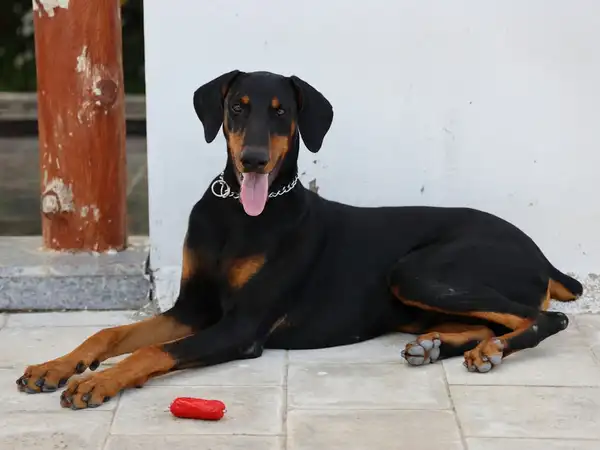
**Myth 1: The Weimaraner is just a leaner Doberman.** - Casual observers routinely confuse them, but: - **Origin** differs: Weimaraner early 1800s vs Doberman 1890; - **Purpose** differs: Weimaraner **gundog** (track+point+retrieve), Doberman **guard**; - **Temperament** differs: Weimaraners are more clingy and companion-dependent; Dobermans are more independent and vigilant; - **Colour** differs: Weimaraner only silver-grey; Doberman is black-tan or red-tan.[1][3]
**Myth 2: Short coat means easy dog.** - Easy coat, hard dog. **Energy demand + separation anxiety + GDV risk + prey drive** - those four together put Weimaraners in the top-5 most-surrendered US sporting breeds.[3][5]
**Myth 3: Blue-eyed Weimaraners are rare and expensive.** - All Weimaraner puppies are blue-eyed and most transition to amber; a minority stay grey-blue. **This is normal breed variation, not a rare mutation.** Any breeder charging a premium for "rare blue-eyed" is running a con. What is genuinely rare is the longhaired variety, recognised by the FCI but not the AKC.[3][4]
**Myth 4: Weimaraners cannot live with cats - absolutely not.** - Absolute claim, but with a kernel of truth. **Weimaraners raised with cats from puppyhood** can coexist peacefully; cats introduced to an adult Weimaraner are usually treated as prey. Cat households should either raise from 8 weeks together, or choose another breed.[5]
**Adoption tips**: rescue Weimaraners are often surrendered for **separation anxiety, destruction, prey drive and GDV medical bills** - labels that describe the breed as designed. If buying from a breeder, insist on parents' **hip/elbow OFA, ophthalmic CERF, thyroid, spinal-dysraphism DNA, vWD DNA** results; discuss prophylactic gastropexy with your vet at the neuter/spay appointment.[6][7]
References
This is an educational overview — for specific health and care advice, please consult the authoritative sources below and your veterinarian.
- [1] Weimaraner History - Weimaraner Club of America (WCA)Official
- [2] Weimaraner - WikipediaEncyclopedia
- [3] Weimaraner Official Breed Standard - AKCOfficial
- [4] FCI Standard No. 99 - WeimaranerOfficial
- [5] Weimaraner Breed Guide - VCA Animal HospitalsVeterinary
- [6] Glickman LT et al. Purdue Bloat Study - JAVMA 2000Study
- [7] OFA CHIC Health Screening Recommendations - WeimaranerStudy
- [8] Ward MP et al. Gastric dilatation-volvulus in dogs - Prev Vet Med 2003Study
- [9] Dodds WJ. Vaccine reactions in Weimaraners - HemopetVeterinary