Felidae · CAT
Donskoy
🌟 You may have met one
The Donskoy was the world's second officially recognised hairless cat breed and is the parent breed of the Peterbald. Uniquely, Donskoy kittens are often born with fur and gradually lose it over 2-24 months, and some individuals even regrow a partial 'winter coat' in cold weather — behaviour seen in no other cat breed.
Overview
The Donskoy (顿斯科伊无毛猫) is a medium-sized cat breed weighing 3.5–5 kg with a 12–15-year lifespan. A natural hairless mutation discovered in Rostov-on-Don, Russia in 1987 — the founder breed behind the Peterbald. Carries the dominant HR hairless gene; sturdier body and thicker skin than a Sphynx, with four coat grades. Warm, calm, cuddly and family-friendly.
Feeding
High metabolism — high-protein food in 3-4 meals a day.
Exercise
Moderate energy; likes being near the owner rather than racing around.
Grooming
Weekly wipe/bath; clean ears often; brush teeth daily; keep warm.
Health
Cold-sensitive, UV-sensitive, and prone to ectodermal-dysplasia (EDA) related dental problems.
Gallery
A closer look at the Donskoy
From origins and personality to daily care and health — helping you judge whether this little companion is really the one for you.
Origin & history
1987 Rostov-on-Don: a rescued kitten and a new dominant hairless gene
Origin & history
1987 Rostov-on-Don: a rescued kitten and a new dominant hairless gene
The Donskoy (Донской) has a dramatic origin story. In 1987, teacher **Elena Kovaleva** in Rostov-on-Don, Russia, took a tortoiseshell kitten named **Varvara** away from boys who were mistreating her.
Varvara initially had a normal short coat, but **within a few months she began to shed and eventually became almost fully bald**. Kovaleva first suspected disease, but the vet found nothing — Varvara was healthy, just hairless. When she grew up and had kittens, **some of her offspring also gradually went bald** — proving a new, distinct hereditary hairless gene.
**Breeder Irina Nemikina** started a systematic programme in 1990, initially naming the breed *Don Sphynx* and later shortening it to *Donskoy* — 'the Sphynx of the Don'.
**Registry recognition**: - **WCF**: 1997 - **TICA**: 2005 (Championship) - **FIFe / CFA / GCCF**: **still not recognised**, mostly over ectodermal-dysplasia concerns
**Genetics — the fundamental contrast with Sphynx**: - **Sphynx (Canada 1966)**: - **Recessive** mutation in **KRT71** (keratin 71) - Kittens are **born hairless** - Same gene as Devon Rex - **Donskoy (Russia 1987)**: - **Dominant** mutation at an unnamed HR locus - Kittens may be **born with fur and gradually lose it between 2 and 24 months** - Some individuals regrow a partial 'winter coat' in cold weather — unique among cats
Filler et al. (2012) confirmed these are distinct genes — Donskoy × Sphynx offspring are typically hairless, but the biology is different.
**Relationship to Peterbald**: the Peterbald descends from a 1994 Donskoy × Oriental Shorthair cross, inheriting the same HR gene. So the Peterbald is essentially the 'oriental version of the Donskoy'.
Recognition of Donskoy remains contested internationally — CFA, FIFe and GCCF worry that the dominant HR gene brings **ectodermal dysplasia (EDA)** and are cautious. TICA and WCF accept the breed but demand strict health screening.
Looks & breed standard
Sturdy body, four coat grades, wrinkled skin — and hair at birth
Looks & breed standard
Sturdy body, four coat grades, wrinkled skin — and hair at birth
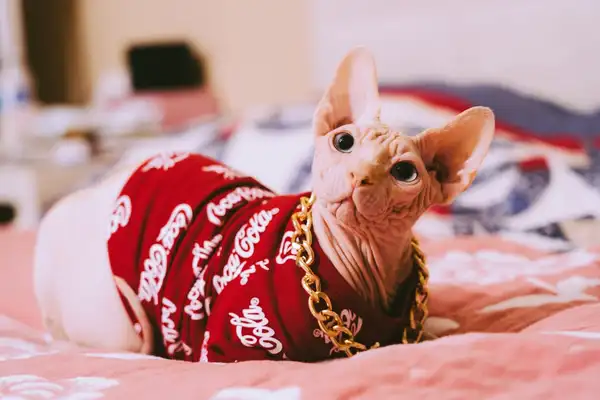
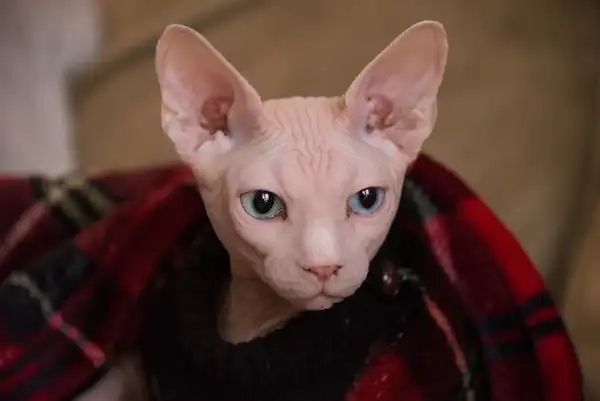
The Donskoy resembles a Sphynx (both hairless) but differs sharply in **body type and skin feel**:
- **Body**: - **Medium to large, sturdy, well-muscled**, adults 3.5-5 kg - Heavy bone, deep chest - **Not oriental** (that is the Peterbald) — **semi-cobby** - Rear legs slightly longer than the front
- **Head**: - **Wedge-shaped but broader than the Peterbald** - Prominent cheekbones, squarer muzzle - **Distinct forehead wrinkles** — a breed hallmark
- **Ears**: - **Large, flared, set high** - Wide base, slightly rounded tips - Narrower than the Peterbald's
- **Eyes**: - Large, almond-shaped, vivid colours (green, gold, blue, odd-eyed) - **No whiskers or eyebrows** is common
- **Skin**: - **Thicker and more elastic than a Sphynx's** — feels like warm silicone or warm glass - **Abundant skin folds** on the neck, armpits and thighs - Warm to the touch (body temperature 1-2°C higher than average due to rapid heat loss)
- **Paws**: **long-fingered ('monkey paws')** — highly dexterous
**Four official coat grades (Donskoy-specific)**: 1. **Rubber Bald**: fully hairless, silicone-like skin, **born hairless** (rare and purest) 2. **Flock**: very short down at birth, lost with age 3. **Velour**: velvet-like fuzz at birth, mostly lost within 1-2 years (may retain fuzz on forehead or tail tip) 4. **Brush**: bristly short coat at birth, may never fully shed
**Winter coat phenomenon** — unique to Donskoy: in cold weather some individuals (especially Velour/Brush) regrow a temporary protective coat that sheds again in spring. No other breed does this.
All colours and patterns are accepted.
Personality in depth
Calm, cuddly and family-friendly — the 'hairless British Shorthair'
Personality in depth
Calm, cuddly and family-friendly — the 'hairless British Shorthair'
The Donskoy's personality is often described as **'hairless body, British-Shorthair soul'** — calm, steady, affectionate and lap-oriented. It is the **easiest-to-manage temperament** of the hairless breeds.
**Key traits**: 1. **Calm and gentle**: - Compared to the Peterbald's oriental frenzy, the Donskoy is **understated** - Follows you around, but is happy to settle rather than perch on your shoulder all day - A true **lap-cat** — long, still cuddles 2. **Affectionate but not clingy**: - Wants to be near you when you are home - Does not yowl or destroy when left alone the way a Peterbald might - Alone-time tolerance **moderate** (better than Peterbald, close to Sphynx) 3. **Gentle with children**: - Patient with careful young children — one of the more family-friendly hairless breeds - Even tolerates mild toddler handling (skin still needs protecting) 4. **Friendly with strangers**: - Does not hide from visitors; accepts petting - Moderate curiosity — does not rummage in every guest's bag like a Peterbald 5. **Great with other cats and dogs**: - Excellent multi-pet cat, rarely starts conflict - Coexists happily with other hairless breeds, Russian Blues, Burmese, Ragdolls, gentle dogs 6. **Soft voice**: low volume and low frequency 7. **Moderate-to-high intelligence**: can learn basic cues, but is not as eager to learn as a Peterbald
**Social needs**: - Moderate to high - No more than 6-7 hours alone - Best with a friendly companion pet
**Vs Peterbald**: - Peterbald: **oriental + high energy + loud** - Donskoy: **semi-cobby + moderate energy + soft voice**
**Not a good fit for**: - Owners wanting a strictly independent cat (still a clingy breed, just less than Peterbald) - Homes without heating - Family members who cannot accept the hairless look
Daily care
Skin, teeth and warmth — the three pillars
Daily care
Skin, teeth and warmth — the three pillars
Daily Donskoy care is similar to Sphynx / Peterbald care, but with an extra focus on **dental issues from EDA**:
**1. Skin care**: - **Heavy sebum** — warm-water wipe/bath weekly - Clean skin folds (neck, armpits, thighs) with **baby wipes** every 2-3 days - Treat dark 'cat acne' patches with a mild antibacterial wipe - During a winter-coat regrowth phase, cut back bathing to preserve natural protection
**2. Warmth**: - No coat = very cold-sensitive; keep winter temperatures above 22°C - Sweaters are ideal (a hairless cat won't tangle them) - Heated beds, multi-layer soft bedding, no direct contact with cold tiles
**3. Dental care (Donskoy-specific)**: - **HR-linked EDA drives serious dental problems** - Kittens may **lose baby teeth early** or have some missing - Adults may have **fewer permanent teeth** than the normal 30 (often 20-26) - Severe cases may be **oligodontic** (few teeth) - **Brush teeth daily** with a soft pet toothbrush and enzymatic cat toothpaste - Annual vet dental exam and cleaning - Cats with tooth loss need **soft food / wet food** rather than large kibble
**4. UV protection**: - Bare skin burns easily; long sun exposure can trigger squamous cell carcinoma - Draw curtains at peak sun
**5. Diet**: - **High metabolism**: 3-4 meals daily - High protein (>36%) - Soft food for cats with dental issues - Plenty of water
**6. Ear cleaning**: - Heavy sebum in the ear canals - **Clean 1-2 times a week**
**7. Alone-time tolerance**: moderate (better than Peterbald, similar to Sphynx)
Health & lifespan
Ectodermal dysplasia, dental loss, skin issues and anaesthetic risk
Health & lifespan
Ectodermal dysplasia, dental loss, skin issues and anaesthetic risk
The Donskoy remains **unrecognised by CFA, FIFe and GCCF**, largely because of its health profile:
**1. Ectodermal dysplasia (EDA)**: - **The breed's signature health concern** - The dominant HR gene affects hair, sweat glands (marginal in cats anyway), teeth and skin glands together - **Dental effects**: - Missing or early-loss deciduous teeth in kittens - Fewer permanent teeth (20-26 vs the usual 30) - Severe cases with **oligodontia** (few teeth) - Impacts eating in kittens and efficiency in adults - **Skin glands**: over-active sebum - **Thermoregulation**: wider temperature swings, sensitive to both cold and heat - Filler et al. 2012 recommend **avoiding HR/HR homozygotes** — homozygotes may be embryonic-lethal or severely affected
**2. Skin disease**: - **Malassezia dermatitis** - **Feline acne / folliculitis** - **Squamous cell carcinoma** from prolonged UV
**3. Cardiac**: - HCM less commonly reported than in Oriental breeds, but still screen - Cardiac ultrasound at 1 and 3 years
**4. Anaesthesia**: - Rapid heat loss, low body temperature - **Requires active warming during anaesthesia** - Pre-op cardiac ultrasound + coagulation panel
**5. Upper-respiratory infections**: - More common in winter - Strict temperature control
**6. Gene-pool concerns**: - Small global registered population - Real inbreeding pressure - Ask for **at least 3 generations** of pedigree and family EDA history
**7. Lifespan**: - Average **12-15 years** - Well-cared-for individuals reach 16-17
**Buyer checklist**: - Ask for **EDA family history + dental status** of parents and siblings - HCM ultrasound + PK-Def / PRA-rdAc where relevant - **Never buy an HR/HR homozygote kitten** — responsible breeders pair HR/hr × hr/hr (normal) - Prefer **TICA / WCF registered** breeders - Take kittens home only at 12-16 weeks (extended nursing + full vaccination)
Fit for your space
A warm home for a warm, calm, cuddly hairless cat
Fit for your space
A warm home for a warm, calm, cuddly hairless cat
**A Donskoy fits well with**: - Households with someone home most of the day - Owners wanting a hairless cat with a **calm, lap-oriented temperament** - Multi-pet homes with Sphynx, Peterbald, Ragdoll, Russian Blue or gentle dogs - Warm indoor environments (>22°C in winter) - Families with children who can handle a cat gently — Donskoys are more patient than Peterbalds - Owners willing to invest in skin + dental care - Buyers who can afford EDA / HCM / PK-Def screening
**Not a good fit for**: - Owners unable to fund lifelong dental care - Homes without heating - People unwilling to bathe, clean ears, dress and brush teeth daily - Households where family members reject the hairless / wrinkled look - Homes with unshaded sunny balconies (UV risk) - Buyers seeking a 'zero health issues' cat — Donskoy sits **below average** on health metrics
**Special notes**: - **Strict indoor housing** — fragile skin, poor cold tolerance - **Do not crossbreed with Sphynx or Peterbald at home** — unknown compound risks - **Never buy HR/HR homozygous kittens** — severe EDA risk - Do not confuse with Peterbald — Donskoy is **sturdy semi-cobby**, Peterbald is **slim oriental**; same gene, opposite body types - **Donskoy is not recognised by CFA / FIFe / GCCF** — if registry credentials matter, choose Sphynx instead - **Dental problems are lifelong** — budget for ongoing veterinary dentistry
References
This is an educational overview — for specific health and care advice, please consult the authoritative sources below and your veterinarian.
- TICA — Donskoy Breed Standard国际猫协标准
- WCF — Donskoy Breed Standard (DSX)国际猫协标准
- Filler et al. 2012 — Genetics of hairlessness in Donskoy & Peterbald学术研究
- Gandolfi et al. 2013 — Feline coat & hair mutations review学术研究
- Ahman & Bergström 2007 — Malassezia in hairless cats学术研究
- UC Davis VGL — Feline HCM / PK-Def testing基因检测
- ICatCare — Donskoy hairless cat profile综合科普
- Wikipedia — Donskoy cat综合科普
- Russian Selective Cat Federation — Donskoy Standard俱乐部官网