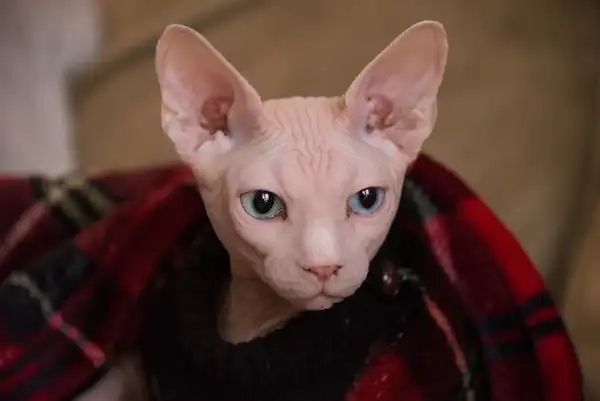
Felidae · CAT
Peterbald
🌟 You may have met one
The Peterbald looks like a Sphynx but is genetically completely different: Sphynx hairlessness comes from a recessive KRT71 mutation (same gene as Devon Rex), while the Peterbald inherits the dominant HR gene from the Donskoy. Because HR is dominant, one copy is enough — which is why Peterbald kittens can be born in five distinct coat grades: bald, flock, velour, brush and straight.
Overview
The Peterbald (彼得秃猫) is a medium-sized cat breed weighing 3–5 kg with a 12–15-year lifespan. A modern hairless breed created in Saint Petersburg in 1994 by crossing Donskoy with Oriental Shorthair — hence the name (Peter + bald). Long, elegant, oriental-type body; hairless to nearly hairless. Extremely outgoing, chatty and clingy — the 'oriental-type hairless cat'.
Feeding
Fast metabolism — high-protein food in 3-5 small meals a day.
Exercise
High energy; loves climbing, jumping and interactive play.
Grooming
Weekly warm-water wipe or bath; clean ears often, and keep warm.
Health
Very cold-sensitive and UV-sensitive; less prone to EDA than Donskoy but still watch dental development.
Gallery
A closer look at the Peterbald
From origins and personality to daily care and health — helping you judge whether this little companion is really the one for you.
Origin & history
1994 Saint Petersburg: Donskoy meets Oriental Shorthair
Origin & history
1994 Saint Petersburg: Donskoy meets Oriental Shorthair
The Peterbald is **one of the youngest hairless cat breeds in the world**, created in 1994 by Russian breeder **Olga S. Mironova** in Saint Petersburg.
**The goal**: By the late 1980s Russia already had its own indigenous hairless breed, the **Donskoy**, from a spontaneous mutation in Rostov-on-Don. Mironova wanted to put the Donskoy's hairless gene into the elegant, oriental body type of the **Oriental Shorthair** — creating a hairless oriental cat.
**The founding cross**: In 1994 the Donskoy male **Afinoguen Myth** was mated to the Oriental Shorthair female **Radma vom Jagerhof**. Two of their kittens — **Mandarin iz Murino** and **Muscat iz Murino** — became the foundation stock of the breed.
**The name**: Peter (Saint Petersburg) + bald — literally 'the bald cat of Peter'.
**Registry recognition**: - **WCF**: 1996 - **TICA**: 2005 (Championship in 2008) - **CFA**: 2009 (Miscellaneous), 2014 Provisional - **FIFe**: **not yet recognised** (too closely related to the Donskoy in registry terms)
**Genetics — the crucial contrast with Sphynx and Donskoy**: - **Sphynx**: hairlessness from a **recessive** mutation in **KRT71** (same gene as Devon Rex) — needs two copies to be hairless - **Donskoy**: hairlessness from a **dominant** locus (labelled HR) — one copy is enough - **Peterbald**: because it descends from the Donskoy, it inherits the **dominant HR** gene — genetically identical to Donskoy hairlessness and **completely different from Sphynx**
So: - Peterbald and Sphynx are **not interchangeable** — different mutations, different risks - Peterbald × Donskoy is genetically compatible (some registries allow it) - Peterbald × ordinary cat produces roughly half hairless kittens
Since 2018 most registries have restricted Peterbald × Donskoy outcrosses to preserve breed independence.
Looks & breed standard
Oriental body, five coat grades and huge ears
Looks & breed standard
Oriental body, five coat grades and huge ears
The biggest visual difference between a Peterbald and a Sphynx/Donskoy is **body type**: the Peterbald is a slender **oriental** cat, while Sphynx and Donskoy are semi-cobby and heavier-boned.
- **Body**: - Long, lithe, firmly muscled but light-boned - Adults 3-5 kg - Rear legs noticeably longer than the front — remarkable jumping ability - Tail long and whip-like
- **Head**: - Long, narrow wedge (mirroring the Oriental Shorthair) - Equilateral triangle from the front - Tapered chin and a long, straight, unbroken nose bridge
- **Ears**: - **Enormous, flared, set low** - Wide-based, pointed tips - Among the largest ears relative to head size in the cat world (like the Oriental Shorthair)
- **Eyes**: - Large, almond-shaped, slightly slanted - Vivid colours — blue, green, gold, odd-eyed
- **Paws**: **long-fingered ('monkey paws')** — remarkable dexterity for grasping small objects
**Five official coat grades (unique to Peterbald)**: Because HR expression varies, kittens can be born at any level: 1. **Bald / Ultra-bald**: fully hairless (often no whiskers or eyebrows), rubbery skin 2. **Flock**: hairs <2 mm, peach-skin feel 3. **Velour**: 2-5 mm velvet-like fuzz 4. **Brush**: >5 mm curly wiry hairs 5. **Straight**: full coat, no HR — visually identical to an Oriental Shorthair
**Note**: a Peterbald's coat grade **can change before age 2** — a flock kitten may become bald, or vice versa. Only Bald / Flock / Velour / Brush are shown; Straight-coats are used for breeding.
**All colours and patterns are accepted**, including colorpoint (from Oriental blood) and ghost tabby visible on velour/brush coats.
Personality in depth
Oriental temperament amped up — clingy, chatty and busy
Personality in depth
Oriental temperament amped up — clingy, chatty and busy
The Peterbald combines the **Oriental / Siamese personality** with the **hairless-cat social intensity** — even more extroverted, more vocal, more clingy, more active than either alone.
**Key traits**: 1. **Extreme clinginess**: follows you room to room, climbs into bed, headbutts constantly, demands a lap. Among the **most cuddle-obsessed** breeds 2. **Very vocal**: - Voice similar to a Siamese (sharper timbre), louder than a Sphynx - Holds all-day 'conversations' — talks back when spoken to - Yowls loudly when left alone — a real neighbour issue 3. **High intelligence**: - Can learn 10+ cues - Uses its **long fingers** to open drawers, flick switches, twist knobs - Child-lock everything openable 4. **Friendly with strangers**: greets guests at the door 5. **Gentle with children**: patient with sensible handling 6. **Great with cats and dogs**: excellent multi-pet choice
**Social needs**: - Very high — do not leave alone more than 5 hours - **Must be kept in pairs or with another friendly pet** - A solo Peterbald develops serious anxiety: overgrooming (licking the bare skin raw), yowling, destructiveness
**Compared with Sphynx**: - Peterbald is **slimmer, busier and more athletic** — needs more vertical space - Sphynx is **sturdier, calmer and more lap-cat**
**Not for**: - Owners seeking an independent, aloof cat - Solo owners frequently away - Small apartments with thin walls (the vocalisation will annoy neighbours)
Daily care
Skin management, warmth and frequent meals
Daily care
Skin management, warmth and frequent meals
Being (nearly) hairless makes Peterbald care **completely different** from an ordinary cat and very similar to Sphynx skin management:
**1. Skin care (the priority)**: - **Heavy sebum production** — with no fur to absorb it, oil builds up on the skin - **Warm-water wipe or bath weekly** using a mild, pet-safe shampoo - Or use **baby wipes** on folds (neck, armpits, belly) - Avoid harsh chemicals or fragrance-heavy cleansers - **Dark brown spots** are usually blocked sebum ('cat acne') — treat with a mild antibacterial wipe
**2. Warmth**: - Hairless + thin subcutaneous fat = **very cold-sensitive** - Winter room temperature must exceed 23°C - **Sweaters work** (won't tangle a hairless cat) - Provide heated beds, blankets and multi-layer soft bedding - Keep away from AC drafts and cold tiles
**3. UV protection**: - Bare skin burns easily - Long stretches on a sunny balcony or window can cause **feline sunburn** (redness, peeling) - Draw curtains during peak sun - Do not carry outside at midday in summer
**4. Diet**: - **High metabolism** (rapid heat loss with no coat) - **3-5 small meals per day** - Cat food with >38% protein - Plenty of fresh water — a fountain helps
**5. Ear cleaning**: - No fur in the ear canals either — sebum builds up quickly - **Clean ears 1-2 times weekly** with a pet-safe otic solution
**6. Claws and whiskers**: - Long, fine claws — offer multiple scratchers (vertical + horizontal) - **Whiskers may be entirely absent** (in bald grades) — perfectly normal
**7. Alone-time tolerance**: **low** — no more than 5 hours solo.
Health & lifespan
Skin issues, cold sensitivity, UV, and inherited EDA risk
Health & lifespan
Skin issues, cold sensitivity, UV, and inherited EDA risk
The Peterbald's health concerns cluster around its **hairless skin** and its **oriental ancestry**:
**1. Skin disease**: - **Malassezia dermatitis** — like Sphynx and Devon Rex, high sebum makes seborrhoeic dermatitis and Malassezia infection common. Treat with antifungals and regular bathing - **Feline acne / folliculitis** from blocked sebum - **Sun-related skin cancer** (squamous cell carcinoma) with prolonged UV exposure
**2. Cold and respiratory infections**: - No coat + short coat = higher winter cold risk - Maintain room temperature >23°C
**3. Ectodermal dysplasia (EDA) risk inherited from Donskoy**: - The Donskoy HR gene is associated not only with hairlessness but also with **ectodermal dysplasia** — dental hypoplasia, early loss of deciduous teeth, missing permanent teeth, abnormal skin glands - **Peterbald incidence is markedly lower than Donskoy** thanks to Oriental dilution - Still, watch dental development; missing teeth in adulthood can affect eating - Breeders should avoid tight inbreeding
**4. HCM (hypertrophic cardiomyopathy)**: - Elevated risk from Oriental ancestry - Recommend cardiac ultrasound at ages 1 and 3
**5. PRA / PK-Def**: - Oriental ancestry may introduce these — UC Davis panel is prudent
**6. Anaesthetic risk**: - Hairless cats lose heat rapidly and drop body temperature - Anaesthesia requires **active warming** - Pre-op cardiac ultrasound and coagulation screen
**7. Lifespan**: - Average **12-15 years** - Well-managed lines reach 16-18
**Buyer checklist**: - Ask for **HCM ultrasound + PK-Def + PRA-rdAc** reports - Discuss any EDA cases in the line (dental history) - **Reject unusually cheap Peterbalds** (<$1500 in the US is a red flag) - Prefer WCF / TICA / CFA registered breeders - Do not take kittens home before 12 weeks — hairless kittens need extended nursing
Fit for your space
For companionship-rich, warm, low-allergen homes
Fit for your space
For companionship-rich, warm, low-allergen homes
**A Peterbald suits**: - Households with someone **home most of the day** (remote work, retirement, larger family) - Homes already containing friendly pets (Sphynx, Donskoy, Oriental, Siamese, Somali) - Owners wanting 'hairless + oriental body + interactive + relatively low allergen' - Warm indoor environments (>23°C in winter) - Buyers drawn to the specifically oriental-type hairless look - Owners willing to keep up intensive skin and ear care - Buyers who can afford HCM / PK-Def / PRA testing
**Not a good fit for**: - Solo owners frequently away from home - Homes without central heating - Owners unwilling to bathe, clean ears and dress the cat regularly - Apartments where a loud, chatty cat will disturb neighbours - Homes with unshaded direct-sun balconies (UV risk) - Family members who dislike the hairless appearance - Buyers unwilling to pay a high price
**Special notes**: - **Strict indoor housing** — bare skin is easily cut, chilled and sunburned - **Do not treat 'hairless = hypoallergenic' as an absolute** — Peterbalds still produce Fel d 1; they just spread less around the home. **Test in person before buying** - Keep in pairs or with a Sphynx/Oriental companion — solo Peterbalds are miserable - Never confuse with a Sphynx — Peterbald is **oriental (slim)**, Sphynx is **semi-cobby (sturdy)**; different genetics too - Do not attempt Peterbald × Donskoy or Peterbald × Sphynx crosses at home — most registries have blocked them for a reason
References
This is an educational overview — for specific health and care advice, please consult the authoritative sources below and your veterinarian.
- TICA — Peterbald Breed Standard国际猫协标准
- CFA — Peterbald Miscellaneous Class国际猫协标准
- WCF — Peterbald Breed Standard (PBD)国际猫协标准
- GCCF — Peterbald Preliminary Breed Standard国际猫协标准
- Filler et al. 2012 — Hairlessness in Donskoy/Peterbald genetics学术研究
- Gandolfi et al. 2010 — KRT71 mutation & feline hairless breeds学术研究
- Ahman & Bergström 2007 — Malassezia in hairless cat breeds学术研究
- UC Davis VGL — Feline HCM & PK-Def panel基因检测
- ICatCare — Peterbald breed profile综合科普
- Wikipedia — Peterbald cat综合科普