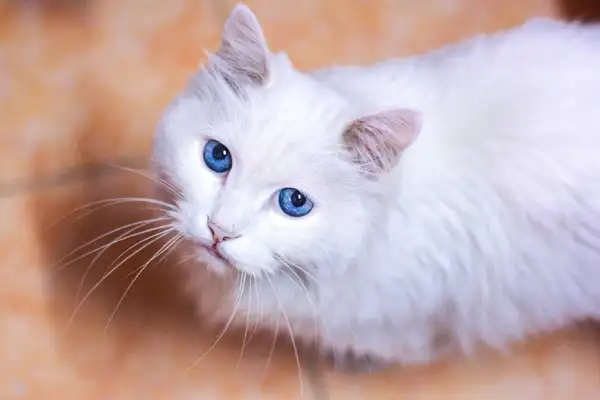
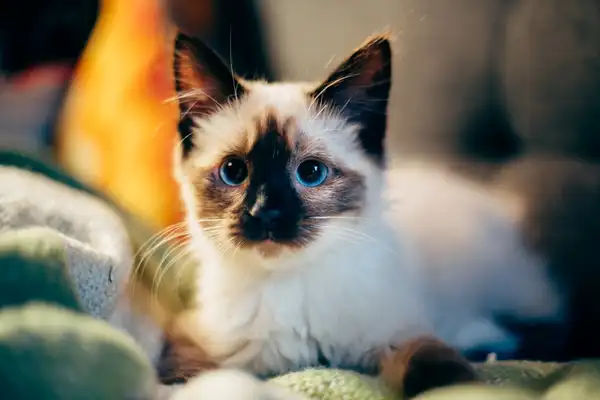
Felidae · CAT
Japanese Bobtail
🌟 You may have met one
The Maneki-neko (beckoning cat) statues found in shrines and shops all over Japan are based on the Japanese Bobtail — especially the Mi-ke tri-colour female. Legend has it that in 17th-century Tokyo, a bobtailed Mi-ke at Gotokuji Temple waved a lord inside just before a lightning strike hit where he had been standing, launching the whole lucky-cat tradition.
Overview
The Japanese Bobtail (日本短尾猫) is a medium-sized cat breed weighing 3–4.5 kg with a 12–16-year lifespan. An ancient native Japanese breed with a naturally short, rabbit-like pom-pom tail. The Mi-ke (tri-colour: white + red + black) pattern is the original inspiration for the famous Maneki-neko lucky cat. Lively, chatty and dog-loyal — often called 'the corgi of cats'. The short-tail gene is dominant but harmless, completely unlike the lethal Manx mutation.
Feeding
Standard high-protein cat food; moderate metabolism, 2-3 meals a day.
Exercise
High energy — enjoys fetch, jumps and interactive play.
Grooming
Shorthair is easy; longhair coat needs combing 2-3 times a week. Moderate shedding.
Health
Exceptionally healthy breed — no Manx-style spinal issues; the short tail is genetically safe.
Gallery
A closer look at the Japanese Bobtail
From origins and personality to daily care and health — helping you judge whether this little companion is really the one for you.
Origin & history
A thousand-year-old cat and the original Maneki-neko
Origin & history
A thousand-year-old cat and the original Maneki-neko
The Japanese Bobtail has been on the Japanese islands for **at least 1,000 years** and is one of East Asia's most iconic native breeds.
**Historical records**: - **8th century, Nara period**: Chinese Tang-dynasty cats — including bobtailed individuals — were sent to the Japanese imperial court to protect sutras from mice - **10th century**: Sei Shonagon's *Pillow Book* describes an emperor's beloved white bobtailed cat - **17th century, Edo period**: ukiyo-e prints and folding screens repeatedly show short-tailed tri-colour cats
**The Maneki-neko legend**: A 17th-century story from Gotokuji Temple in Tokyo tells of a tri-colour bobtail that raised its paw and beckoned Lord Ii Naotaka into the temple just before lightning struck where he had been standing. In gratitude the temple became a prayer site, and the Maneki-neko tradition was born. All three iconic Maneki-neko traits — **the raised paw, Mi-ke tri-colour, and short tail** — come straight from the Japanese Bobtail.
**Coming to the West**: American breeder Elizabeth Freret imported three Japanese Bobtails from Japan in 1968 and began systematic breeding.
- **CFA**: shorthair recognised in **1976**, longhair variety in **1993** - **TICA**: recognised in **1979** - **FIFe**: recognised in **1989** - **GCCF**: preliminary recognition in **2013**
**The short-tail gene**: Xu et al. (2016, *PLOS Genetics*) confirmed that the Japanese Bobtail's tail is caused by a mutation in **HES7**, entirely different from the **T-box** mutation in the Manx. This is critical: - **Manx**: homozygous lethal (M/M), heterozygous carriers (M/m) show 20-30% Manx syndrome (spina bifida, incontinence, pelvic defects) - **Japanese Bobtail (HES7)**: incomplete dominance, low homozygous lethality, spine/rectum/pelvis all normal
The Japanese Bobtail is therefore the **only genetically 'safe' short-tailed domestic breed**.
Looks & breed standard
Rabbit-tail pom-pom, Mi-ke and a triangular face
Looks & breed standard
Rabbit-tail pom-pom, Mi-ke and a triangular face
The Japanese Bobtail's signature look rests on three details: **the tail, the Mi-ke pattern, and the triangular head**.
- **Tail (the core feature)**: - Naturally short, only **3-10 cm long** (vs 20-25 cm in an ordinary cat) - **Curled, kinked and fluffy** — like a rabbit tail or pom-pom - **No two Bobtail tails are alike** (curve, angle, shape) — CFA standard: 'tail shape is not scored, only its presence and length' - Vertebrae reduced to 3-8 (vs 18-23 in an ordinary cat)
- **Head**: **equilateral triangle** — neither round nor wedge-shaped - Long straight nose bridge with no stop - High cheekbones and a tapering muzzle
- **Ears**: **large, upright**, set high with a wide base and clearly separated
- **Eyes**: **large oval, slightly slanted** (an oriental accent) — vivid gold, green, blue or odd-eyed
- **Body**: **long, lean, firmly muscled**, adults 3-4.5 kg
- **Rear legs distinctly longer** than the front, producing a front-low, rear-high stance and remarkable leaping power
**Colours**: **Mi-ke (white + red + black tri-colour)** is the classic and most auspicious pattern. Also accepted: - Bicolour (white + one solid) - Solid (black, white, red) - Tortoiseshell and torbie - Tabby and torbie-tabby - **Longhair variety (Japanese Bobtail Longhair)** — semi-long coat with a chest ruff and a more dramatic tail pom-pom
**Not accepted**: colorpoint patterns, because bringing in Siamese blood would introduce other health risks.
Personality in depth
Chatty, clingy, smart and dog-loyal
Personality in depth
Chatty, clingy, smart and dog-loyal
The Japanese Bobtail is often nicknamed **the 'corgi of cats'** — short-tailed, active, interactive, chatty, and always trailing its owner.
**Key traits**: 1. **Chatty**: after the Siamese, it is one of the **most talkative pedigreed breeds**, but with a **soft voice** — described as chirping, muttering, and singing rather than screaming. It maintains a running low-volume conversation with you 2. **Dog-like loyalty**: - Actively learns fetch — carries small toys, balls or paper wads around - Follows the owner from room to room - Runs to the door to greet returning family 3. **Very high intelligence**: capable of learning 10+ cues (sit, high-five, jump obstacles, hit a button) 4. **Great with children**: **CFA lists it among the top family-friendly breeds** — tolerant of noise, gentle handling and toddler energy (still teach children to leave the tail alone) 5. **Friendly to other cats and dogs**: an excellent multi-pet choice 6. **Adaptable to travel**: unusually well-adjusted to new environments and one of the few breeds that walks nicely on a harness
**Social needs**: - **Medium-to-high companion time** — 30-45 minutes of active engagement daily - Left alone more than 6 hours, it will protest (loud calling, scratching doors, opening drawers) - Best kept **in pairs**, with a friendly dog or with another active cat
**Not a match for**: - Households seeking a quiet, decorative pet - People at work all day with no companion animal at home - Homes with a fragile senior cat that needs absolute quiet - Neighbours or roommates intolerant of a talkative cat
Daily care
Simple upkeep, high interaction, plenty of enrichment
Daily care
Simple upkeep, high interaction, plenty of enrichment
The Japanese Bobtail is genuinely **easy to keep** — healthy, hardy, low-maintenance. The main investment is your time for play.
**1. Grooming**: - **Shorthair**: single coat, comb once a week; moderate shedding - **Longhair**: comb 2-3 times a week, focusing on the chest ruff and tail pom-pom - Rarely needs bathing
**2. Tail care**: - **Do not tug, grab or squeeze the short tail** — the joint area is delicate - Very short tails can occasionally trap faeces around the vent; check hygiene regularly - **Never 'straighten' or manipulate the tail** — it is a genetic trait, not a defect
**3. Diet**: - Standard high-protein cat food - Moderate metabolism, 2-3 meals per day - Active enough to allow free-feeding, but monitor body condition
**4. Exercise**: - 30-45 minutes of interactive play daily - Loves **fetch, wand toys, laser + treat games** - Needs **vertical space** — cat trees, shelves, open furniture pathways - Strong rear legs make it an exceptional jumper; plan your décor accordingly
**5. Training**: - **One of the few cat breeds that clicker-trains reliably** - 5-10 minutes daily can teach sit, shake, jump-through, fetch and name response - Harness training is realistic and enriching — this is a genuine 'walkable' cat breed
**6. Claws, ears, teeth**: standard care. Overall dental health is solid.
Health & lifespan
No Manx syndrome, normal spine and superb overall health
Health & lifespan
No Manx syndrome, normal spine and superb overall health
The Japanese Bobtail is **one of the healthiest pedigreed cat breeds in the world**. CFA, TICA and FIFe all note in their breed files: 'no known breed-specific genetic diseases.'
**1. The short-tail gene (contrast with Manx)**: - Mutation in **HES7** (Xu et al. 2016, PLOS Genetics) - **Incomplete dominance**: both homozygotes (BB) and heterozygotes (Bb) are viable and fertile - **No spina bifida, no tethered cord, no bladder/bowel defects** — completely unlike the Manx T-box mutation - Manx **M/M is embryonic lethal; M/m carries a 20-30% risk of Manx syndrome** - The Japanese Bobtail's short tail is a genuinely **safe** trait, refined by centuries of natural and artisan selection
**2. Other health notes**: - **HCM**: occasional, lower rate than most pedigreed cats - **PKD (polycystic kidney disease)**: extremely rare - **Dental health**: moderate to good - **Allergies / dermatology**: uncommon
**3. Lifespan**: - Average **12-16 years** - Well-bred individuals routinely 18-20 - Native Japanese moggy bobtails frequently reach 20+
**4. Mi-ke genetics**: - Tricolour is X-linked, so **nearly all Mi-ke cats are female** - The rare Mi-ke male is typically **XXY (Klinefelter's)** — usually sterile with shorter lifespan - Japanese culture treats them as ultra-rare talismans but they have **no breeding value**
**5. Breeder guidance**: - Annual HCM ultrasound - Maintain gene-pool diversity - Never cross to Manx — the T-box mutation would introduce lethal defects
Fit for your space
A great fit for families, kids, multi-pet homes and beginners
Fit for your space
A great fit for families, kids, multi-pet homes and beginners
**A Japanese Bobtail fits well with**: - **Families with children** — CFA-endorsed family breed, tolerates noise and handling (but children should still be taught to leave the tail alone) - **Multi-pet homes** — friendly with cats and dogs - **First-time owners** — healthy, stable, low-maintenance - Households wanting **hands-on interaction** — the cat can be trained, plays fetch, and can be walked on a harness - Buyers drawn to the cultural symbolism (Maneki-neko, Mi-ke) - Apartments and houses alike, so long as you can give 30+ minutes of daily engagement
**Not a good fit for**: - Owners seeking a quiet, decorative cat - People at work all day with no companion animal - Homes with a fragile senior cat that needs total quiet - Neighbours or flatmates who can't tolerate a talkative cat
**Special notes**: - **The short tail is genetic, healthy and painless** — do not ask a vet to 'correct' it - **Do not confuse this breed with the Manx** — Manx tails come with disease; Japanese Bobtail tails do not - **Almost all Mi-ke are female** — any breeder selling a 'Mi-ke male' should provide detailed genetic testing - **Strict indoor housing** (curiosity + jumping ability make escape easy) - **Two cats or a canine companion** is ideal — solo bobtails get bored fast - **Harness-walking is realistic** — start young; this is one of the few breeds truly suited to outings
References
This is an educational overview — for specific health and care advice, please consult the authoritative sources below and your veterinarian.
- CFA — Japanese Bobtail Breed Article国际猫协标准
- TICA — Japanese Bobtail Breed Standard国际猫协标准
- FIFe — Japanese Bobtail Breed Standard (JBT)国际猫协标准
- GCCF — Japanese Bobtail Breed Standard of Points国际猫协标准
- Xu et al. 2016 PLOS Genetics — HES7 mutation causing short tail in Japanese Bobtail学术研究
- Buckingham et al. 2013 J Hered — Manx T-box mutation contrast学术研究
- ICatCare — Japanese Bobtail breed profile综合科普
- Wikipedia — Japanese Bobtail & Maneki-neko origin综合科普
- Gotokuji Temple (Tokyo) — Maneki-neko historical site综合科普
- UC Davis VGL — Feline Coat Color & Tortoiseshell/Mi-ke Genetics基因检测