Felidae · CAT
Turkish Angora
🌟 You may have met one
A Turkish national treasure. Its most iconic look is a snow-white long coat with odd eyes (one blue, one gold). Ankara Zoo in Turkey still runs a dedicated purebred Angora breeding program under state protection.
Overview
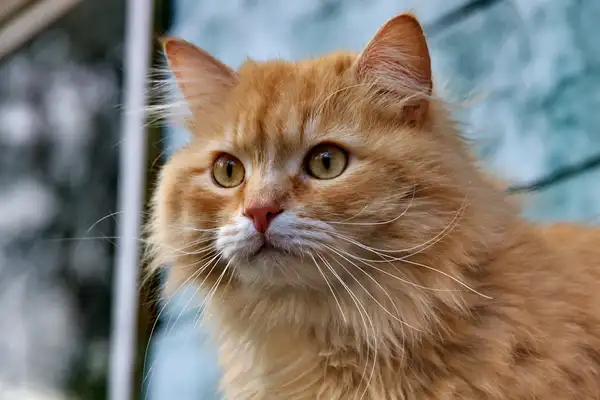
The Turkish Angora (土耳其安哥拉) is a medium-sized cat breed weighing 2.5–5 kg with a 12–18-year lifespan. One of the oldest long-haired cat breeds, famous for its silky white coat and the classic odd-eyed (one blue, one gold) look. Lively and clever, it loves interacting with people.
Feeding
Fast metabolism — feed a high-protein cat food supplemented with a moderate amount of wet food.
Exercise
Energetic and playful; loves chasing toys and climbing, so a cat tree is recommended.
Grooming
The silky, single-layer long coat rarely mats — brushing 1-2 times per week is enough.
Health
Solid-white blue-eyed or odd-eyed individuals are prone to hearing problems, but the breed is generally healthy and long-lived.
Gallery
A closer look at the Turkish Angora
From origins and personality to daily care and health — helping you judge whether this little companion is really the one for you.
Origin & history
Origin & history
The Turkish Angora (Turkish: Ankara kedisi) comes from the Ankara region in central Turkey and is **one of the oldest documented long-haired cat breeds**. Records of them at the Ottoman court date back to the 16th century; in the 1520s the Italian traveler Pietro della Valle described "silky-coated white cats from the Ankara region" in his letters — roughly a hundred years earlier than his descriptions of the Persian.
During the 17th and 18th centuries, Angoras were sent as "exotic treasures" to European courts in large numbers — they appear in portraits alongside Louis XIV, Marie Antoinette, and Napoleon. In the late 19th century, Angoras were extensively crossed with Persians in Europe (particularly in Britain), and pure-blooded Angoras were **nearly driven to extinction** on the continent.
After World War II, the Turkish government recognised the crisis facing this national treasure. **Ankara Zoo** had already taken on the task of pure-blooded Angora conservation from 1917 — with special emphasis on the white, odd-eyed lineage. In 1962 American breeder Walter Grant imported the first white Angoras from Ankara Zoo to the United States. The CFA accepted registration in 1968 (initially white only), TICA followed in 1978, and other colours were certified over time. To this day **Ankara Zoo still maintains a dedicated Angora breeding facility**, and white odd-eyed lines require Turkish government approval before they can leave the country.
Looks & breed standard
Looks & breed standard
The defining feature of the Turkish Angora is its **single-layer, silky long coat** — it is one of the very few long-haired cats without a pronounced undercoat (Persians, Maine Coons, and Norwegian Forest Cats all have double coats). The texture feels like silk rather than wool, which brings two big benefits: 1. **Rarely mats**: brushing 1-2 times a week is enough — many times simpler than a Persian 2. **Low shedding**: without a dense undercoat, seasonal shedding (spring/autumn) is far less dramatic than a Persian or Maine Coon
The body is small-to-medium (2.5-5 kg), long and elegant — a semi-foreign type completely unlike the round, chunky Persian. The head is a moderately long wedge, with large almond eyes (slightly slanted, set high) and large upright ears. The tail is long and flexible, with the long fur forming a plume.
**Odd eyes** are the most iconic look — one blue eye and one gold — but this only appears in solid-white individuals, resulting from co-dominant expression of the W (white) gene and blue eyes. The same genetic combination causes **congenital deafness in about 65-85% of solid-white blue-eyed Angoras** (Bergsma & Brown 1971, J Hered), while roughly half of odd-eyed individuals are deaf on one side (the blue-eyed side). The CFA accepts all traditional colours (excluding pointed patterns and chocolate/cinnamon).
Personality in depth
Personality in depth
The Turkish Angora is the polar opposite of the Persian in temperament — **active, extroverted, interactive, and opinionated**. The CFA breed description sums it up as lively, intelligent, socially engaging, and energetic.
It bonds closely with family and will follow you from room to room. It is somewhat wary of strangers but generally does not hide. It retains a strong climbing instinct and loves the top perch of a cat tree or the top of a bookshelf. It also carries the **water-loving genes** of ancient Turkish ship cats — many individuals will play in water bowls or jump into bathtubs (a trait even more pronounced in its close relative, the **Turkish Van**, the famous "swimming cat").
High intelligence: it can open drawers, learn to fetch, and be leash-trained. It is also one of the few domestic cats that willingly takes on **the role of "top cat"** in a household — it needs a leadership position within a cat group, so cohabiting with another dominant cat may cause conflict.
Friendly with children and dogs while retaining independence. Suits owners looking for an "elegant, active, moderately affectionate" pet.
Daily care
Daily care
Compared with other long-haired cats, day-to-day care of the Turkish Angora is **noticeably simpler**:
1. **Grooming**: A pin brush plus fine-tooth comb 1-2 times a week is enough. The silky single-layer coat rarely mats and doesn't need daily brushing. During shedding season (spring/autumn) step it up to every 2-3 days.
2. **Care of white coats**: White fur easily yellows from tear stains, saliva, urine, and food. You can use a whitening cat shampoo with a blue tint, or simply accept that "snow-white in youth, slightly yellow in middle age" is normal.
3. **Diet**: A medium-cat high-protein formula is fine. Angoras are long-lived (commonly 15-18 years); in senior years, switch to a senior formula plus joint support.
4. **Exercise & environment**: At least one cat tree, plus a windowsill or bookshelf they're allowed to climb. Angoras need real vertical space — a purely floor-level apartment doesn't suit them.
5. **Teeth**: Moderate incidence of gingivitis after middle age; annual oral checks recommended.
6. **Hearing testing**: All white blue-eyed / odd-eyed Angora kittens **should have BAER hearing testing** so owners know whether they have unilateral or bilateral deafness (deaf cats need targeted care and cannot be free-roaming).
Health & lifespan
Health & lifespan
The Turkish Angora is **one of the healthiest and longest-lived pedigree domestic cats** — 15-18 years is common. Still, three specific breed issues stand out:
1. **Congenital sensorineural deafness**: The most well-known issue. Co-dominant expression of **W (dominant white) plus blue eyes** is often accompanied by abnormal development of the cochlear stria vascularis, resulting in bilateral deafness in 65-85% of blue-eyed white cats and unilateral deafness (blue-eyed side) in about 40-50% of odd-eyed white cats. Gold-eyed white cats have about a 20% deafness rate (Strain 2004, Vet J review). Non-white individuals hear normally.
2. **Hypertrophic cardiomyopathy (HCM)**: Moderate incidence; no Angora-specific MYBPC3 mutation has been mapped. Breeders should perform annual cardiac ultrasound screening.
3. **Hereditary Ataxia**: An Angora-specific autosomal recessive disorder. Homozygous kittens develop tremors and unsteady gait at 2-4 weeks old and almost always die before weaning (Sponenberg 1988, J Hered). No genetic test is currently available; breeders must trace pedigrees to avoid it.
Additionally, from middle age onward, watch dental health and weight (Angoras are usually active enough that obesity is uncommon).
Fit for your space
Fit for your space
The Turkish Angora is **one of the more beginner-friendly** long-haired cats — healthier than a Persian, more independent than a Maine Coon, easier to care for than a Sphynx, and quieter than a Siamese.
**Good fit for**: - Homes with some vertical space (need not be large, but should have a cat tree, cat wall, or bookshelf top) - Owners wanting an "elegant long coat + active + affectionate + low grooming" pet - Multi-person / multi-pet households with children or dogs (usually gets on well) - Owners who are home moderately (4-6 hours a day) - Detached houses / homes with gardens (with escape-proofing)
**Not a fit for**: - Owners wanting a "quiet, low-energy" cat - Solo living + no other pets + long hours away from home - Homes that already have a dominant / highly territorial cat (the Angora needs the "top cat" position) - **A white blue-eyed individual, if deaf, must never be free-roamed / kept outdoors** (they can't hear cars, dogs, or predators)
Both CFA and TICA recommend the Turkish Angora as an "entry-level long-haired cat breed".
References
This is an educational overview — for specific health and care advice, please consult the authoritative sources below and your veterinarian.
- CFA — Turkish Angora breed article国际猫协标准
- TICA — Turkish Angora Breed Group国际猫协标准
- FIFe — Turkish Angora Breed Standard (TUA)国际猫协标准
- Bergsma & Brown 1971 J Hered — White cats and deafness学术研究
- Strain 2004 Vet J — Deafness prevalence in white cats学术研究
- Sponenberg 1988 J Hered — Hereditary ataxia in Turkish Angora学术研究
- Lipinski et al. 2008 Genomics — Cat breed origins学术研究
- Ankara Zoo — Turkish Angora conservation program官方档案
- ICatCare — Turkish Angora breed profile综合科普