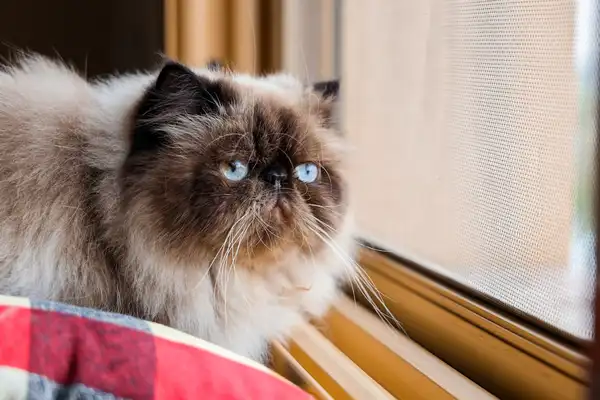
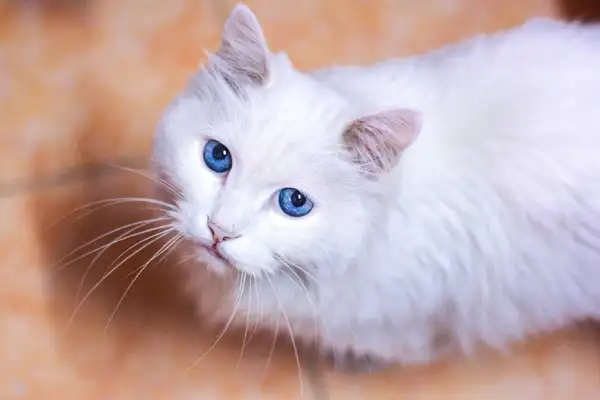
Felidae · CAT
Persian
🌟 You may have met one
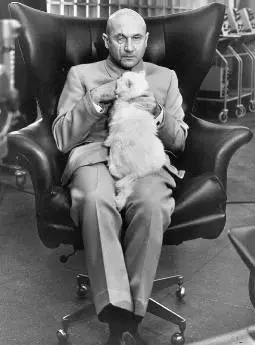
The white long-haired cat that Blofeld strokes in the *007* films — the near-synonym for "Bond villain cat" — is a Persian.
Overview
The Persian (波斯猫) is a medium-sized cat breed weighing 3–5.5 kg with a 12–17-year lifespan. The aristocrat of the cat world — a flowing long coat, a flat face, and big eyes. Personality is quiet and elegant, not playful, and requires an owner willing to invest time in coat care.
Feeding
The flat face needs a shallow bowl; a long-hair-specific hairball formula plus periodic malt-paste supplementation is recommended.
Exercise
Low exercise needs — gentle play is the way.
Grooming
Daily brushing is required or the coat mats fast; monthly baths; wipe eyes daily.
Health
Polycystic kidney disease, HCM, respiratory and skin issues are common. Care costs rank among the highest for domestic cats.
Gallery
A closer look at the Persian
From origins and personality to daily care and health — helping you judge whether this little companion is really the one for you.
Origin & history
Origin & history
The Persian is the earliest documented long-haired domestic cat deliberately selected by humans. In the early 17th century, Italian nobleman and explorer Pietro della Valle brought back a group of "long-haired, gray, silky-shouldered" cats from Persia (modern-day Iran), and together with the Angoras that French explorer Nicolas-Claude Fabri de Peiresc brought back from Turkey, they laid the foundation of the European long-haired cat.
At the 1871 first-ever cat show at London's Crystal Palace, Persians shared top billing with British Shorthairs. Queen Victoria herself kept two blue Persians, which pushed the breed to the peak of fashion.
From the 1940s to 1950s, American breeders pursued the "extreme face" (peke-face / ultra-face), pushing the nose upward and moving the eyes toward the forehead — the birth of the flat-faced Persian we know today. This shift split the CFA and European GCCF, with Europe still favoring the more moderate doll-face (traditional face) — the direction most aligned with health-focused breeding today.
Looks & breed standard
Looks & breed standard
The CFA groups Persian colors into 7 divisions: Solid, Silver/Golden, Smoke, Tortoiseshell/Parti-color, Bi-color/Calico, Himalayan (colorpoint / Himalayan cat), and Tabby — spanning more than 60 official combinations.
Face types come in three levels: the traditional doll-face (visible nose bridge with a slight stop), show-type (nose and eyes nearly on the same horizontal line), and peke-face or ultra-face (nose above the lower eyelid, the most extreme show grade). Recent CFA standards emphasize open nostrils to reduce breathing issues.
Coat length reaches 10–15 cm — one of the longest in domestic cats — and requires daily grooming.
Personality in depth
Personality in depth
The Persian is one of the least active domestic cats. The CFA's breed description sums up its personality with three words — "quiet, sweet, gentle." It would rather lie still on a windowsill or a lap for hours and rarely vocalizes.
Sensitivity to strangers and noise is above average — slow to warm but with a long memory; once trust is established, the Persian bonds long-term. It doesn't like being picked up or having its belly rubbed — it prefers to come to you when you sit down.
Because activity drive and vigilance are low, the Persian relies on the owner's judgment for care — the classic "if you don't manage it, it won't drink water all day" cat. Owners must actively promote hydration and movement.
Daily care
Daily care
The Persian's daily grooming is one of the most time-consuming among domestic cats: 5–10 minutes of daily brushing is required, or mats form quickly and end in shave-downs. Use a steel-pin brush plus a long-hair fine-tooth comb, working through torso, armpits, inner thighs, and tail base one section at a time.
The flat face bends nasolacrimal ducts, causing tear overflow and brown stains. Wipe the eye area daily with warm-water sterile gauze to reduce periocular dermatitis and pigment deposits.
Bath every 3–4 weeks, using a low-irritant long-hair shampoo, and dry the coat completely afterward — a wet coat invites fungal infection (especially ringworm). In hot summers, a strategic shave of the belly and inner thighs can help with heat dissipation.
Health & lifespan
Health & lifespan
Three breed diseases matter most: Polycystic Kidney Disease (PKD), Brachycephalic Obstructive Airway Syndrome (BAOS), and Hypertrophic Cardiomyopathy (HCM).
PKD is the Persian's historically highest-prevalence hereditary disease. A 1990s survey put the PKD1 mutation positivity rate in North American Persians at 38% (Biller et al. 1996 JAVMA). More than 20 years of genetic screening under responsible breeding has pushed positivity below 5%, but always insist on the parents' PKD genetic reports before buying.
BAOS comes from the flat face — narrow nostrils, elongated soft palate, everted nostrils — causing chronic breathing difficulty, snoring, and poor exercise tolerance. UFAW and the UK RCVS both list extreme brachycephaly as a welfare-risk trait.
HCM is common in Persians and Exotics; annual cardiac ultrasound catches it early.
Fit for your space
Fit for your space
The Persian is a strictly indoor companion cat. Its thermoregulation is weak (long coat + flat face) — hot, humid summers cause overheating, while cold, dry winters bring skin fungal issues. Ideal indoor temperature 20–26°C, humidity 45–60%.
Low activity means space isn't a constraint, but furniture stability is — the Persian isn't good at leaping or complex routes. Give it low, wide-platform cat furniture rather than tall skinny cat trees, and keep jump heights under 1.2 m.
Slow reactions and high care needs make the Persian unsuitable for outdoor life or long-term coexistence with large dogs or highly active children. It needs a quiet, temperature-stable home with someone dedicated to grooming.
References
This is an educational overview — for specific health and care advice, please consult the authoritative sources below and your veterinarian.
- CFA — Persian Breed Standard官方猫协会
- TICA — Persian Breed Standard国际猫协标准
- GCCF — Persian Standard of Points英国猫协标准
- ICatCare — Persian breed profile综合科普
- Biller et al. 1996 JAVMA — Prevalence of PKD in Persians学术研究
- UFAW — Brachycephaly and Health Issues in Persian Cats动物福利
- Schlueter et al. 2009 J Feline Med Surg — Brachycephalic feline noses学术研究
- Bond Villain Cats — Blofeld's Persian & the trope流行文化
- RVC VetCompass — Brachycephalic Cats Study流行病学