Felidae · CAT
Maine Coon
🌟 You may have met one
Mrs. Norris, Filch's watchful cat in Harry Potter, is a Maine Coon. The breed is also a regular in the Guinness records for longest domestic cat, with body lengths often over a meter.
Overview
The Maine Coon (缅因猫) is a giant cat breed weighing 5–11 kg with a 12–15-year lifespan. The giant of the domestic cat world — adult males can top 10 kg. Gentle, friendly with people and other animals, and rightly nicknamed the "gentle giant."
Feeding
A high-protein formula designed for large cats, with joint support in mind.
Exercise
Plenty of energy for chasing and climbing — a large, sturdy cat tree is a must.
Grooming
Long, dense coat — brush 2-3 times a week and step it up during seasonal shedding.
Health
Prone to hypertrophic cardiomyopathy, hip dysplasia, and spinal muscular atrophy. Genetic screening is strongly advised.
Gallery
A closer look at the Maine Coon
From origins and personality to daily care and health — helping you judge whether this little companion is really the one for you.
Origin & history
From Maine barn cat to Best in Show at the 1895 cat show
Origin & history
From Maine barn cat to Best in Show at the 1895 cat show
The Maine Coon is one of the oldest naturally-occurring breeds in the United States. In 19th-century Maine port towns, long-haired ship cats — likely brought over on European Viking traders or English farmers' cats — crossed with local shorthairs and gradually formed a large, long-haired mouser tough enough to endure -30 °C winters. Maine farmers valued them as working cats and kept only the strongest, most cold-hardy individuals for breeding.
At the first American cat show, held in 1895 at Madison Square Garden in New York, a brown tabby Maine Coon named Cosey took Best in Show. The CFA still preserves Cosey's silver collar and medal.
The rise of the Persian in the early 20th century pushed the Maine Coon aside — some CFA officials even declared the breed "extinct" in the 1950s. Enthusiast groups like the Central Maine Cat Club and MCBFA (Maine Coon Breeders and Fanciers Association) revived the breed in the 1960s and 1970s, and the CFA fully re-recognized it in 1976.
Looks & breed standard
Massive frame + tufted ears + a plumed tail
Looks & breed standard
Massive frame + tufted ears + a plumed tail
The Maine Coon is one of the largest domestic cat breeds. Adult males average 6-10 kg, females 4-7 kg, and body length (excluding the tail) is typically 70-90 cm. They mature exceptionally slowly — 3 to 5 years to full size, about 2-3 years slower than most breeds.
Maine Coons regularly appear in the Guinness records for the longest domestic cat: Stewie (Mymains Stewart Gilligan) reached 123 cm in 2010, and Barivel measured 120 cm in 2018.
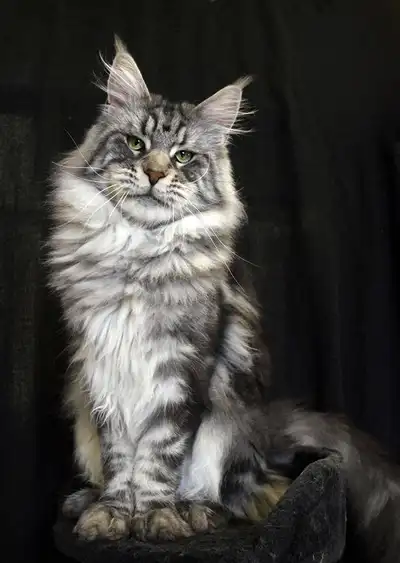
Signature features include a solid, square muzzle, broad forehead, large upright ears with lynx tips, snowshoe fur between the toes, and a bushy "raccoon tail" (the name Coon derives from raccoon). The double coat has a long, water-resistant outer layer over a short, dense undercoat. The CFA recognizes 75+ colors, but the classic look is still the brown tabby.
Personality in depth
Gentle giant: dog-like, interactive, water-loving
Personality in depth
Gentle giant: dog-like, interactive, water-loving
The Maine Coon is famously called a "gentle giant" — huge in size but gentle in temperament, rarely aggressive, and comfortable around children, dogs, and other cats. Both CFA and TICA breed profiles use the word "dog-like" to describe them: they can be trained to shake, fetch, and even walk on a leash outdoors.
Their voice isn't the high-pitched call of a Siamese — Maine Coons speak in low chirps and trills. They are expressive without being noisy.
One of the most charming quirks is a genuine love of water. Maine Coons will actively play in water bowls and sinks and often accept baths without protest. This traces back to their working history on ships and in snowbound farmyards, where the water-resistant double coat earned its keep.
Daily care
Weekly grooming + large-cat food + joint care
Daily care
Weekly grooming + large-cat food + joint care
The Maine Coon's double coat calls for moderate — not high — grooming: 2-3 times a week is enough, stepping up to every other day during spring and autumn shedding. Armpits, inner thighs, and the base of the tail are hot spots for tangles and deserve extra attention. They don't need daily brushing like a Persian.
A giant frame means higher daily calorie needs (an active adult can require 300-400 kcal/day) and a longer skeletal development window. Use a large-breed cat or kitten formula through 15-18 months, then switch to strict portion control as an adult — Maine Coons put on weight easily.
Joint care is central: from age one, add omega-3s, chondroitin, and glucosamine to reduce the risk of hip dysplasia and osteoarthritis. When shopping for a big cat tree, check platform weight ratings and slope carefully — Maine Coons shouldn't be jumping down from extreme heights.
Health & lifespan
Four-panel screen: MYBPC3-HCM, SMA, HD, PKD
Health & lifespan
Four-panel screen: MYBPC3-HCM, SMA, HD, PKD
The Maine Coon has one of the best-mapped genetic disease profiles among domestic cats, and every responsible breeder runs a four-panel screen:
1. **Hypertrophic Cardiomyopathy (HCM)**: caused by the A31P mutation in MYBPC3. Meurs et al. 2005 (HMG) first mapped this mutation in Maine Coons, estimating carrier rates around 30-35% and clinically affected rates around 5-10%. Managed with genetic testing plus annual cardiac ultrasound.
2. **Spinal Muscular Atrophy (SMA)**: a LIX1 gene deletion, reported by Fyfe et al. 2006 (Genome Res). Carrier rate is about 6-10%. Homozygotes develop progressive muscle wasting after 12-16 weeks of age, though lifespan can still be normal.
3. **Hip Dysplasia (HD)**: OFA data ranks the Maine Coon as one of the most-affected breeds (~18-24%).
4. **Polycystic Kidney Disease (PKD1)**: occasional.
Average lifespan is 12-15 years — shorter than smaller cats, largely due to cardiac disease and cancer.
Fit for your space
Cold-tolerant + spacious + team-oriented household
Fit for your space
Cold-tolerant + spacious + team-oriented household
The Maine Coon is one of the most cold-tolerant domestic breeds — that double coat keeps them comfortable at 0-10 °C. In summer, though, they need air conditioning: above 30 °C they overheat easily, and clipping the belly or offering a cooling mat helps.
Space matters: at minimum a dedicated room's worth of floor activity area plus a large cat tree (>150 cm tall with multiple platforms). Airflow and good window views count too — Maine Coons will happily spend hours perched at a window watching birds.
Households with children, other cats, or friendly dogs are a plus. What Maine Coons cannot handle well is prolonged solitude — feeling neglected, they'll knock things over, jump on counters, and yowl for attention.
References
This is an educational overview — for specific health and care advice, please consult the authoritative sources below and your veterinarian.
- CFA — Maine Coon Breed Standard官方猫协会
- TICA — Maine Coon Breed Standard国际猫协标准
- MCBFA — Maine Coon Breeders and Fanciers Association全国单猫种俱乐部
- Meurs et al. 2005 HMG — MYBPC3 A31P in Maine Coon HCM学术研究
- Fyfe et al. 2006 Genome Res — SMA in Maine Coon (LIX1)学术研究
- OFA Feline Hip Dysplasia — Maine Coon breed statistics官方基因数据库
- Guinness World Records — Longest cat (living / ever)记录档案
- ICatCare — Maine Coon breed profile综合科普
- UC Davis VGL — Maine Coon HCM & SMA Panel基因检测