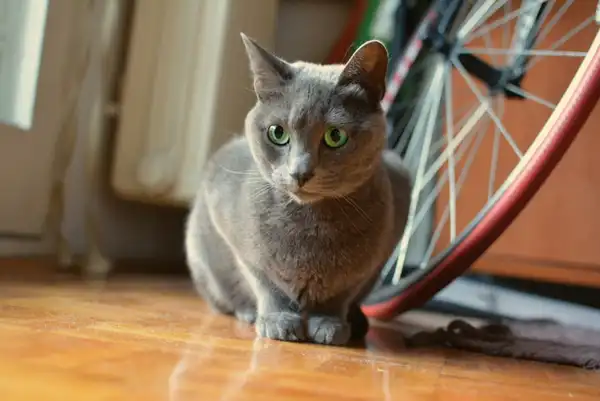
Felidae · CAT
Siberian
🌟 You may have met one
Vladimir Putin has kept a Siberian at home; he once presented a Siberian kitten named Mir (Russian for "peace") as a state gift to the governor of Akita Prefecture, Japan.
Overview
The Siberian (西伯利亚森林猫) is a large cat breed weighing 4.5–9 kg with a 12–18-year lifespan. One of Russia's "three great cats." Its triple-layer, water-resistant coat handles the harsh cold. Surprisingly "lower-allergen" (less Fel d 1 protein) — a possible option for allergy-prone cat lovers.
Feeding
Large-cat high-protein formula; keep an eye on joint health.
Exercise
Energetic — loves climbing and jumping, needs plenty of space.
Grooming
Thick long coat — brush 2-3 times a week; daily during shedding season.
Health
Generally healthy; watch for HCM and dental care.
Gallery
A closer look at the Siberian
From origins and personality to daily care and health — helping you judge whether this little companion is really the one for you.
Origin & history
Origin & history
The Siberian (Russian: сибирская кошка) is the formal name for Russia's native long-haired cat. This large long-haired cat has existed in Russian folklore for at least 1,000 years — described in the 12th-century "Tale of Igor's Campaign" and appearing frequently in 19th-century Russian fairy tales. It has long existed as a "farm cat" or "barn cat" throughout rural Russia and Ukraine.
As a registered breed it is very young: - 1987: The Soviet Cat Fanciers' Association (Kotofei) first registered the Siberian in Moscow, drafting the first breed standard - 1990: Elizabeth Terrell imported three Siberians from Leningrad to the United States, founding the American lineage - 1996: TICA officially recognised it; CFA followed in 2006; FIFe recognised it in 1997
Lipinski's 2008 genetic study showed the Siberian, Norwegian Forest Cat, and Maine Coon **share some ancestral lineage** but evolved independently — three northern cat pools by convergent evolution. Together with the Russian Blue and Nebelung, they are called "Russia's three great cats" (broadly extended to include the Neva Masquerade as the pointed version of the Siberian).
**The Neva Masquerade** is the pointed Siberian, developed in Saint Petersburg (formerly Leningrad, near the Neva River) in the 1980s. TICA and FIFe treat it as a Siberian pointed variant; CFA still registers it as a separate breed.
Looks & breed standard
Looks & breed standard
The Siberian's defining feature is its **extraordinarily thick triple-layer coat** — the most direct visual difference from the Norwegian Forest Cat and Maine Coon:
- **Guard hair (outer layer)**: Long and glossy, containing semi-water-resistant guard oils - **Awn hair (middle)**: Medium length, tough - **Down (undercoat)**: Very short, dense, wool-like, superb insulation
This triple structure lets it survive Siberian climates of −30°C. The undercoat sheds mostly in summer and regrows in winter — spring and autumn are the **major shedding seasons**, and daily brushing yields enough fur to fill a shoebox.
Large body (males 5-9 kg, females 3.5-6 kg); frame sturdier than a Norwegian Forest Cat, close to a Maine Coon but with a shorter, boxier torso. The head is a **rounded trapezoidal triangle** (between the equilateral triangle of the Norwegian Forest Cat and the boxy square of the Maine Coon). Eyes are large and slightly round; colour ranges through gold, green, blue, or odd-eyed.
All traditional colours (solid, tabby, tortie, bicolor, smoke, silver) are accepted by CFA and FIFe. Neva Masquerade point colours are listed separately.
Personality in depth
Personality in depth
The Siberian shares the "large steady northern cat" temperament with the Norwegian Forest Cat and Maine Coon, but overall **is clingier than the Norwegian and more active than the Maine Coon**. The CFA breed description sums it up as dog-like personality, powerful, agile, affectionate.
It bonds steadily with family — following them around, sitting on laps, greeting at the door — but its expression is not as over-the-top as a Burmese or Sphynx. It doesn't rush strangers, but it also doesn't hide — usually within 30 minutes it will approach and say hello.
It retains strong **hunting and climbing instincts** — one of the few domestic cats able to voluntarily jump more than 5 body lengths. High cat trees and bookshelf-top pathways are a must. It is also one of the **most water-loving** domestic cats, actively lounging by water bowls or jumping into bathtubs.
High tolerance of children, dogs, and other cats — the Siberian is often recommended as the top pick for **multi-person / multi-pet households** among large long-haired cats.
Daily care
Daily care
Siberian day-to-day care essentials:
1. **Grooming (the main event)**: - Regular: 2-3 times a week with a long-tooth pin brush + fine-tooth comb, focusing on the ruff, breeches, and belly - **Shedding season (twice a year, 3-4 weeks each)**: Daily brushing with a de-shedding tool, or your home fills with drifting undercoat - Do not shave (disrupts the natural growth rhythm of the triple coat)
2. **Diet**: Large-cat-specific high-protein formula (protein >36%). Long growth period (fully mature at 4-5 years); do not restrict calories in the first 3 years. From middle age, focus on joint nutrition (glucosamine + Omega-3).
3. **Exercise + Environment**: At least one >200 cm cat tree and permission to climb bookshelves or a cat wall. It needs true vertical space.
4. **Teeth**: Large long-haired cats have moderately elevated gingivitis and FORL rates in middle age; annual oral checks recommended.
5. **Climate**: Cold-hardy, heat-intolerant — AC / shade is a must in summer, especially in the south.
Health & lifespan
Health & lifespan
The Siberian is **among the healthier pedigree cats**, but a few concerns remain:
1. **Hypertrophic cardiomyopathy (HCM)**: Moderate incidence; no Siberian-specific MYBPC3 mutation has been mapped. Breeders should perform annual cardiac ultrasound (Kittleson & Côté 2021, J Vet Cardiol).
2. **Polycystic kidney disease (PKD)**: Occasional; the PKD1 mutation test (same locus as the Persian) can screen it.
3. **HCM/GI comorbidities**: In middle-aged Siberians, gastrointestinal sensitivity plus cardiac issues sometimes co-occur — comprehensive assessment needed.
4. **The "low-allergen cat" debate**: This is the Siberian's most misreported issue. - **Some scientific basis**: Fel d 1 secretion in Siberians **varies enormously among individuals**, with some individuals significantly lower than the average domestic cat (Bastian 2016 review notes some Siberian lines have lower Fel d 1) - **However**: "low" ≠ "none." The Siberian is not a universally hypoallergenic cat. Truly cat-allergic people should **spend 30-60 minutes closely with the specific individual before buying**, or run a Fel d 1 blood test. You cannot conclude anything from breed alone. - A dedicated 2011 J Allergy Clin Immunol study on Siberians and Fel d 1 concluded: **Fel d 1 levels among Siberians span the same range as ordinary domestic cats — there is no guarantee that "Siberian = hypoallergenic."**
Fit for your space
Fit for your space
The Siberian is **relatively beginner-friendly** among large long-haired cats — clingier than the Norwegian Forest Cat, more independent than the Maine Coon, more active than the Ragdoll, and healthier than the Persian.
**Good fit for**: - Homes with a room's worth of dedicated activity space and room for vertical cat furniture - Multi-person / child-friendly homes - Multi-pet homes with other friendly cats or dogs - Owners drawn to a "large + steady + affectionate + healthy" pet - Detached / with-yard living arrangements (with escape-proofing)
**Not a fit for**: - Purely floor-plan small apartments with no vertical space - Owners who cannot tolerate drifting undercoat filling the home during spring / autumn - Severely cat-allergic buyers who assume "Siberian = hypoallergenic" (**must** test in person before buying) - Fully non-AC hot-humid southern environments
International Cat Care (ICatCare) recommends the Siberian as an "entry-level large long-haired breed."
References
This is an educational overview — for specific health and care advice, please consult the authoritative sources below and your veterinarian.
- CFA — Siberian breed article国际猫协标准
- TICA — Siberian Breed Group国际猫协标准
- FIFe — Siberian Breed Standard (SIB)国际猫协标准
- Lipinski et al. 2008 Genomics — Genetic origin of cat breeds学术研究
- Bastian et al. 2016 J Immunol — Fel d 1 as major cat allergen学术研究
- Kittleson & Côté 2021 J Vet Cardiol — Feline HCM review学术研究
- Kurushima et al. 2013 Anim Genet — Cat breed origins学术研究
- UC Davis VGL — Siberian panel基因检测
- ICatCare — Siberian breed profile综合科普