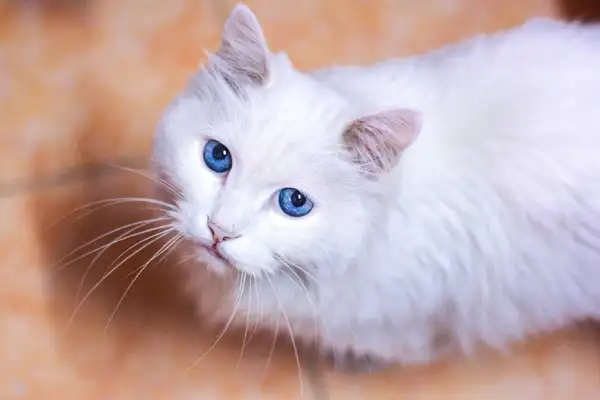
Felidae · CAT
Norwegian Forest Cat
🌟 You may have met one
In Norse mythology, Freya — the goddess of love and beauty — rode a chariot pulled by two enormous Norwegian Forest Cats. The double coat and semi-water-resistant undercoat evolved for the Nordic winter.
Overview
The Norwegian Forest Cat (挪威森林猫) is a large cat breed weighing 4–9 kg with a 14–16-year lifespan. The old friend of Viking longships — dense double coat and a big neck ruff. Independent and steady, cold-tolerant, and fond of climbing to high perches.
Feeding
A large-cat, high-protein formula with fat kept in check to prevent obesity.
Exercise
Good energy — loves climbing and outdoor views. Provide a tall cat tree.
Grooming
Long, dense coat — brush 2-3 times a week, and daily during the shedding season.
Health
Prone to Glycogen Storage Disease IV, HCM, and hip dysplasia.
Gallery
A closer look at the Norwegian Forest Cat
From origins and personality to daily care and health — helping you judge whether this little companion is really the one for you.
Origin & history
Skogkatt, Viking ships, and Norway's national cat rescued from extinction in 1938
Origin & history
Skogkatt, Viking ships, and Norway's national cat rescued from extinction in 1938
The Norwegian Forest Cat's Norwegian name **skogkatt** ("forest cat") appears in Nordic folk tradition going back nearly a thousand years. The Norse *Edda* poems repeatedly describe Freya's chariot as pulled by "two large forest cats," and by the time the *Prose Edda* was written in the 13th century these cats were already widespread across Scandinavia as ship cats and barn cats. Genetic research suggests the Norwegian Forest Cat is likely the product of long-haired cats brought from Anatolian Ankara during the Viking era, naturally selected in Norway's harsh climate together with local Nordic shorthairs (Kurushima 2013, Anim Genet).
As a formal registered breed it is quite young. Norwegian breeder Carl-Fredrik Nordane began organized registration in the 1930s. WWII cut the population close to extinction, and it wasn't until 1938, when King Haakon VII of Norway declared the Norwegian Forest Cat a "national treasure," that systematic conservation began. FIFe accepted the breed in 1977, TICA in 1984, and CFA in 1993.
Studies show Norwegian Forest Cats, Maine Coons, and Siberians — the three "northern longhair" breeds — share some ancestral bloodlines, but the Norwegian Forest Cat's gene pool is independent of the Maine Coon's; the two are examples of **convergent evolution**, not common descent (Lipinski 2008, Genomics).
Looks & breed standard
Double coat, semi-water-resistant undercoat, heart-shaped face, and a right-triangle silhouette
Looks & breed standard
Double coat, semi-water-resistant undercoat, heart-shaped face, and a right-triangle silhouette
The core feature is an **exceptionally cold-adapted double coat**: the outer layer is long and glossy with clear semi-water-resistance; the inner layer is dense as wool, forming in winter a prominent neck "ruff," hindquarter "britches," and a squirrel-like plumed tail. The undercoat is shed in summer, so the cat looks radically different by season. This dramatic seasonal shed is the biggest care difference from a Persian.
Body type is large (males 5-9 kg, females 3.5-6 kg), heavily boned, with hind legs noticeably longer than the front legs — different from the Maine Coon's more balanced build. In profile the cat approximates a right triangle — low at the front, high at the back, with a broad chest. The head is an **equilateral triangle** (not the Maine Coon's square shape), with large slightly slanted almond eyes and lynx-tipped ears.
CFA and FIFe accept nearly all traditional colors (solid, tabby, tortie, bicolor, smoke, silver), but **do not allow point patterns or chocolate/cinnamon** (these colors were historically used by FIFe to detect illegal Siamese or Oriental introductions).
Personality in depth
Independent, steady, slow to warm up — a classic "northern big cat"
Personality in depth
Independent, steady, slow to warm up — a classic "northern big cat"
The Norwegian Forest Cat's temperament shares traits with other northern big cats like Maine Coons and Siberians: steady, independent, slow to warm up, neither as clingy as a Burmese nor as low-energy as a Persian. The CFA breed profile calls it "sweet, friendly but reserved."
Wegies are cautious with strangers and typically need 1-2 weeks to build trust with a new family. Once bonded, they show a stable, reliable attachment — but expressed as "wherever you are, I'll be nearby," rather than the shoulder-riding closeness of a Burmese.
They retain a strong climbing instinct — one of the few domestic cats that will climb **head-first down** a large tree (most cats have to reverse butt-first). Tall cat trees, tops of bookshelves, and window perches are essential. The predatory instinct is intact too — wand toys and treat balls will hold their attention long-term.
Tolerance of children and other animals is generally high, and most adult Wegies avoid conflict with other cats — making them one of the **more peaceful multi-cat household** breeds.
Daily care
Daily brushing during coat blows, jumping space, and a large-cat high-protein formula
Daily care
Daily brushing during coat blows, jumping space, and a large-cat high-protein formula
Care essentials that shouldn't be skipped:
1. **Grooming**: - Regular: 2-3 times a week with a long-tooth pin brush plus a comb. - **Coat blow (twice a year, spring and autumn)**: daily, along with a FURminator-style de-shedder — otherwise the whole house fills with fluff. - No trimming. Do not shave — it disrupts the underlayer's growth cycle.
2. **Diet**: a large-cat, high-protein formula (>36% protein) with joint support (glucosamine + chondroitin sulfate). The growth phase is long (fully mature at 4-5 years) — do not restrict calories in the first 3 years.
3. **Exercise + environment**: at minimum a 200 cm+ tall cat tree, bookshelf-top pathways, and window seats. It needs true 3D space — a flat 2D apartment will frustrate it.
4. **Teeth**: like Maine Coons and Persians, gingivitis and FORL rates rise in middle age — plan on annual dental exams.
5. **Climate**: cold-tolerant but not heat-tolerant. Air conditioning and shade are essential in summer; do not leave in an unclimatized apartment in a hot southern climate.
Health & lifespan
GSD IV, HCM, hip dysplasia, and eye disease
Health & lifespan
GSD IV, HCM, hip dysplasia, and eye disease
Breed-specific diseases in the Norwegian Forest Cat are relatively well defined, and responsible breeders test for the following:
1. **Glycogen Storage Disease IV (GSD IV)**: an autosomal recessive glycogen metabolism disease caused by GBE1 mutations. Homozygote kittens develop sudden neurological symptoms (tremors, unstable gait) at 4-5 months and nearly all die before age one (Fyfe 2007, Mol Genet Metab). UC Davis VGL and Wisdom Panel offer testing. Every breeding cat must be screened.
2. **Hypertrophic Cardiomyopathy (HCM)**: moderate incidence — annual cardiac ultrasound is recommended (Gundler 2008 J Feline Med Surg).
3. **Hip Dysplasia**: a common issue among large cat breeds. Adults need joint protection and weight management (Keller 1999 Vet Comp Orthop Traumatol).
4. **Progressive Retinal Atrophy (PRA)**: occasional in the breed, with a mapped genetic locus (Ahonen 2013 PLoS ONE).
5. **Polycystic Kidney Disease (PKD)**: occasional. Responsible breeders screen with ultrasound.
Overall, the Norwegian Forest Cat is comparatively healthy among large longhaired breeds — 14-16 years is a common lifespan.
Fit for your space
Space + vertical enrichment + climbing allowed: not a fit for entirely flat apartments
Fit for your space
Space + vertical enrichment + climbing allowed: not a fit for entirely flat apartments
The Norwegian Forest Cat is **not suited to an entirely flat, small apartment**, **not suited to unclimatized humid southern homes**, and **not suited to owners who want an instantly clingy pet**. It's the classic "northern big cat" — needing space, verticality, and patience.
**Good fit for**: - Homes with at least one dedicated activity room and space for a tall cat tree or cat wall - Owners willing to accept slow bonding and dramatic seasonal shedding - Multi-pet households already sharing with a friendly cat or dog - Detached homes with yards (safely secured against escape)
**Poor fit for**: - Studio apartments without vertical space - Owners who can't tolerate the two-season fluff explosion - First-time owners who expect immediate friendliness
International Cat Care and FIFe both remind buyers to verify GSD IV and HCM screening records before purchase.
References
This is an educational overview — for specific health and care advice, please consult the authoritative sources below and your veterinarian.
- CFA — Norwegian Forest Cat breed article国际猫协标准
- TICA — Norwegian Forest Cat Breed Group国际猫协标准
- FIFe — Norwegian Forest Cat Breed Standard (NFO)国际猫协标准
- Fyfe et al. 2007 Mol Genet Metab — GBE1 mutation causing GSD IV学术研究
- Lipinski et al. 2008 Genomics — Genetic origin of cat breeds学术研究
- Ahonen et al. 2013 PLoS ONE — PRA in Norwegian Forest Cat学术研究
- Keller et al. 1999 Vet Comp Orthop Traumatol — Feline hip dysplasia学术研究
- UC Davis VGL — Norwegian Forest Cat Panel (GSD IV, blood type)基因检测
- ICatCare — Norwegian Forest Cat breed profile综合科普