Felidae · CAT
Ragdoll
🌟 You may have met one
In the 1960s, California breeder Ann Baker developed the breed from a white long-haired queen named Josephine, deliberately selecting for the trait of relaxing completely — like a doll — when picked up. That's how the name Ragdoll came about.
Overview
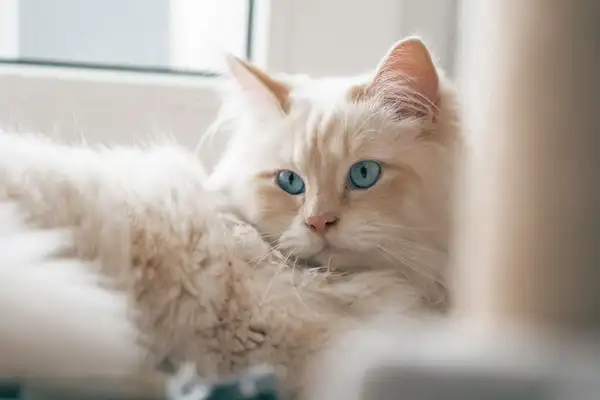
The Ragdoll (布偶猫) is a large cat breed weighing 3.5–9 kg with a 12–17-year lifespan. Named for the way they go limp like a rag doll when picked up. Blue eyes, colorpoint long coat, and an exceptionally gentle, people-loving temperament — often called the "angel cat."
Feeding
A large-cat formula with cardiac support in mind. Long-coat blends and hairball control ingredients help.
Exercise
Moderate exercise needs. They love to shadow their humans — interactive play sessions are the way.
Grooming
Long but low-mat coat — brush twice a week, focusing on the tail and armpits.
Health
High rates of hypertrophic cardiomyopathy (HCM) — genetic testing is recommended, and urinary stones are also common.
Gallery
A closer look at the Ragdoll
From origins and personality to daily care and health — helping you judge whether this little companion is really the one for you.
Origin & history
The controversial 1960s origin — Josephine and Ann Baker
Origin & history
The controversial 1960s origin — Josephine and Ann Baker
The Ragdoll's history is short compared to most breeds — it began in 1960s Riverside, California, with a white long-haired queen named Josephine. Owned by Ann Baker's neighbor, Josephine had reportedly been in a car accident, and the kittens she produced afterward all showed the distinctive trait of relaxing when picked up and having high pain tolerance. Baker continued to selectively breed her descendants, forming today's Ragdoll.
Ann Baker herself was highly controversial: she trademarked the name "Ragdoll" in 1971 and founded the IRCA (International Ragdoll Cat Association), demanding that all owners pay her royalty fees. This led to a break with early breeders, who split off in 1975 to form the Ragdoll Fanciers' Club International (RFCI) and got the breed registered with mainstream associations like CFA and TICA. The CFA fully accepted the breed in 1993, and the trademark expired in 2000, at which point the industry normalized.
Baker also promoted unscientific claims later in life (alien intervention, CIA genetic experiments), which have been thoroughly refuted by genetic research — a 2013 UC Davis feline genome study showed the Ragdoll's genes come from a conventional mix of Maine Coon, Birman, Persian, and domestic long-haired cats.
Looks & breed standard
Colorpoint + blue eyes + a large soft-boned frame
Looks & breed standard
Colorpoint + blue eyes + a large soft-boned frame
The Ragdoll is the second-largest domestic cat breed by size (behind only the Maine Coon). Adult males weigh 5.5-9 kg, females 3.5-6 kg. The CFA standard requires blue eyes and a colorpoint coat — these are the two ironclad rules of the breed.
Colors come in six main points: Seal, Blue, Chocolate, Lilac, plus two rarer options — Red/Flame and Cream. Patterns come in four types: Colorpoint (Siamese-like), Mitted (with white "boots"), Bicolor (V-shaped white face), and Van (color only on ears and tail — the rarest).
Kittens are born completely white; the point coloring emerges at 8-12 weeks and reaches its final color only at full maturity (around age four). The coat is medium-long, silky, and mostly single-layered with little matting — making Ragdolls one of the easier long-haired cats to groom.
Personality in depth
The "Ragdoll effect": pick them up and they go soft
Personality in depth
The "Ragdoll effect": pick them up and they go soft
The core trait the breed is named for is that they go completely limp when picked up (the floppy/limp response), like an actual rag doll. This is most pronounced in kittenhood but persists into adulthood in most individuals. Early rumors attributed this to "nervous system abnormalities" or "pain tolerance," but veterinary literature has never found supporting physiological evidence — it's now considered a behavioral trait derived from selective breeding, tied to loose muscle and skeletal relaxation.
Overall temperament is best described as "dog-like cat": Ragdolls follow their owners from room to room, learn their own names, and enjoy being carried and having their bellies rubbed. The CFA officially describes them as *laid-back* and *people-oriented*.
Because they trust humans absolutely, Ragdolls have poor threat awareness — they don't run from danger. Never let them roam free or outside unsupervised.
Daily care
Silky low-maintenance coat + weight watching
Daily care
Silky low-maintenance coat + weight watching
Despite being long-haired, the Ragdoll's coat is mostly single-layered, silky, and nearly free of dense undercoat — unlike Persians, they rarely mat. Brushing 2-3 times a week is enough to keep them well-groomed, with more frequency during coat blows in spring and autumn. The armpits, inner thighs, and base of the tail are the priority areas.
They mature slowly (fully grown at 4 years old), so young Ragdolls need high-calorie diets — a large-breed kitten formula until 15-18 months is a common approach. From adulthood on, portion control is critical: Ragdolls gain weight easily, and obesity is an independent risk factor for HCM.
A bath every 1-2 months is enough, using a gentle long-hair-specific shampoo. Nail trimming and ear cleaning are routine.
Health & lifespan
MYBPC3-R820W plus PKD and FLUTD
Health & lifespan
MYBPC3-R820W plus PKD and FLUTD
The Ragdoll's most important breed disease is **Hypertrophic Cardiomyopathy (HCM)**. Meurs et al. 2007 in *J Vet Cardiol* mapped the MYBPC3 R820W mutation in Ragdolls — a different locus in the same gene as the Maine Coon's A31P mutation. Estimated carrier rate is 20-30%, and homozygotes have significantly elevated disease risk. Every responsible Ragdoll breeder does R820W genetic screening plus annual cardiac ultrasound.
**Polycystic Kidney Disease (PKD)**: Ragdoll PKD positivity has historically been much lower than in Persians, but screening is still needed — especially in lines sharing Persian ancestry.
**Feline Lower Urinary Tract Disease (FLUTD)**: Large-bodied and quiet Ragdolls often drink too little water, making stones a real risk. Use flowing water bowls, encourage wet food, and get an annual urinalysis.
Average lifespan is 12-17 years, and long-lived individuals aren't unusual.
Fit for your space
Quiet indoor cat with family-first companionship
Fit for your space
Quiet indoor cat with family-first companionship
Ragdolls are absolutely indoor companion cats: low vigilance, large body, slow reactions, and blue eyes that are sunlight-sensitive — they aren't suited for outdoor life at all. The ideal household has stable routines, someone home most of the time, and calm emotional atmosphere.
They tolerate children and other friendly animals extraordinarily well and rarely initiate aggression. In multi-cat households the Ragdoll usually becomes the "peacekeeper," living peacefully with Siamese, Maine Coons, and other Ragdolls alike.
Space requirements aren't high (they don't jump as much as Maine Coons), but they need multiple resting spots that let them stay near their humans — sofa perches, bed spots, and a cat bed by your desk are more welcome than a tall cat tree. This is the classic "wherever you go, they go" cat.
References
This is an educational overview — for specific health and care advice, please consult the authoritative sources below and your veterinarian.
- CFA — Ragdoll Breed Standard官方猫协会
- TICA — Ragdoll Breed Standard国际猫协标准
- RFCI — Ragdoll Fanciers' Club International全国单猫种俱乐部
- Meurs et al. 2007 J Vet Cardiol — MYBPC3 R820W in Ragdoll HCM学术研究
- UC Davis VGL — Ragdoll HCM (R820W) Test基因检测
- Lyons et al. 2016 PLoS ONE — 99 Lives feline genome (Ragdoll ancestry)学术研究
- ICatCare — Ragdoll breed profile综合科普
- The Cat Fanciers' Association — Ragdoll breed article综合科普