Felidae · CAT
Birman
🌟 You may have met one
Legend traces the breed to a Burmese temple. When an aged monk died his cat stood upon him and its coat turned golden while its four paws became white as a pure soul. From that day on, Birmans have been said to carry the spirits of the temple monks.
Overview
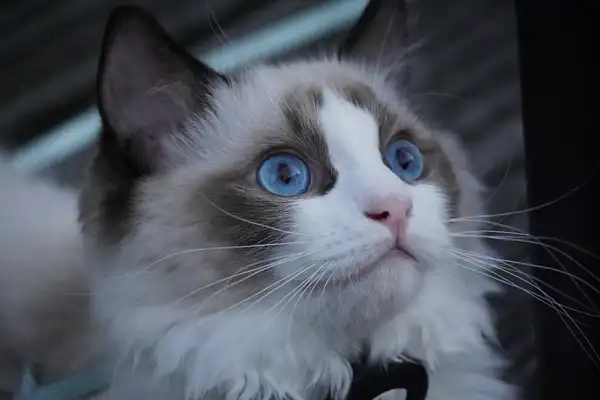
The Birman (伯曼猫) is a medium-sized cat breed weighing 3–6.5 kg with a 12–16-year lifespan. The 'sacred cat' of Burmese temples. Blue eyes, colorpoint long fur and four white gloves are its classic hallmarks. Gentle and quiet, and a close relative of the Ragdoll.
Feeding
A longhair formula for medium-sized cats, supplemented with a hairball remedy.
Exercise
Moderate exercise needs; loves playing right beside its owner.
Grooming
Silky long coat that rarely mats; brush twice a week.
Health
Prone to HCM and spongiform encephalopathy — genetic testing is recommended.
Gallery
A closer look at the Birman
From origins and personality to daily care and health — helping you judge whether this little companion is really the one for you.
Origin & history
Origin & history
The Birman (Sacred Cat of Burma) is the domestic cat breed **richest in legend**. **Note**: Birman and Burmese are entirely different — the Birman is a colorpoint longhair with blue eyes (this entry), while the Burmese is the shorthair, copper-eyed, medium-sized Burmese cat.
**The temple legend (the Kittah myth)**: As recorded in French breeder documents from Burmese oral tradition — in the mountains of northern Burma (in what is now Shan State) stood a temple on Mount Lao-Tsun, dedicated to the goddess **Tsun-Kyan-Kse** (a golden goddess with sapphire-blue eyes). The priest Mun-Ha kept a beloved white, yellow-eyed cat named **Sinh**. One night raiders stormed the temple; as Mun-Ha fell, Sinh stood upon him and stared into the goddess's face — in that instant Sinh's **coat turned golden, his eyes deep blue, and the four paws resting on his master turned pure white (gloves)**, symbolizing that his master's soul had been carried onward. From that night, every cat in the temple bore the same markings.
**Modern registration timeline**: - **1919**: Auguste Pavie and Major Gordon Russell (said to have aided the temple) received a pair of Birmans as a gift and shipped them to France. The male died on the voyage; the pregnant female **Sita** survived and produced the first litter - **1925**: France's FFF (Fédération Féline Française) formally recognized the Birman as an independent breed - **World War II**: European chaos brought the breed to the brink of extinction — by 1946 **only two registered Birmans remained in all of Europe**. Breeders reconstructed the line by outcrossing to Persians and Siamese - **1966 GCCF, 1967 CFA, 1966 FIFe recognition** - **1990s**: bloodlines stabilized, and the breed became a globally popular medium-sized blue-eyed longhair
**Birman vs Ragdoll**: the Birman (France, 1925) predates the Ragdoll (California, 1960) by 35 years. The two look similar — both colorpoint, blue-eyed and longhaired — but Ragdolls are larger (5-9 kg vs Birman 3.5-6.5 kg), Ragdolls have no white gloves, and the Birman skull is shorter and rounder.
Looks & breed standard
Looks & breed standard
The most iconic feature of the Birman standard is that **all four feet must have white gloves and laces (gloves & laces)** — this is what sets the Birman apart from every other colorpoint longhair.
**Gloves**: - **Front paws white**: from claw tip up to and level with the metacarpal (wrist), **precisely level, no more, no less** - **Rear paws white plus laces**: white extends from the toes to the hock, ending at the back in an **inverted V (laces)** — the more symmetric the better - **Show judges apply extreme scrutiny to glove symmetry**: uneven gloves are a serious fault - Genetically controlled by the **W mutation at the Sepia locus** (Grade et al. 2012 *Anim Genet*) — this is the **Birman's proprietary white-spotting gene**, distinct from the W total-white or bicolor loci
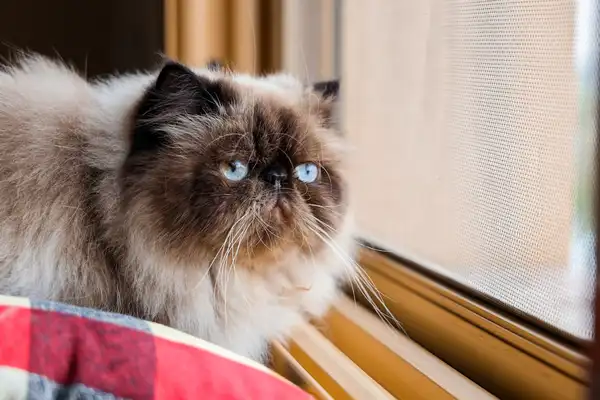
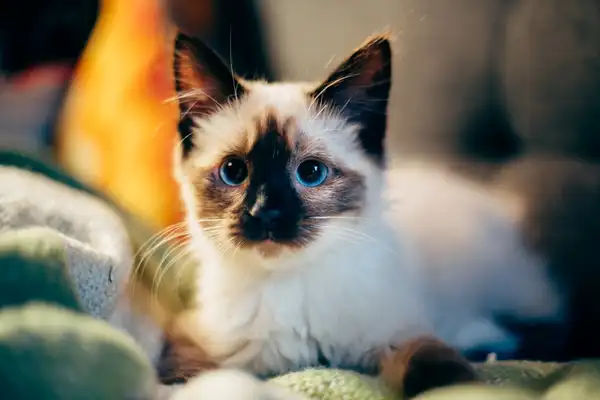
**Other features**: - **Head**: **medium modified round**, natural nose curve (**no flat face, no depressed nose**) — the key distinction from the Persian and Himalayan - **Eyes**: **deep blue (the deeper the better)**, round or slightly oval - **Body**: medium-large; males 4.5-6.5 kg, females 3-5 kg. Moderate skeleton — **not the extreme size of a Ragdoll** - **Coat**: **medium-long, silky texture, minimal undercoat** - **Advantage**: rarely mats — a **low-maintenance longhair** compared with the Persian or Himalayan - Distinct neck ruff and plumed tail - **Point colors**: seal / blue / chocolate / lilac / red / cream / tortie plus tabby variants - **Adult color**: Birman kittens are **born completely white** (colorpoint expression is controlled by a temperature-sensitive tyrosinase mutation shared with the Himalayan, Ragdoll and Siamese); points begin to appear at 2 weeks and stabilize fully in adulthood
Personality in depth
Personality in depth
The Birman's temperament is often described as **somewhere between the soft laziness of a Ragdoll and the deep quietness of a Persian**. The CFA breed profile sums it up as gentle, sweet, quiet, dignified, playful but not disruptive.
**Core traits**: 1. **Gentle and quiet**: does not yowl, disturb, climb high or destroy furniture. **One of the most well-mannered** breeds in the domestic cat world 2. **Steady bond with the family**: the Birman follows its owner around, but not obsessively — more like a silent companion who quietly stays beside you 3. **Moderate activity**: **slightly more active than a Ragdoll and more active than a Persian**; plays with wand toys and chases lasers, but only in short bursts (10-20 minutes) before settling down 4. **Gentle with strangers**: does not proactively greet visitors but will not hide either, and tolerates being petted by guests 5. **Excellent with children**: allows kids to carry, stroke and follow it with almost no biting or scratching 6. **Multi-pet friendly**: coexists peacefully with dogs and other cats 7. **Moderate intelligence**: can learn to respond to its name and simple commands, though it learns more slowly than a Burmese, Devon Rex or Siamese 8. **Voice**: extremely quiet — soft, non-shrill mews
**Alone-time tolerance**: moderate. **Under 8 hours a day is fine**; over 10 hours, adopt in pairs. Its need for company is higher than the Persian's but lower than the Burmese's.
Daily care
Daily care
The Birman is **one of the lowest-maintenance medium-sized longhair cats** — a key advantage over the Persian and Himalayan.
1. **Grooming**: - **Twice a week is enough** (Persians and Himalayans need daily brushing) — the sparse undercoat rarely tangles - Use a long-tooth pin brush plus a fine comb, focusing on the neck ruff, thigh britches and belly - Increase to 3-4 times a week during spring and fall shedding - **Under normal care, professional grooming trims are almost never needed**
2. **Diet**: - Standard high-protein food for medium cats (protein >32%) - 2-3 meals a day - Manage calories in middle age (mid-life obesity rate is average for domestic cats) - A weekly hairball remedy is a helpful supplement for a longhair cat
3. **Eye and ear care**: - **Birmans have no flat face, so no tear staining** (another advantage over the Persian and Himalayan) - Weekly ear checks
4. **Teeth**: - Middle-age gingivitis risk is normal — schedule an annual dental check
5. **Exercise and environment**: - Low-to-moderate exercise needs - A medium cat tree (100-150 cm), wand toys and puzzle feeders are enough - No need for tall vertical space (Birmans do not especially enjoy heights)
6. **Multi-pet management**: **one of the easiest breeds to integrate** with other pets — no special measures needed.
7. **Keeping the gloves clean**: the white paws pick up litter and food stains easily. **Wipe all four feet regularly with a clean damp cloth** to keep them bright.
Health & lifespan
Health & lifespan
The Birman has middling health — much better than the Persian or Himalayan, but with several breed-specific issues:
1. **Hypertrophic cardiomyopathy (HCM)**: - Moderate incidence; the Kittleson & Côté 2021 review lists the Birman among the breeds enriched for MYBPC3 HCM - **Annual cardiac ultrasound screening is recommended**
2. **Congenital hypotrichosis with meningoencephalocele** (congenital hairlessness plus meningoencephalocele): - A Birman-specific hereditary syndrome, **autosomal recessive** - First reported by Casal et al. 1994 *J Vet Intern Med* - Affected kittens are born hairless or sparsely haired with a bulging forehead (meninges herniating through a skull defect); most die within weeks - Prevention: parental genetic testing by breeders
3. **Diabetes and hereditary chronic kidney disease (CKD)**: - The UK O'Neill 2016 *J Feline Med Surg* large-scale epidemiology study (VetCompass database) found that Birmans have **an above-average rate of early-onset CKD** (before age 10) - Recommendation: annual SDMA and urinalysis from age 8 onward
4. **Feline spongiform encephalopathy**: - A handful of Birman cases reported, but very rare
5. **Taurine-deficiency sensitivity**: Birmans are more sensitive to inadequate dietary taurine — **must be fed commercial cat food (which is universally taurine-supplemented); do not feed dog food or purely homemade vegetarian diets**
6. **Comorbidities (shared with all domestic cats)**: FLUTD, obesity, periodontal disease
**Average lifespan**: **12-16 years**; over 18 with responsible care is not rare.
**Recommended breeder screening**: - Annual HCM cardiac ultrasound - Congenital hypotrichosis + meningoencephalocele genetic test (standard for responsible breeders) - Serum SDMA + BUN + creatinine annually from age 8
Fit for your space
Fit for your space
The Birman is **the most beginner-friendly medium-sized blue-eyed longhair** — lower-maintenance than the Persian or Himalayan, slightly livelier than the Ragdoll and quieter than the Burmese.
**A good match for**: - First-time longhair-cat owners (no daily brushing required) - Households with children or elderly members - Urban apartments (no need for tall vertical space) - Families that want colorpoint plus blue eyes plus elegant long fur plus a gentle temperament - Owners unable to handle the daily grooming cost of a Persian or Himalayan - Anyone seeking a quiet, elegant pet - Multi-pet households (compatible with dogs and other friendly cats)
**Not a match for**: - Households wanting an extremely active or hunter-type cat (look at the Bengal, Abyssinian or Chinese Li Hua instead) - Owners expecting an extremely clingy, dog-like companion (look at the Burmese, Devon Rex or Sphynx instead) - Buyers unable to fund dual HCM plus CKD screening - Households where no one is home for over 10 hours with no companion animal available
**Special notes**: - **Must be kept indoors** (long fur soils easily and blue-eyed cats are prone to getting lost with no outdoor experience) - When buying, ask the breeder for **HCM ultrasound + Congenital Hypotrichosis / Meningoencephalocele genetic test + a three-generation pedigree** - **Beware of market confusion**: - In China, 'Birman' is often sold with cats that are actually Ragdolls, Himalayans or Siamese - A true Birman must have all three: **white gloves + deep blue eyes + medium skeleton** - A colorpoint longhair without white gloves **is not a Birman** (probably a Himalayan or Ragdoll) - Consider adoption first: shelters occasionally have Birman-mix colorpoint longhairs (they may lack the gloves but often share the temperament and looks)
References
This is an educational overview — for specific health and care advice, please consult the authoritative sources below and your veterinarian.
- CFA — Birman Breed Article国际猫协标准
- TICA — Birman Breed Standard国际猫协标准
- GCCF — Birman Breed Standard of Points国际猫协标准
- FIFe — Sacred Birman Breed Standard (SBI)国际猫协标准
- Grade et al. 2012 Anim Genet — Genetics of Birman gloves (Sepia W)学术研究
- Casal et al. 1994 J Vet Intern Med — Congenital hypotrichosis with meningoencephalocele in Birmans学术研究
- Kittleson & Côté 2021 J Vet Cardiol — Feline HCM & MYBPC3 in Birman学术研究
- O'Neill et al. 2016 J Feline Med Surg — Chronic kidney disease in Birman (VetCompass)学术研究
- UC Davis VGL — Birman genetic testing panel基因检测
- ICatCare — Birman breed profile综合科普