Canidae · DOG
Labrador Retriever
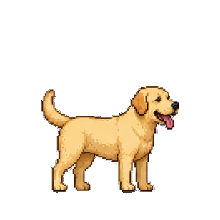
🌟 You may have met one

Brian Griffin from Family Guy — the martini-sipping, novel-writing white Lab who audits college classes — is arguably the most "cultured" spokesdog this breed has ever had.
Overview
The Labrador Retriever (拉布拉多寻回犬) is a large dog breed weighing 25–36 kg with a 10–12-year lifespan. One of the most popular breeds in the world, and a top choice for guide, search-and-rescue, and detection work. Steady, easy to train, and famously food-driven — you'll need to portion carefully. A great fit for active families.
Feeding
Prone to weight gain — measure meals strictly. Fresh food and vegetables can complement kibble.
Exercise
One to two hours of vigorous activity a day. Swimming and fetch are natural favorites.
Grooming
The short coat is easy to groom — brush once or twice a week, but expect heavy seasonal shedding.
Health
High rates of hip and elbow issues — schedule regular eye and cardiac checks as well.
Gallery
A closer look at the Labrador Retriever
From origins and personality to daily care and health — helping you judge whether this little companion is really the one for you.
Origin & history
Origin & history
The Labrador Retriever doesn't actually come from the Labrador Peninsula — its true ancestor is the St. John's Water Dog, a fisherman's working dog from Newfoundland, Canada. In the 18th century, Portuguese, Irish, and English fishermen and settlers brought this breed to Newfoundland to help pull nets and retrieve cod that came off the hook. Its short, water-repellent coat and swimming ability made it ideal for the job. [1][2]
In the early 1800s, cod trading ships between Newfoundland and Poole harbor in England carried these dogs to the UK. The 2nd Earl of Malmesbury lived near Poole and used them as waterfowl gundogs — records suggest he was hunting with St. John's Water Dogs by around 1809. His son first called the dog a "Labrador Dog" in a letter, and the name stuck. [2][3][4]
The Duke of Buccleuch's breeding program in Scotland was equally pivotal. Two 1880s Buccleuch stud dogs, Ned and Avon, are the common ancestors of nearly every modern Labrador. [1][3]
The UK Kennel Club officially recognized the Labrador as a distinct breed in 1903, and the American Kennel Club followed in 1917. Only black was recognized at first — yellow was accepted in 1899, and chocolate wasn't formally added to the standard until the mid-20th century. [1]
The original St. John's Water Dog went extinct in the mid-20th century because of Newfoundland's dog tax and rabies quarantine policies. The last two known males were photographed in the 1980s. Their bloodline lives on only through the Labrador and a few related breeds like the Chesapeake Bay Retriever. [1][2]
Looks & breed standard
Looks & breed standard
Both the AKC and the UK Kennel Club recognize only three official coat colors: **black, yellow, and chocolate**. Every other name — silver, charcoal, champagne, fox-red, English cream — is essentially a shade or dilute variant of these three. [5][6]
Yellow spans a wide range, from near-white "English cream" to deep coppery "fox-red" — all classified as "yellow" under AKC. [5]
The so-called "silver Labrador" has been controversial for decades. The AKC registers them as "chocolate with dilute," but the Labrador Retriever Club (LRC) has stated clearly: the dilute gene (dd) has never been documented in purebred Labradors, and the Weimaraner is the only breed that carries dd naturally. Silver Labs are almost certainly the product of a historical Weimaraner cross. Roughly 10-30% of silver Labs develop Color Dilution Alopecia. [6][7]
On size: adult males stand about 57-62 cm at the shoulder and weigh 29-36 kg; females run slightly smaller. The short, dense, water-resistant double coat and the trademark "otter tail" are the breed's defining features.
Personality in depth
Personality in depth
Stanley Coren's *The Intelligence of Dogs* ranks the Labrador **7th in working intelligence** — a Lab typically learns a new command in 5-15 repetitions. That trainability, combined with a soft mouth (they can carry a boiled egg without cracking it), is why Labs are the world's most common **guide, service, search-and-rescue, and therapy dogs**. [8]
Labs have a food obsession that goes beyond typical canine appetite. A 2016 University of Cambridge study published in *Cell Metabolism* found that about 23% of Labradors carry a POMC gene mutation, which knocks out part of the satiety pathway — meaning these dogs feel physiological hunger more or less constantly. The same study found the mutation is even more common (~76%) in guide-dog Labs, because trainability and food drive were selected for together. [8]
This explains two things: why Labs respond so well to treat-based training, and why obesity is the breed's number-one care challenge. It's not that they're greedy — their brains simply can't tell them they're full.
Temperamentally, Labs are friendly with people and other dogs (the AKC standard explicitly requires "stable, kindly" temperament) and show almost no guarding aggression — which also means they don't make good watchdogs. Before age three, they can be extravagantly high-energy: chewing furniture, jumping on people, and eating whatever they find is entirely normal.
Daily care
Daily care
**Exercise**: A healthy adult Lab needs 1-2 hours of moderate-to-vigorous exercise daily. They are natural swimmers, and swimming is one of the ideal forms of exercise — much easier on hips and elbows than running. [8]
**Diet control**: This is the single biggest job for a Lab owner. The POMC mutation plus efficient metabolism means free-feeding almost guarantees obesity. Weigh food precisely by body weight, feed twice a day, and use a slow-feed bowl (which also reduces GDV/bloat risk). Avoid free-feeding and limit treats. [8]
**Grooming**: The short coat is straightforward — brush once or twice a week. But during the two seasonal blows in spring and autumn, shedding is enormous and daily brushing is required. It's a double-coated breed — never shave a Lab.
**Puppy skeletal protection**: Before 18 months, avoid stairs, jumping off furniture, and long-distance running — anything that stresses hip joints and growth plates. Keep calcium-to-phosphorus ratios around 1.2:1 in food to avoid overly rapid growth.
Health & lifespan
Health & lifespan
Labs live about **10-12 years** on average. The **Dogslife project** — the first large-scale online longitudinal health study of Labradors, run jointly by the UK Kennel Club and the University of Edinburgh — has followed over 1,400 KC-registered Labs since 2010. Early data showed roughly 44.3% experienced clinical symptoms during the tracking period. [9]
Major hereditary conditions include: - **Hip dysplasia**: polygenic, and OFA data shows about 12% of reported Labs have hip issues. Breeding stock should have OFA or PennHIP evaluations. - **Elbow dysplasia**: often accompanies hip dysplasia. - **Exercise-Induced Collapse (EIC)**: recessive DNM1 gene mutation, causing sudden hindlimb collapse after 5-15 minutes of intense exercise. This is a Lab-specific breed disease — EIC genetic testing is mandatory before breeding. [8] - **Progressive Retinal Atrophy (PRA-prcd)**: late-onset blindness, screenable via DNA test. - **GDV (bloat)**: common in deep-chested breeds. Slow-feed bowls plus post-meal rest reduce risk.
Spay/neuter timing needs weighing carefully. The Labrador Retriever Club and recent research generally recommend **delaying spay/neuter to 12-24 months** to reduce risks of orthopedic disease and certain cancers.
Common myths & adoption tips
Common myths & adoption tips
**Myth 1: Easy to train = low maintenance.** Trainability doesn't mean training is optional. Without systematic energy release and rule-setting during the first three years — the "destructive phase" — a Lab can be more overwhelming than a small breed. At 30+ kg, a single joyful jump can knock a small child over.
**Myth 2: You can let them off-leash outdoors.** Labs are relatively docile, but their "eat everything" oral drive is genuinely dangerous. Every year Labs end up at the vet for eating socks, chicken bones, or garbage. Keep them leashed in open environments.
**Myth 3: "Silver Labs" are a rare color.** As explained in the appearance section, silver is a dilute color that the LRC does not recognize, and it comes with elevated Color Dilution Alopecia risk. Don't pay a "rare color" premium. [6][7]
**Adoption tips**: Labs are among the most commonly surrendered breeds — because their puppy energy is overwhelming, their adult size is bigger than expected, and their food intake surprises new owners. Adoption channels are plentiful, and many countries have dedicated Lab Rescue organizations. Adult Labs from rescues have usually passed the destructive phase and are often easier to live with than puppies.
References
This is an educational overview — for specific health and care advice, please consult the authoritative sources below and your veterinarian.
- [1] Labrador Retriever - American Kennel Club (AKC)Official
- [2] St. John's to Labrador: A Dog's Journey - Product of NewfoundlandHistory
- [3] Labrador Retriever History and Origin - Labrador Retriever GuidesReview
- [4] Le labrador : l'histoire - Société Centrale Canine (France)Official
- [5] Labrador Retriever Colors: Complete Guide - iHeartDogsReview
- [6] The Issue of the Silver Labrador - Labrador Retriever Club, Inc. (LRC)Official
- [7] Dilute Committee Report - Labrador Retriever Club (2026)Study
- [8] Labrador Retriever POMC Gene / EIC (Cell Metabolism 2016 & AKC)Study
- [9] Dogslife: A web-based longitudinal study of Labrador Retriever health in the UK - BMC Veterinary ResearchStudy