Felidae · CAT
Scottish Fold
🌟 You may have met one
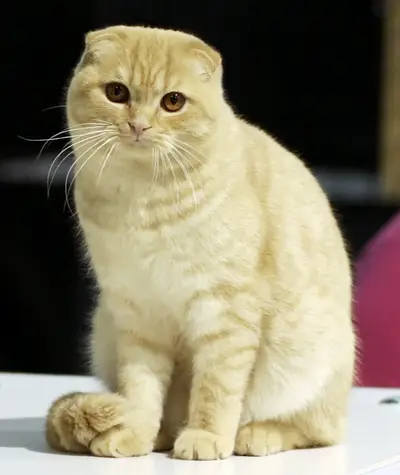
Taylor Swift's beloved cats Meredith and Olivia are both Scottish Folds. The breed traces back to Susie, a mutant white farm cat found in Scotland in 1961 — every fold-eared descendant comes from her line.
Overview
The Scottish Fold (苏格兰折耳猫) is a medium-sized cat breed weighing 2.5–6 kg with an 11–14-year lifespan. That signature folded ear comes from a cartilage-development gene defect. The look is undeniably cute, but the breed's health risks demand serious consideration. Temperament is gentle and affectionate.
Feeding
A regular high-quality cat food is fine; add fish oil and chondroitin to support joints.
Exercise
Low exercise needs — avoid high-intensity jumping to reduce joint strain.
Grooming
Short coat, brush weekly. Fold ears need frequent cleaning to prevent ear mites.
Health
The "folded ear" is actually osteochondrodysplasia. Nearly every Scottish Fold carries an arthritis risk — understand this fully before buying.
Gallery
A closer look at the Scottish Fold
From origins and personality to daily care and health — helping you judge whether this little companion is really the one for you.
Origin & history
From Susie on a Scottish farm to a global ethical debate
Origin & history
From Susie on a Scottish farm to a global ethical debate
In 1961, farmer William Ross in Perthshire, Scotland spotted a white long-haired cat named Susie whose ears folded forward. The Ross family began breeding from Susie's descendants and formally registered the breed with the GCCF in 1966.
Problems quickly emerged: early fold × fold pairings produced offspring with severe skeletal deformities. In 1971 the UK's GCCF and FIFe suspended registration of the Scottish Fold, on the grounds that the ear cartilage defect affected the entire skeleton. In 1974 the breed was exported to the United States, where CFA and TICA still use fold × straight-eared pairings — a strategy considered to reduce, but not eliminate, risk.
In 2019 the British Veterinary Association (BVA) explicitly called for an end to breeding and buying Scottish Folds; in 2023 the Netherlands Ministry of Agriculture added the fold to its prohibited-breeding list. GCCF and FIFe still refuse to recognize the breed.
Looks & breed standard
Three grades of ear fold + skeleton-wide involvement
Looks & breed standard
Three grades of ear fold + skeleton-wide involvement
The signature trait is the forward-and-downward-folding ear. CFA classifies fold intensity into three grades: single fold (tips slightly bent), double fold (mid-ear crease), and triple fold (ears clamped tight to the skull — the classic show grade). The deeper the fold, the more pronounced the whole-body skeletal involvement.
Every Scottish Fold kitten is born with straight ears — folding starts around 3-4 weeks of age. Some kittens don't develop the fold at all and grow up with straight ears; these are called Scottish Straights and can be safely used as breeding partners.
Beyond the ears, Scottish Folds display a classic "round-round-round" look: round head, round eyes, round body. Coats come in shorthair and longhair (the longhair is called Highland Fold or Scottish Fold Longhair). CFA accepts a wide color range.
Personality in depth
A gentle breed that often masks its pain
Personality in depth
A gentle breed that often masks its pain
Scottish Folds are typically described as gentle, quiet, and affectionate — but it's important to note that this "calmness" is often the result of chronic joint pain limiting movement. Studies show most adult Scottish Folds develop osteoarthritis to varying degrees.
They tend to be reserved with strangers, warming up slowly but bonding closely with their owners. They can live with dogs and other cats, but rely more heavily on human companionship than a British Shorthair does.
Because "quiet" is often mistaken for "contented," many owners fail to notice behavioral changes — reduced jumping, huddling, avoiding stairs — that actually signal joint pain. Sudden withdrawal warrants a vet visit right away.
Daily care
Joint support + weekly tail flexibility check
Daily care
Joint support + weekly tail flexibility check
Every routine care priority centers on the joints. From age one, supplement with omega-3s, chondroitin, and glucosamine to meaningfully delay osteoarthritis. Avoid high jumps (>1 m) and hard chases; furnish the home with low, wide platforms.
Check tail flexibility once a week: run your fingers gently from base to tip. Normal tails feel supple and articulated. Stiffness, nodules, or a thickened tip signal skeletal changes and warrant an X-ray.
Because the folded ear leaves the ear canal poorly ventilated, weekly ear cleaning is essential to reduce mites and fungal infections. Use vet-approved ear cleaner with cotton balls (never push cotton swabs deep into the canal).
Shorthaired folds need brushing once a week; longhaired folds 2-3 times a week.
Health & lifespan
Osteochondrodysplasia — no fold escapes it
Health & lifespan
Osteochondrodysplasia — no fold escapes it
The folded ear traces back to a dominant TRPV4 mutation (named Fd by Malik et al. 2015 J Feline Med Surg, and mapped genetically by Gandolfi et al. 2016 Sci Rep). This mutation disrupts hyaline cartilage development throughout the body — not just the ears, but wrists, hocks, spine, and pelvis too. **Every Scottish Fold that carries Fd will develop osteochondrodysplasia (OCD) to some extent.**
Homozygotes (Fd/Fd) are the worst affected — obvious lameness and reduced jumping typically appear within six months. Heterozygotes (Fd/fd) have milder symptoms but are still affected. Radiographic changes can be identified from six months of age.
Responsible breeders only use Fd × fd pairings to avoid homozygotes, but even so, every heterozygote has a 100% risk of skeletal changes. This is precisely why the UK BVA, the Netherlands Agriculture Ministry, and international welfare organizations recommend halting Scottish Fold breeding.
Beyond OCD, Scottish Folds' HCM and PKD rates are similar to other domestic cats and warrant routine screening.
Common myths & adoption tips
An ethical guide to buying a fold
Common myths & adoption tips
An ethical guide to buying a fold
A few common misconceptions deserve to be corrected:
1. **"Straight-eared kittens are healthy; folded-eared kittens are not" — false.** The Fd gene is dominant. Any cat with the Fd/x genotype will develop skeletal disease regardless of ear phenotype. Only Scottish Straights that don't carry Fd are truly free of the disease — but you can't tell from appearance alone; genetic testing is required.
2. **"Outcrossing prevents genetic disease" — false.** Every fold-eared cat necessarily carries Fd.
3. **"Supplements can cure osteochondrodysplasia" — false.** Chondroitin and similar can slow progression, but they cannot reverse a genetic disorder.
If you already have a Scottish Fold: schedule regular X-rays (at ages 1, 3, and 5), never encourage jumping, supplement joint care for life, and see a vet immediately for obvious lameness. If you're considering a purchase, please fully understand the ethical and health costs above — or choose a genetically negative Scottish Straight as an alternative.
References
This is an educational overview — for specific health and care advice, please consult the authoritative sources below and your veterinarian.
- CFA — Scottish Fold Breed Standard官方猫协会
- TICA — Scottish Fold Breed Standard国际猫协标准
- Gandolfi et al. 2016 Sci Rep — TRPV4 mutation in Scottish Fold学术研究
- Malik et al. 2015 J Feline Med Surg — Osteochondrodysplasia in Scottish Fold cats学术研究
- BVA — Statement on breeding of Scottish Fold cats动物福利
- ICatCare — Scottish Fold breed profile综合科普
- RVC VetCompass — Scottish Fold health study流行病学
- UC Davis VGL — Scottish Fold TRPV4 (Fd) Test基因检测
- GCCF — Statement on non-recognition of Scottish Fold英国猫协立场


