Felidae · CAT
Somali
🌟 You may have met one
Somalis were originally seen as 'defective' long-coated kittens in Abyssinian litters and given away as pets. It was breeder Evelyn Mague who, in the 1960s, established them as a distinct breed — naming them after Somalia, the country neighbouring Abyssinia (modern Ethiopia).
Overview
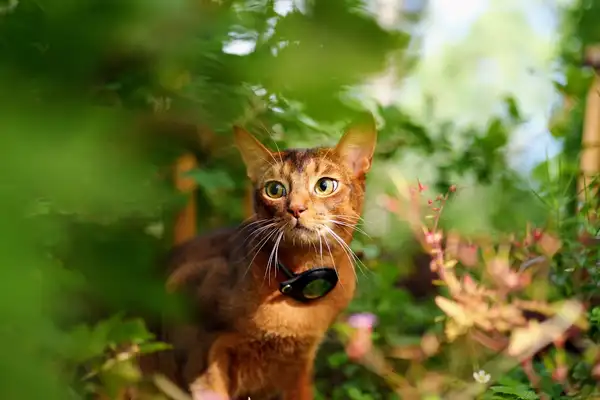
The Somali (索马里猫) is a medium-sized cat breed weighing 3.5–5.5 kg with a 12–16-year lifespan. The semi-longhaired version of the Abyssinian, often called 'the fox of the cat world'. Ruddy ticked coat, two-toned facial ruff, plumed fox-like tail and dark 'mascara' eyeliner. Extremely active, intelligent and clingy — one of the busiest longhaired breeds you can own.
Feeding
High-protein diet; fast metabolism supports free-feeding or 3-4 meals a day.
Exercise
Very high exercise needs — provide tall cat trees, puzzle feeders and 30+ minutes of daily interactive play.
Grooming
Silky semi-long coat rarely mats; comb 1-2 times weekly, more during seasonal shedding.
Health
Screen for PK deficiency (UC Davis test), PRA-rdAc (CEP290), HCM and renal amyloidosis.
Gallery
A closer look at the Somali
From origins and personality to daily care and health — helping you judge whether this little companion is really the one for you.
Origin & history
From 'defective' Abyssinian longhair to an independent breed
Origin & history
From 'defective' Abyssinian longhair to an independent breed
The Somali's history is inseparable from that of the Abyssinian. In the early 20th century, Abyssinian breeders occasionally saw kittens with **noticeably longer coats** appearing in otherwise standard litters. These longhaired kittens were first treated as **contamination or a flaw**, quietly rehomed as pets and never registered or shown.
The breeder who ultimately turned them into a distinct breed was **Evelyn Mague** of New Jersey. In 1963 she encountered a returned Abyssinian longhaired male named 'George' at a show and was struck by his beauty — the plumed tail, the two-toned ruff on the cheeks, the perfect ticked pattern. She began a systematic breeding programme and founded the **Somali Cat Club of America** in 1972.
The name comes from the geography of the region: since the Abyssinian is named after Abyssinia (modern Ethiopia), Mague chose the neighbouring country **Somalia** for the longhaired cousin, symbolising 'same land, different face'.
**Recognition timeline**: - **CFA** recognised the Somali as an independent breed in **1979** - **TICA** recognised it in **1979** - **FIFe** in **1982** - **GCCF** in **1991**
Modern genetic work (Lyons 2007; Gandolfi 2013) has confirmed that the Somali coat is caused by a **recessive mutation in FGF5** — the same locus responsible for long hair in other breeds. Two carrier shorthaired Abyssinians can therefore still produce Somali kittens. Genetically, **Somali and Abyssinian are simply the short- and long-coated forms of the same bloodline**, and several registries permit cross-registration between them.
Looks & breed standard
Fox tail, two-toned ruff and the ticked signature
Looks & breed standard
Fox tail, two-toned ruff and the ticked signature
The Somali's signature look can be summed up as a **longhaired fox**. The CFA breed standard uses phrases such as *wild, feral appearance, fox-like tail*:
- **Body**: medium, lithe and firmly muscled without being heavy; adults are 3.5-5.5 kg - **Head**: modified wedge with softly rounded cheeks and a slight nose break, gentler than the Abyssinian's - **Ears**: **large and cupped**, wide at the base, often carrying lynx tips - **Eyes**: almond-shaped, large and expressive, gold or green, framed by dark mascara-like liner - **Tail**: **long, thick and dramatically plumed** — the source of the fox comparison - **Coat**: **semi-longhaired (medium-long)**, silky and fine, with a distinct chest ruff and rear-leg breeches
The **core pattern is ticked tabby**: every guard hair carries 4-12 alternating light and dark bands (**agouti banding**), producing the wild-shaded look unique to the Abyssinian/Somali family. **Four official colours**: - **Ruddy (usual)**: warm red-brown base with black ticking; the classic - **Red (sorrel)**: honey-gold base with chocolate ticking - **Blue**: cream base with slate-blue ticking - **Fawn**: pale cream base with warm-grey ticking
Compared with the Abyssinian, the Somali differs only in coat length — the same blueprint stretched into a semi-longhair. Everything from the ticking, ear tufts, mascara eyes and body outline is shared.
Personality in depth
Non-stop activity, high intelligence and heavy attachment
Personality in depth
Non-stop activity, high intelligence and heavy attachment
If the Abyssinian is 'the monkey among cats', the Somali is that same monkey **plus fur**. Its activity level, curiosity and social demands are all at the top of the feline spectrum, and it copes very badly with long stretches of solitude.
**Key traits**: 1. **Constant motion**: it spends most of its waking hours moving — jumping onto the fridge, the door frame, the bookshelf and treating the entire house as a 3D playground 2. **Skilled paws**: it is remarkably good at operating things with its paws — opening cupboards, twisting knobs, pulling out drawers, flicking switches. **Child locks are strongly recommended** 3. **A shadow of the owner**: Somalis are follower cats, tracking you between rooms and often landing on the book you are reading or the keyboard you are typing on 4. **Talkative but soft**: frequent chirps and trills rather than the loud voice of a Siamese 5. **High intelligence**: they can learn fetch, opening doors, coming when called, sit and other cues 6. **Sociable with strangers**: unlike a British Shorthair, a Somali usually walks straight up to guests to inspect them
**Social needs**: Somalis really should be **kept in pairs or with a dog**. Left alone more than eight hours a day, they tend to overgroom, become destructive or slip into depression-like behaviour. They mix wonderfully with other Somalis, Abyssinians, Burmese, Siamese and lively dogs; they are **not a great match for older, quiet cats** such as Persians or British Shorthairs, whom they will pester.
They are not suited to owners looking for a quiet, decorative pet, nor to households that cannot tolerate a cat on the counters, in the sink or across the keyboard.
Daily care
Surprisingly easy grooming plus vertical space
Daily care
Surprisingly easy grooming plus vertical space
The Somali is one of the rare **longhaired breeds that are genuinely easy to groom**. Key routine points:
**1. Grooming**: - The semi-long coat is silky and **almost never mats** — it is nothing like a Persian or Maine Coon undercoat - A **weekly comb-out** with a metal or wide-tooth comb is enough most of the year - During spring and autumn shedding, comb daily with an undercoat rake to remove loose fur - Bathing is rarely needed unless the cat is unusually dirty or being shown
**2. Vertical space**: - **Non-negotiable**: at least one cat tree of 1.8 m or higher, ideally at a window - Cat shelves or perimeter walkways above head height greatly improve quality of life - Plan on **30-45 minutes of active play daily** — wand toys, laser pointer with a treat reward, puzzle feeders
**3. Diet**: - Fast metabolism justifies **high-protein food (>36%)** with wet food included - Adults may free-feed but monitor body condition — the long coat can hide weight gain - Provide plenty of fresh water; a circulating fountain is worth the investment
**4. Claws, ears, teeth**: - Claws: heavy scratcher — offer multiple textures (vertical + horizontal, sisal + corrugated) - Ears: large ears collect dust; check every two weeks - Teeth: some Somali lines are prone to chronic gingivitis and stomatitis, so start weekly tooth brushing early
Health & lifespan
PK-Def, PRA-rdAc, HCM and renal amyloidosis
Health & lifespan
PK-Def, PRA-rdAc, HCM and renal amyloidosis
The Somali / Abyssinian family is one of the most thoroughly studied groups in feline genetics. The main health issues:
**1. Pyruvate kinase deficiency (PK-Def / PKD)**: - **The single most breed-specific disease** in Abyssinians and Somalis - **Autosomal recessive** mutation in the PKLR gene, causing an unstable red-blood-cell metabolism and **intermittent haemolytic anaemia**, lethargy, jaundice and splenomegaly - Age of onset varies enormously — from 6 months to 12 years - **UC Davis VGL offers a PK-Def genetic test** as part of the Abyssinian/Somali panel - Responsible breeders should show **both parents' PK-Def status** and never mate carrier × carrier
**2. Progressive retinal atrophy (PRA-rdAc)**: - Caused by a mutation in the **CEP290** gene (Menotti-Raymond 2007) - Vision begins to decline around 1.5-2 years and is usually complete by 5 - UC Davis and Optigen offer genetic testing; it is **standard mandatory screening** for the breed
**3. Hypertrophic cardiomyopathy (HCM)**: - Reported in Somali/Abyssinian at moderate frequency - Recommend a cardiac ultrasound at age 1 and again around age 3
**4. Renal amyloidosis**: - A breed-associated middle-age kidney disease presenting as polydipsia/polyuria, weight loss and chronic renal failure - **No genetic test is available**; catch it early through routine biochemistry and urinalysis - Boyce 1984 and DiBartola 1986 described this breed-specific amyloidosis in detail
**5. Gingivitis / stomatitis**: relatively common in Somali lines and demands lifelong dental care.
Overall life expectancy is **12-16 years**, with well-screened lines regularly reaching 18+.
Fit for your space
Best for high-interaction households with vertical space
Fit for your space
Best for high-interaction households with vertical space
**A Somali fits well with**: - Experienced cat owners who have kept Abyssinians, Burmese, Siamese, Devon Rex or other high-drive breeds - Homes with **plenty of company** available (remote workers, retirees, larger households) - Rooms that can accommodate **vertical space** — tall cat trees, cat shelves, open-plan layouts - Households with other active cats or friendly dogs - Families looking for the compromise of 'long coat + dog-like interaction + relatively easy grooming' - Buyers willing to fund PK-Def, PRA-rdAc and HCM screening
**Not a good fit for**: - Owners who live alone and are away >8 hours a day - People wanting a quiet, decorative or lap-only cat (look at Persian, Ragdoll or Ragamuffin instead) - Small apartments with no room for vertical furniture - Households with older, quiet resident cats who will be pestered by a young Somali - Anyone who cannot tolerate a cat climbing on top of the fridge, prying open cupboards or landing on the keyboard
**Special notes**: - **Strict indoor housing** — the Somali's activity, curiosity and outstanding climbing skills make it very escape-prone - Ask breeders for documented **PK-Def and PRA-rdAc test results**, plus clearly stated carrier status of both parents - Be wary of unusually cheap 'Somali kittens' — some are Abyssinian longhairs sold without screening - Consider getting **two Somalis** or pairing with an active dog; solo Somalis often develop behavioural problems from sheer boredom
References
This is an educational overview — for specific health and care advice, please consult the authoritative sources below and your veterinarian.
- CFA — Somali Breed Article国际猫协标准
- TICA — Somali Breed Standard国际猫协标准
- FIFe — Somali Breed Standard (SOM)国际猫协标准
- GCCF — Somali Breed Standard of Points国际猫协标准
- UC Davis VGL — Pyruvate Kinase Deficiency in Abyssinian & Somali基因检测
- Menotti-Raymond et al. 2007 — CEP290 mutation & PRA-rdAc in Abyssinian/Somali学术研究
- Grahn et al. 2012 — PKLR mutation causing feline PK-deficiency学术研究
- Boyce et al. 1984 — Familial renal amyloidosis in Abyssinian cats学术研究
- ICatCare — Somali cat breed profile综合科普
- Somali Cat Club of America (SCCA)俱乐部官网