Canidae · DOG
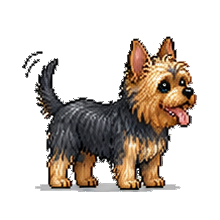
Yorkshire Terrier
🌟 You may have met one
Today's luxury handbag dog was a 19th-century professional ratter, darting between weaving machines in British cotton mills. War hero Smoky (found by GIs in the New Guinea jungle in WWII) weighed under 2 kg but pulled a 21-meter telegraph line through an under-runway culvert, saving the US Army three days of digging.
Overview
The Yorkshire Terrier (约克夏梗) is a small dog breed weighing 1.8–3.2 kg with a 13–16-year lifespan. The pocket-sized aristocrat with a silky floor-length coat. Bold and stubborn, Yorkies need early socialization to keep the attitude in check.
Feeding
Small-breed formula; avoid hard bones.
Exercise
30 minutes of walking a day is enough.
Grooming
Silky coat needs daily brushing; most owners choose a puppy cut.
Health
Prone to luxating patella, tracheal collapse, and periodontal disease.
Gallery
A closer look at the Yorkshire Terrier
From origins and personality to daily care and health — helping you judge whether this little companion is really the one for you.
Origin & history
Origin & history
The Yorkshire Terrier's roots are firmly in mid-19th-century northern England — **Yorkshire and Lancashire** during the Industrial Revolution. Scottish weavers moved south to English cotton mills, wool mills, and coal fields, bringing **Clydesdale (or Paisley) Terriers, Skye Terriers, Waterside Terriers** (now extinct), and a few **Manchester Terriers**. Millworkers cross-bred a small long-coated terrier that could scoot under spinning machinery, kill rats, and protect thread bobbins. Its first name was blunt: "broken-haired Scotch Terrier". [1][2] The breed's official debut was the **1861 Leeds Dog Show**, still catalogued as "broken-haired Scotch terrier" but with the recognizable Yorkie prototype already present. [1][3] The dog that made the breed was **Huddersfield Ben** (born 1865 in Huddersfield, owner Mary Ann Foster) — 5 kg / 11 lb, he entered 74 shows between 1865-1871 and won 74 prizes while siring extensive offspring. Nearly every purebred Yorkie today traces back to him. He is the true foundation sire, and was killed by a carriage on a street at age 6. [1][2][4] The **UK Kennel Club** first registered the breed as "Yorkshire Terrier" in **1874**, and it received full breed status in **1886**. [1][2] Yorkies reached the US early — first arrival 1872, **AKC recognition 1878**. Early US dogs also weighed 5-6 kg ("working size"), but pet-market pressure through the early 1900s shrank them to today's 4-7 lb (1.8-3.2 kg). [3][5]
Looks & breed standard
Looks & breed standard
Both AKC and The Kennel Club define the Yorkie as a **compact toy dog with a square silhouette, weighing no more than 7 lb (3.2 kg)** — most show winners cluster around 4-6 lb (1.8-2.7 kg). This is a different animal from the market-hyped "teacup Yorkie", which almost always comes with severe health issues. [1][3] The signature is the **steel blue and tan** two-tone coat, and the color isn't there at birth: puppies are born mostly black with a bit of tan, then over roughly **3 years** the tan on the head, chest, and legs deepens to rich gold while the black on the body and tail fades to deep steel blue. [3][6] The coat itself is a **single-layer silky long coat** — no undercoat. That's the physical reason for its low-shed / low-allergen reputation, and also why Yorkies **must wear clothes in winter** (no undercoat = no insulation). Show dogs grow the coat to floor length and daily divide it into strands wrapped in silk ("wrapping the coat") to prevent friction breakage. Family dogs (95% of pets) opt for a **puppy cut** at 2-4 cm all over. [6] Head: small skull, V-shaped erect ears, black button nose, dark round eyes. Adult shoulder height 20-23 cm; short but straight legs; tails were traditionally docked to half length, but many European countries banned docking after 2000. AKC allows a natural tail. [1][3]
Personality in depth
Personality in depth
Stanley Coren's 1994 intelligence ranking put the Yorkie at **#27** — Above Average Working Dogs. It masters basic commands in 5-15 repetitions and responds correctly on the first attempt about 70% of the time — impressive for a toy breed. [7] AKC uses three words for temperament: **tomboyish, feisty, affectionate** — toy build, terrier boldness. That's the unique Yorkie formula. [3] It's the poster child for **Napoleon complex**: it won't back down from big dogs, barks at strangers first, and guards territory fiercely. Vintage training manuals warned "don't let the small size fool you" — Yorkies are velcro at home and tough guards outside. [6] But that courage comes at a cost: **big-dog attacks are the leading cause of traumatic injury death in Yorkies**. In the 2018 UK VetCompass survey of 4,000 small-breed injuries, Yorkshire Terriers ranked in the top three for bite wounds. Never let one interact unsupervised with unfamiliar large dogs. [8] **Training difficulty** comes from the smart-plus-stubborn-plus-toy-dog-spoiling combo — Yorkies learn quickly but often "know but don't do", and small size makes owners lenient, feeding "small dog syndrome": resource guarding, barking, refusal to obey. Both SSCA and AKC insist Yorkies **be trained like large dogs**, with early socialization (100 novel experiences during the 8-16 week critical period) and "NILIF (Nothing In Life Is Free)". [5][6] **Separation anxiety** is moderate to high — toy breeds are highly bonded, so keep alone-time under 4-6 hours. **Barkiness** is the biggest neighbor-relations concern — doorbells, footsteps, and TV all trigger it, so train a quiet cue early.
Daily care
Daily care
The Yorkie's silky single coat **barely sheds** (AKC lists it as hypoallergenic-leaning; a 2011 PubMed study confirmed lower Can f 1 protein output than double-coated breeds), but **without care it will mat within three days**. [6] Two grooming schools exist. **Show-dog long coat** — grow to floor length (reached around 18 months), bathe weekly with silk-coat conditioner, then daily brush and separate strands wrapped in silk paper ("crackering / wrapping") to prevent breakage. Wraps only come off 24 hours before a show. Time investment 30-45 minutes/day, expensive, mostly for breeders. **Family puppy cut** — trim the whole body to 2-4 cm with a rounded "teddy face", groomer visits every 4-8 weeks, brushing every other day. Chosen by 95% of pet owners. [6] **Dental care is priority #1** for Yorkies. AVMA/Vetstreet 2024 data show that **70-85% of Yorkies have periodontal disease by age 3**. The universal toy-breed problem hits Yorkies hardest — a narrow jaw plus crowded teeth plus a soft-food diet build tartar fast. Owners **must brush daily** with a canine paste and get **an annual dental cleaning under general anesthesia**, or teeth start dropping and chronic infection reaches the kidneys after 5-7 years. [8][9] **Feeding note**: Yorkie puppies are prone to **hypoglycemia** — feed small amounts every 3-4 hours until 4 months, and watch for lethargy, tremors, or pale gums. Carrying glucose powder can save a life. [8] **Daily exercise**: 30-45 minutes of low-to-moderate walks plus indoor play; skip long-distance treks (tracheal collapse risk — see health).
Health & lifespan
Health & lifespan
Yorkies rank among the most disease-loaded toy breeds. VetCompass (Royal Veterinary College, based on ~900,000 dogs) 2018 dedicated study lists the highest-incidence issues: [8][9] **① Periodontal disease** — **70-85% affected by age 3** (among the highest of any breed). Toy jaw + long life + soft diet stack the odds; management is daily brushing plus annual anesthetic dental cleanings. **② Luxating patella** — **25-30% affected**, mostly Grade I-II (intermittent hopping); Grade III-IV needs surgery. Watch for the classic "three-legged skip for a few steps" during walks. Breeders should provide OFA patella grades. **③ Tracheal collapse** — **15-20% affected**, presenting as a **goose-honking cough**, especially with excitement, leash pull, or cold air. Management: **lifetime harness use, never a collar**; weight control (obesity is the main aggravator); avoid secondhand smoke. [8] **④ Portosystemic shunt (liver shunt)** — Yorkies have the highest breed risk, at **~35× baseline** (2-3% incidence). Blood bypasses the liver, letting toxins build up; symptoms include stunted puppy growth, post-meal behavioral changes, and seizures. Bile-acid blood test screens; surgical ligation cures. [8][9] **⑤ Mitral valve disease (MVD)** — around **10-15% of 10-year-old Yorkies show a heart murmur**, progressing to failure late in life; annual auscultation, echo when needed. [8] **⑥ Legg-Calvé-Perthes** and **distichiasis (double-row eyelashes)** are also seen. Puppy hypoglycemia is common under 4 months (see care). **Lifespan 13-16 years** is average for toy breeds, but 18+ isn't rare with good breeding and careful care.
Fit for your space
Fit for your space
Yorkies have parked in the AKC top 15 for decades (#13 in 2024). The staying power comes from near-perfect urban fit: [3][5] **① Tiny footprint** — 1.8-3.2 kg body, 30-45 minutes of daily exercise, indoor play covers the rest. A 30 sqm studio is plenty. **② No undercoat, virtually no shedding** — friendly to allergen-sensitive apartment dwellers. **③ Low body odor and easy indoor litter-box training** — rainy or snowy days, no need to go out. [6] But the flip side is a **glass-bone constitution**: **not for households with children under 4** — not because Yorkies are aggressive, but because they are **too fragile**. AKC explicitly warns that toy dog + preschooler needs strict supervision: a fall from the sofa can fracture a bone; wrong-hold posture causes patella slippage; accidental steps become emergency-room visits. [3] With other pets, Yorkies do well with familiar house cats and other toy dogs, but **should never live with or repeatedly visit medium-to-large dogs**. Bites are among the top three causes of Yorkie trauma death, and even one round of "dog play" from a friendly big dog can be fatal. [8] **Climate**: extremely cold-sensitive with no undercoat — must wear clothing in autumn/winter (especially below -5°C). In summer, watch for heatstroke (dark steel-blue coats warm quickly in sun; skip midday outings). [6] **Ideal owner profile**: single professional, retiree, remote worker, apartment dweller. Someone able to spend 20-30 minutes daily on brushing/brushing teeth/basic training, willing to accept lifetime training difficulty, with a moderate budget (grooming + dental + cardiac screening ~3,000-6,000 CNY/year). **Separation anxiety** is the biggest psychological cost to weigh — Yorkies are heavily attached toy dogs, and 40+ hours of alone-time per week degrades behavior sharply. **Famous representatives**: WWII hero **Smoky** (1.9 kg, found in New Guinea 1944, 12 combat missions, pulled a 21-meter telegraph line through an under-runway culvert, called "the world's first therapy dog"); **Sylvia** (1945 UK Guinness record — 6.35 cm at the shoulder, 113 g, the smallest adult dog in history). [1][10]
References
This is an educational overview — for specific health and care advice, please consult the authoritative sources below and your veterinarian.
- [1] Yorkshire Terrier - 起源、Huddersfield Ben、1874 命名 (Wikipedia)Review
- [2] Yorkshire Terrier 品种简介 (Britannica)Official
- [3] Yorkshire Terrier Breed Info & Standard (American Kennel Club)Official
- [4] Huddersfield Ben - 约克夏梗奠基公犬 (Yorkshire Terrier Club of America)Official
- [5] AKC 2024 年度品种流行度排行榜 - 约克夏 #13Official
- [6] Yorkshire Terrier 被毛、训练、护理综合指南 (VCA Animal Hospitals)Study
- [7] The Intelligence of Dogs - Coren 智商榜第 27 名 (Stanley Coren 1994)Study
- [8] VetCompass Yorkshire Terrier 常见疾病流行病学 (Royal Veterinary College)Study
- [9] 约克夏梗健康问题 - 牙周病/髌骨/气管塌陷/门脉分流 (Vetstreet)Study
- [10] Smoky the War Dog - 二战英雄约克夏 (Yorkie Rescue / Animals in War Memorial)Review