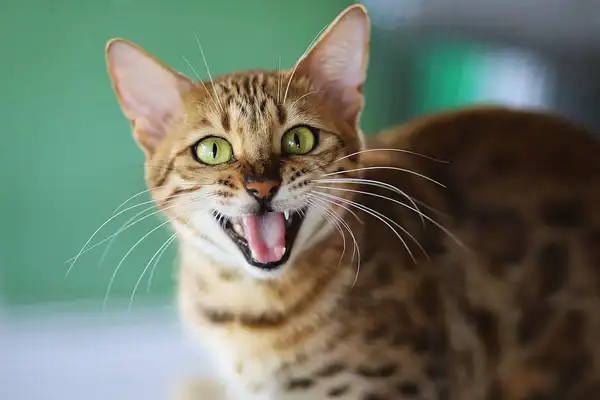
Felidae · CAT
American Shorthair
🌟 You may have met one
The American Shorthair's ancestors are said to have arrived on the Mayflower in 1620 as "ship's cats" — mousers on the crossing from England. That's why the breed is called "America's first native cat."
Overview
The American Shorthair (美国短毛猫) is a medium-sized cat breed weighing 3.5–7 kg with a 15–20-year lifespan. The classic silver-tabby cat with a gentle, independent personality and high tolerance for children. Robust and low-maintenance, it's a common companion cat in Western households.
Feeding
Not picky about food — a standard high-protein cat kibble works. Watch portions to prevent obesity.
Exercise
Retains a hunting streak; 15–20 minutes of interactive play a day maintains figure and staves off boredom.
Grooming
Short coat is easy — brush weekly, more during spring and fall coat blows.
Health
Overall healthy; watch for hypertrophic cardiomyopathy and dental care.
Gallery
A closer look at the American Shorthair
From origins and personality to daily care and health — helping you judge whether this little companion is really the one for you.
Origin & history
Origin & history
The American Shorthair (ASH) descends from British working cats brought to North America by 17th-century European colonists. The Mayflower's 1620 passenger records list cats (used to control shipboard rats), and those cats bred on in the North American colonies as "working farm cats." The 19th-century expansion of American railroads spread the breed nationwide, ratting in grain warehouses, stables, and freight cars.
Early in the 20th century the CFA opened purebred registration, and in 1904 the first named ASH male, Buster Brown (a brown tabby), was formally registered — marking the breed's transition from street cat to purebred. It was originally called Domestic Shorthair; the CFA renamed it American Shorthair in 1966 to distinguish it from non-pedigreed household shorthairs.
The American Shorthair is one of the CFA's top ten most popular breeds — healthy, stable, reasonably priced, and widely called "the benchmark American family cat."
Looks & breed standard
Looks & breed standard
The most iconic ASH image is the Silver Classic Tabby: silver-white base with black marbled markings — the most common ASH color at CFA shows and the cat on Whiskas packaging.
But the breed has 80+ officially recognized colors, spanning solids, tabbies, tortoiseshells, bicolors, and smokes — one of the widest palettes in domestic cats. Pattern types include classic tabby (marble), mackerel tabby, spotted tabby, and ticked (Abyssinian-style), with the classic marble being the ASH signature.
Body type is medium-large semi-cobby — longer, longer-legged, and more agile than the British Shorthair. Adult males 5–7 kg, females 3.5–5 kg. Round face with a squared jaw, round large eyes, medium-set ears. The overall look is "solid working cat," not the ornamental type of Persian or Ragdoll.
Personality in depth
Personality in depth
The American Shorthair has one of the most **balanced** temperaments among domestic cats — not as reserved as the British Shorthair, not as talkative and clingy as the Siamese, sitting neatly in the middle.
The CFA's breed description sums it up as "easy-going, robust, adaptable" — moderately open to strangers, friendly with children, dogs, and other cats, and one of the least conflict-prone breeds in a mixed household.
The strong working-cat instinct persists: the ASH will sit at a window watching birds for hours, then quietly patrol the house at night. Toy mice, wand toys, and flying-disc games spark far more prey drive than in most house cats.
Highly independent — 8–10 hours alone won't cause anxiety — while still enjoying company: sit down on the sofa and it'll come lie against your leg.
Daily care
Daily care
The American Shorthair is one of the easiest domestic cats to care for. The short coat needs weekly brushing; shedding intensifies during spring and fall coat blows, when a Furminator or similar de-shedding tool every 2–3 days keeps things under control.
Not picky about food — a standard high-protein (>35%) adult formula is enough. But because appetite is strong and activity moderate, obesity is the most common issue. Feed at the low end of package guidelines, twice a day; from age one on, switch to a calorie-controlled adult formula.
Exercise is moderate — more than a British Shorthair needs. 20–30 minutes of wand-toy or laser-pointer play daily keeps the ASH fit and happy. A big cat tree or sunny window perch handles most behavioral needs.
Bathing is rarely necessary unless there's localized soiling. Nail trims and ear cleanings follow standard protocol.
Health & lifespan
Health & lifespan
The American Shorthair is one of the longest-lived domestic cats (15–20 years is common), with a light breed-specific disease burden.
Main health concerns:
1. **Hypertrophic cardiomyopathy (HCM)**: Meurs et al. 2005 mapped an MYBPC3 A74T variant in the ASH, though the positivity rate is far lower than the Maine Coon's A31P. Annual cardiac ultrasound screening is recommended.
2. **Obesity and diabetes**: The ASH has one of the highest obesity rates among CFA cats, and strict weight control after middle age is important. Diabetes risk climbs sharply with obesity.
3. **Dental disease**: A universal shorthair issue — regular dental cleanings for older cats.
There are no PKD, SMA, or extreme facial-structure syndromes. The breed's gene pool is broad and selection has been long — a clear health advantage among domestic cats.
Fit for your space
Fit for your space
The ASH adapts to virtually any household structure — single, couple, kids, other pets. A 40-square-meter apartment is enough; a bigger house is a bonus for exploration.
Because the breed retains strong working-cat instinct, the ASH is one of the few CFA breeds allowed in supervised outdoor enclosures (though pure indoor life is still recommended for longevity). If you have a balcony, install cat-proof netting — the ASH is quick, and will follow a bird right off the ledge.
Insensitive to temperature and humidity, adaptable across climates. Big changes like moving or renovation may cause a short-term appetite drop, but usually resolves within 2–3 days.
References
This is an educational overview — for specific health and care advice, please consult the authoritative sources below and your veterinarian.
- CFA — American Shorthair Breed Standard官方猫协会
- TICA — American Shorthair Breed Standard国际猫协标准
- CFA — American Shorthair breed article & history综合科普
- Meurs et al. 2005 HMG — MYBPC3 variants in cats学术研究
- ICatCare — American Shorthair breed profile综合科普
- Öhlund et al. 2017 J Vet Intern Med — Feline diabetes and obesity risk学术研究
- Mayflower Society — Cats on the Mayflower voyage历史文献
- American Cat Fanciers Association — ASH history美国猫协
- The Cat Fanciers' Association Yearbook — Buster Brown 1904 registration历史文献