Canidae · DOG
Australian Shepherd
🌟 You may have met one
Despite the name, the 'Australian Shepherd' is a genuine American breed — it originated on 19th-century California ranches and has only an indirect Australian connection. The name comes from the Basque shepherds who arrived in the American West via Australia, along with their sheepdogs.
Overview
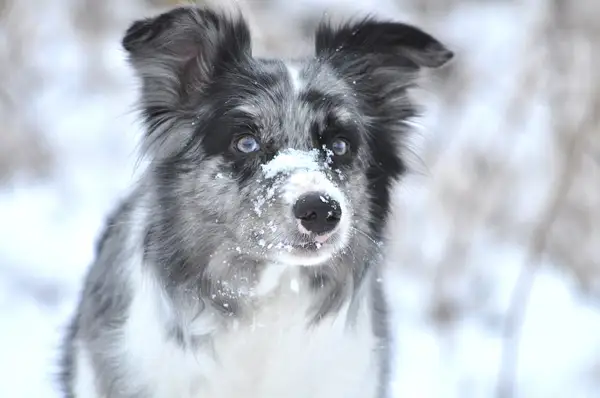
The Australian Shepherd (澳大利亚牧羊犬) is a large dog breed weighing 16–32 kg with a 12–15-year lifespan. A brilliant, energetic herding dog often sporting heterochromia and merle patterns. Very high exercise and mental stimulation needs — bored Aussies redecorate the house.
Feeding
Medium-large breed formula with high protein.
Exercise
About 1.5–2 hours daily plus mental training.
Grooming
Medium-long coat, brush 2–3 times a week.
Health
Watch for hip dysplasia, eye disease (CEA), and epilepsy.
Gallery
A closer look at the Australian Shepherd
From origins and personality to daily care and health — helping you judge whether this little companion is really the one for you.
Origin & history
Origin & history
The Australian Shepherd (Aussie) has one of the most misleading breed names — it wasn't born in Australia but on the American West Coast (especially California) in the 19th century [1][2]. The most widely accepted origin story: mid-19th-century Basque shepherds from the Pyrenees emigrated via Australia to the American West to run ranches, and the sheepdogs they brought crossed with local Collies and Border Collies to shape the modern breed. American cowboys called them 'Australian shepherds' after their arrival route [2][3].
The Aussie was pushed into public consciousness by post-WWII rodeo culture. In the 1950s–60s, trainer Jay Sisler toured US rodeos with his three Aussies (Stubby, Shorty, Queenie) and appeared in Disney films, launching the breed to fame [3][4].
The Australian Shepherd Club of America (ASCA) was founded in 1957, but the AKC didn't formally recognize the Aussie until 1993, in the Herding Group [1].
Looks & breed standard
Looks & breed standard
AKC standard: males 20–23 inches (51–58 cm) at the shoulder, 50–65 lb (23–29 kg); females 18–21 inches (46–53 cm), 40–55 lb (18–25 kg) — medium-large [5].
Coat is the Aussie's most striking visual signature. AKC recognizes four base colors: black, blue merle, red, and red merle — each optionally combined with white and copper points. Blue and red merle come from the dominant merle gene (M-locus) that creates the mottled coat, a trait shared with the Collie family [5][6].
Heterochromia is far more common in Aussies than in most breeds — one blue and one brown eye, or blue-and-brown split within a single eye — because merle affects pigment distribution [6]. A medium double coat with dense neck ruff keeps Aussies warm on cold ranches.
Personality in depth
Personality in depth
The Aussie ranks in the top 20 in Stanley Coren's 1994 Intelligence of Dogs, typically learning new commands in 5–15 repetitions [7]. It's a classic high-drive working dog; the AKC describes it as 'intelligent, work-oriented, exuberant' [1].
Extremely loyal to family — a 'one-owner' clingy dog by nature — while maintaining reserve toward strangers with a natural protective instinct. This makes the Aussie an excellent search-and-rescue, guide, therapy, and military/police dog [8].
The biggest risk is boredom: without adequate physical exercise and mental games, the Aussie invents its own work — chewing furniture, chasing cats, running circles, biting anything that moves. This is the leading reason Aussies are surrendered; before adopting, honestly evaluate whether the household can supply 1.5–2 hours of high-intensity daily activity [8][9].
Daily care
Daily care
The Aussie is a genuine athletic engine: 1.5–2 hours of high-intensity daily exercise — free running, disc, agility, water play, tracking, scent work [1][8]. Simple walks are far from enough — plan at least twice a week for open-space sprint sessions.
Mental training is equally essential: puzzle feeders, hide-and-seek games, trick training, and treibball are all Aussie favorites. Giving it a 'job' works better than giving it a toy [9].
Coat: medium double coat, brush 2–3 times a week, daily during coat-blow. Aussie shedding is on the higher side even for herding breeds. Do not shave — the double coat provides both heat and cold insulation, and shaving increases heatstroke and sunburn risk.
Merle-coat training tip: because heterochromia and the merle gene correlate, some Aussies have mild light sensitivity — avoid indoor high-frequency flash devices, and use clear hand signals for training [6].
Health & lifespan
Health & lifespan
MDR1 gene deficiency (Multi-Drug Resistance 1, formally the ABCB1-1Δ mutation) is the Aussie's most famous breed-specific issue — an estimated 50% of Aussies carry the mutation [10][11]. Carriers are hypersensitive to many common drugs (ivermectin, loperamide, some chemotherapy and antiemetic agents) — normal doses can cause severe neurotoxicity or death. After adopting any Aussie you must run MDR1 testing and inform every vet before medication — this literally saves lives [11].
Double merle tragedy: two merle dogs bred together produce 25% double-merle (MM) puppies, resulting in extensive white coat, hearing impairment, vision impairment, or full deafness/blindness — the direct product of irresponsible breeding [6][12]. Reputable breeders never breed merle × merle.
Eye disease: Collie Eye Anomaly (CEA) and Progressive Retinal Atrophy (PRA) both have high incidence — CERF/OFA eye exams and genetic testing recommended [11][13].
Other common issues: hip dysplasia, epilepsy, hypothyroidism, cancer (hemangiosarcoma, lymphoma), autoimmune disease. Average lifespan 12–15 years — one of the longer-lived herding breeds [1].
Fit for your space
Fit for your space
The Aussie's ideal living environment is a farm, ranch, or detached home with a large yard — it needs to run, and it needs a job [1][8]. Apartment life isn't impossible but requires strict conditions: an owner with abundant time (2+ hours of outdoor activity plus 30+ minutes of mental games daily) and a nearby dog park, off-leash area, or pet-friendly hiking trail.
The Aussie is climate-adaptable from cold-temperate to subtropical, but the double coat makes long hot summers uncomfortable — schedule training for early morning or dusk and keep water available.
On family structure, the Aussie is best matched to active households; children should be 8+ (young kids running and screaming can trigger the herding instinct — circling and heel-nipping). Aussies get along with other dogs but often assert dominance, requiring early socialization and multi-dog household rules.
References
This is an educational overview — for specific health and care advice, please consult the authoritative sources below and your veterinarian.
- AKC — Australian Shepherd Breed Profile官方犬业协会
- United States Australian Shepherd Association — Breed History全国单犬种俱乐部
- Jay Sisler — Rodeo trick dog history (Idaho State Historical Society)历史与人文
- Australian Shepherd Club of America (ASCA)官方俱乐部
- AKC — Australian Shepherd Official Breed StandardAKC 品种标准
- Clark et al. 2006 — Retrotransposon insertion in SILV is responsible for merle patterning of the domestic dog (PNAS)学术研究
- Coren S. — The Intelligence of Dogs (犬类智商排名)学术与科普
- VCA — Australian Shepherd Behavior & Care综合科普
- Washington State University — MDR1 Multidrug Sensitivity in Dogs (VCPL)学术兽医