Felidae · CAT
Balinese
🌟 You may have met one
The Balinese has no geographic connection to Bali, Indonesia. In the 1950s, American breeders felt the flowing silky fur resembled the graceful poses of Balinese temple dancers — hence the name.
Overview
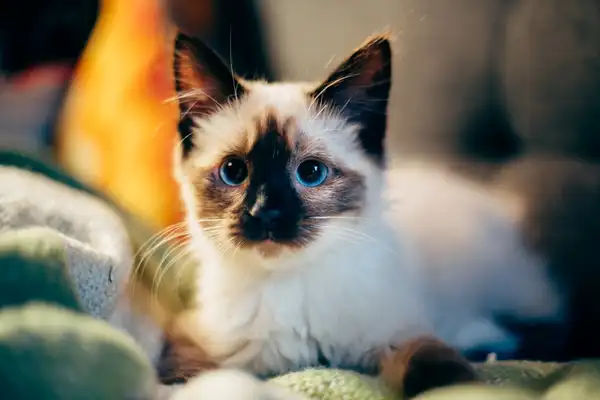
The Balinese (巴厘猫) is a small cat breed weighing 2.5–5 kg with a 12–20-year lifespan. Nicknamed the 'longhaired Siamese', the Balinese has Siamese-style pointed coloration, sapphire-blue eyes and elegant long silk fur. Its personality mirrors the Siamese — vocal, deeply affectionate and extremely intelligent. A single-layer coat means shedding is surprisingly low.
Feeding
High metabolism — feed high-protein cat food in 3 daily meals.
Exercise
Moderate-to-high exercise needs; loves jumping, chasing and wand play — 20-30 minutes of daily interaction.
Grooming
The single-layer long coat rarely mats; brush 1-2 times a week. Shedding is unusually low for a longhaired cat.
Health
Watch for HCM, PRA (progressive retinal atrophy) and strabismus — common Siamese-line issues.
Gallery
A closer look at the Balinese
From origins and personality to daily care and health — helping you judge whether this little companion is really the one for you.
Origin & history
Origin & history
The Balinese is **the long-haired variant of the Siamese** — essentially a distinct breed derived from a **recessive long-hair mutation (FGF5)** that appears sporadically in the Siamese gene pool.
**Early records**: - The CFA registered long-haired Siamese offspring as early as 1928 - In the 1940s and 1950s, New York breeder **Helen Smith** and California breeder **Marion Dorsey** began systematically breeding long-haired Siamese - Helen Smith felt the silky long coat and graceful movements evoked **Balinese temple dancers**, and named the breed **Balinese** — **with no geographic connection to Bali, Indonesia**
**Molecular basis**: the Balinese long coat comes from a **recessive mutation in FGF5 (Fibroblast Growth Factor 5)** (Kehler 2007), the same gene mutated in Persians, Maine Coons and other long-haired breeds — but at an **independent locus**.
**Recognition history**: - **CFA**: 1970 - **TICA**: recognized with Javanese included as a color variant - **FIFe**: 1983 - **GCCF**: 1986, as 'Balinese' and 'Balinese-Javanese'
**Classification dispute**: - **CFA**: recognizes only the 4 traditional pointed colors (seal, blue, chocolate, lilac) as Balinese; other colors (red, cream, tortie, lynx) are called **Javanese** - **TICA / FIFe**: all color variants are Balinese
Genetically, the Balinese and the Siamese are extremely close — effectively 'two coat-length variants of the same breed'.
Looks & breed standard
Looks & breed standard
The Balinese combines **a Siamese body with a medium-length single-layer coat**. The CFA standard reads *svelte, dainty, long silky coat, plumed tail*.
- **Head**: **extreme wedge** (modern type) — the tip of the nose to the tips of the ears form a perfect equilateral triangle - **Ears**: **very large and high-set**, pointed, bat-like - **Eyes**: **brilliant sapphire blue** (a byproduct of the pointed-color gene) — every Balinese must have blue eyes - **Body**: **slim, dainty, tightly muscled** on a fine skeleton — identical to the Siamese; adults 2.5-5 kg (petite to small) - **Legs and tail**: extremely long, slender legs; a long **plumed tail** - **Coat**: **single-layer medium-length hair (no down)** — the Balinese's signature, completely different from the double coat of a Persian - Silky in texture, lying close to the body - Longest on the tail (plumed), medium on the body, shortest on the face - **Single-layer structure means low shedding and minimal matting** - **Colorpoint**: face, ears, legs and tail are darker than the body — a byproduct of the temperature-sensitive **TYR/cs tyrosinase mutation**
**Four traditional CFA Balinese points**: seal, blue, chocolate, lilac
**Javanese variant colors**: red, cream, tortie, lynx points
**Distinguishing from other long-haired breeds**: - **Himalayan**: Persian body (round face/body) + colorpoint + double coat - **Ragdoll**: medium-large + colorpoint + semi-long coat, much larger than a Balinese - **Balinese**: slim Siamese body + colorpoint + single-layer long coat
Personality in depth
Personality in depth
The Balinese personality is **essentially identical to the Siamese** — it is 'the long-haired Siamese' and belongs to the **Oriental camp** psychologically, the opposite of the quiet British Shorthair, Persian or Russian Blue.
**Key behavioral traits**: 1. **Very vocal**: frequent, medium-volume, baby-like plaintive meowing — the Balinese may be **the most talkative of all long-haired breeds** 2. **Dog-like devotion**: follows the owner from room to room; will accompany you into the bathroom 3. **Very intelligent**: learns to open doors, fetch and press switches — **one of the top 3 cat breeds by intelligence** (alongside Siamese and Oriental Shorthair) 4. **One-owner tendency**: like the Siamese, may **favor one family member** especially 5. **Very high social need**: **>6 hours alone triggers visible anxiety**, overgrooming, food refusal or destruction 6. **Active but not frantic**: calmer than the Cornish/Devon, livelier than the Persian — mid-to-high energy 7. **Great with children, dogs and other cats**
**Watch out for**: - The Balinese is **not a 'quiet ornamental' cat** — for silence, look at the Persian or British Shorthair - **Keeping in pairs or with a dog** is the recommended setup — prevents separation anxiety
The Balinese is a perfect combination of **'affectionate + long-haired + blue-eyed'**, ideal for households who love 'conversations' with their cat.
Daily care
Daily care
Balinese care is **remarkably simple** — no down layer, and the long coat rarely mats.
1. **Brushing**: - **1-2 times a week** with a **wide-tooth comb plus boar-bristle brush**, root to tip - Moulting (spring/autumn): step up to 3 times a week - **No professional trimming needed** (unlike a Persian)
2. **Bathing**: - **Every 8-12 weeks** with a low-allergen pet shampoo - Low-heat blow-drying with a straightening comb is fine (no need to preserve curl)
3. **Diet**: - **High metabolism, high protein**: 3 meals daily, protein >38% - Like the Siamese, low body fat — small frequent meals suit best - Some individuals crave sweets (Siamese trait) — do not offer human sweets
4. **Eyes**: - The extreme wedge head places eyes close together — **wipe daily** - Some individuals have **strabismus** (Siamese-gene trait) — no vision impact, but note it
5. **Ears**: - Large ears build wax — **clean every 2 weeks**
6. **Exercise**: - **20-30 minutes of high-intensity daily interaction** (wand toys, laser, fetch) - Cat tree **>2 m tall** (Siamese-type strong verticals) - **Tip**: 5-10 minutes of daily clicker training
7. **Teeth and claws**: standard care
**Shedding**: - **Surprisingly low** — single-layer long coat and no down produces less shedding than a double-coated shorthair (like a British Shorthair) - But **Fel d 1 output is normal** — **not hypoallergenic**; do not buy just because shedding is low
Health & lifespan
Health & lifespan
Because the Balinese shares almost the entire Siamese lineage, hereditary risks overlap heavily:
1. **Hypertrophic Cardiomyopathy (HCM)**: - Moderate-to-high incidence (Siamese line) - **Annual echocardiogram from age 4 is recommended**
2. **Progressive Retinal Atrophy (PRA)**: - **Siamese-specific recessive mutation in CEP290** (Menotti-Raymond 2010) - Symptoms: reduced night vision progressing to total blindness in adulthood - **UC Davis VGL and Optigen offer PRA genetic testing** — mandatory before purchase
3. **Amyloidosis (AA)**: - **The Siamese line is prone to hepatic/renal amyloid deposition** - Symptoms: liver/kidney failure after age 7 - Genetic mechanism not fully defined
4. **Strabismus and tail kink**: - **Byproducts of the TYR (colorpoint) gene** — abnormal optic-nerve crossings - Some individuals show crossed eyes plus a kinked tail tip; health is unaffected but breed standard is
5. **GI sensitivity (IBD)**: - Common in the Siamese line — inflammatory bowel disease and food allergies
6. **Gingivitis and FORL**: - High incidence — **weekly brushing plus annual dental cleaning**
7. **PK-Def (pyruvate kinase deficiency)**: - Recessive Siamese-line mutation, testable at UC Davis VGL
8. **Anesthesia risk**: - **Low body fat plus some undiagnosed HCM** — a cardiac ultrasound is mandatory before anesthesia
**Average lifespan**: **12-20 years** — the Balinese is a **long-lived breed**, with healthy individuals routinely reaching 15+ years.
**Before you buy**: request from the breeder **HCM echo, PRA test, PK-Def test and a three-generation pedigree**.
Fit for your space
Fit for your space
The Balinese combines **'long-haired Siamese + high interaction + long lifespan'**, ideal for **households that can provide consistent company**.
**A good match for**: - **Large families** (multiple members share company) - Multi-pet homes with Devon Rex, Sphynx, Siamese or dog already present - Cat lovers wanting 'colorpoint + blue eyes + long coat' without the double coat of a Persian or Ragdoll - Owners who enjoy 'conversations' with their cat and can tolerate frequent meowing - Homes with room for a >2 m cat tree and a runway of open space - Buyers who can afford HCM, PRA and PK-Def testing
**Not a match for**: - **Owners who live alone and are away >6 hours a day** — separation anxiety is severe - **Households requiring silence** (newborns, recording work, hypersensitive neighbors) - Owners seeking an independent, non-clingy pet (see Persian, Chartreux, Russian Blue) - Homes with severe cat allergies (**the Balinese is not hypoallergenic** — despite low shedding, Fel d 1 output is normal) - Households that cannot tolerate high interaction and shoulder-climbing
**Special notes**: - **Strict indoor housing**: long fur soils easily, blue eyes disorient outdoor cats - **Frequent vocalization**: verify household members and neighbors will tolerate it - **Market confusion**: in China, 'long-haired Siamese mixes' are often sold as Balinese; a legitimate breed requires a three-generation pedigree plus a PRA test - **Consider adoption first**: shelters occasionally have long-haired colorpoint mixes at a fraction of the breeder price - **Pair recommendation**: if you are home <6 hours a day, **keep two together** — the Balinese is one of the most social breeds
References
This is an educational overview — for specific health and care advice, please consult the authoritative sources below and your veterinarian.
- CFA — Balinese Breed Article国际猫协标准
- TICA — Balinese Breed国际猫协标准
- GCCF — Balinese Breed Standard of Points国际猫协标准
- FIFe — Balinese Breed Standard (BAL)国际猫协标准
- Kehler et al. 2007 J Hered — FGF5 mutation & long hair in cats学术研究
- Menotti-Raymond et al. 2010 Invest Ophthalmol Vis Sci — CEP290 & PRA in Siamese/Balinese学术研究
- ICatCare — Balinese breed profile综合科普
- UC Davis VGL — Balinese/Siamese genetic testing panel基因检测
- Wikipedia — Balinese cat综合科普
- Balinese & Javanese Cat Club (UK)俱乐部官网