Felidae · CAT
Tonkinese
🌟 You may have met one
The name comes from the Gulf of Tonkin in northern Vietnam — a purely 'Oriental-sounding' choice with no geographic connection, chosen to match its Siamese-plus-Burmese heritage.
Overview
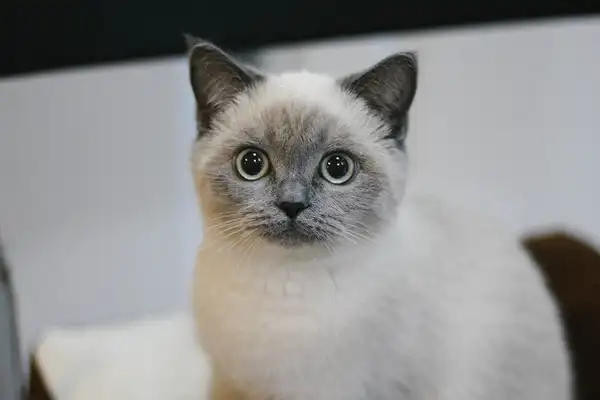
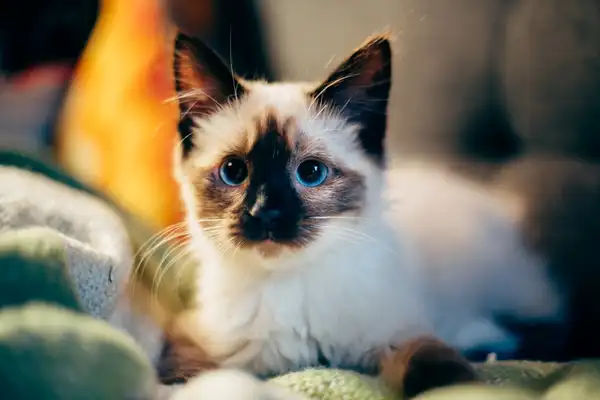
The Tonkinese (东奇尼猫) is a small cat breed weighing 3–5.5 kg with a 12–18-year lifespan. Bred by crossing Siamese and Burmese, the Tonkinese inherits the best of both: warm, extroverted, extremely intelligent and dog-like in devotion. Its signature aqua-turquoise eyes and gentle 'mink' coloration are far less extreme than a Siamese.
Feeding
High-protein cat food in 2-3 daily meals; metabolism sits between the Siamese and Burmese.
Exercise
Moderate-to-high needs; loves jumping, chasing and fetch — 20+ minutes of daily play.
Grooming
The short, close-lying coat needs only a weekly rubber-glove or bristle brushing; shedding is low.
Health
Generally healthy; watch for HCM, PK-Def and GM2 gangliosidosis (Burmese line).
Gallery
A closer look at the Tonkinese
From origins and personality to daily care and health — helping you judge whether this little companion is really the one for you.
Origin & history
Origin & history
The Tonkinese is **the world's first breed created by deliberate hybrid breeding**, established in the 1960s by Canadian breeder **Margaret Conroy** in Toronto, with a parallel program by American breeder **Jane Barletta**.
**Breeding goals**: - The Siamese was **too extroverted, vocal, extremely slim and blue-eyed** - The Burmese was **calmer, chunkier and gold-eyed** - Breeders wanted to combine the two: **an intermediate body, unique eye color and balanced personality**
**Genetic basis**: the Siamese carries the **TYR/cs (colorpoint, blue eyes)** allele and the Burmese carries the **TYR/cb (sepia, gold eyes)** allele — **two alleles of the same TYR gene**. Crossing them: - **cs/cs**: Siamese-style colorpoint, blue eyes - **cb/cb**: Burmese-style sepia, gold eyes - **cs/cb** (heterozygous): **intermediate 'mink' color with signature aqua-turquoise eyes** — the **Tonkinese type**
**Categories**: - **Mink pattern** (heterozygous cs/cb): the **core identifying trait**, aqua eyes - **Point pattern** (cs/cs): Siamese-like, blue eyes - **Solid/Sepia pattern** (cb/cb): Burmese-like, gold eyes
**Recognition**: - **CFF (Canadian Cat Association)**: 1965 - **CFA** 1979, **TICA** 1979, **GCCF** 1991, **FIFe** 2002
**Naming**: originally 'Tonkanese', later changed to **Tonkinese**, borrowed from Vietnam's **Gulf of Tonkin** — with **no geographic relationship**; simply an 'Oriental-sounding' choice that matched the breed's Oriental heritage.
Looks & breed standard
Looks & breed standard
The Tonkinese is textbook 'middle child of the Oriental family' — **intermediate between the Siamese and the Burmese**. TICA and CFA both describe it as *medium, well-muscled, surprisingly heavy*:
- **Head**: modified wedge, softer than a Siamese but more angular than a Burmese; medium muzzle with a slight break; nose length between the two parents - **Ears**: medium, wide at the base, tips slightly rounded — set at 45 degrees between the Siamese (side) and Burmese (top) - **Eyes**: **the defining trait**. Almond-shaped, slightly slanted, and depending on pattern: - **Mink**: signature **aqua/turquoise** — a shade unique to the Tonkinese - **Point**: sky blue (Siamese-like) - **Solid/Sepia**: gold to yellow-green (Burmese-like) - **Body**: medium length, well-muscled, surprisingly **heavier than it looks** (the 'brick wrapped in silk' feel is inherited from the Burmese) - **Legs & paws**: slender but proportional, oval paws, hind legs slightly longer than front - **Tail**: medium length, tapered, in balance with the body - **Coat**: short, close-lying, silky and shiny, low undercoat
**Color palette**: four historical colors (Natural, Champagne, Blue, Platinum) x three patterns (Mink, Point, Solid/Sepia) = 12 base combinations. TICA also accepts newer colors (Cinnamon, Fawn, Red, Cream, Tortie, Tabby).
Adult weight: 3-5.5 kg, males slightly larger. **Watch for confusion with the Siamese or Burmese**: a pure blue-eyed 'Tonkinese' is genetically a Siamese (cs/cs); a pure gold-eyed one is genetically a Burmese (cb/cb) — only the **aqua-eyed mink** is the classic 'Tonkinese type'.
Personality in depth
Personality in depth
The Tonkinese temperament is nicknamed **'the perfect middle ground'** — combining the Siamese's extroversion with the Burmese's warmth. Both CFA and TICA use *people-oriented, dog-like, playful, intelligent* to describe it.
**Key behavioral traits**: 1. **Extremely social**: door-greets, follows the owner room to room, insists on 'shoulder time' or lap time 2. **Dog-like devotion**: quickly learns its name, comes when called, many individuals fetch and walk on a leash 3. **Highly vocal but musical**: talks constantly but the voice is **softer and more melodic** than a Siamese 4. **Strong energy without being hyper**: enjoys interactive play, jumping and climbing, but calms down as an adult 5. **Gets on with kids, dogs and other cats**: one of the **most family-friendly breeds** overall 6. **Intelligence**: opens doors, learns clicker training, solves puzzle feeders quickly
**Watch out for**: - Alone for >8 hours daily leads to visible loneliness — a companion cat is strongly recommended - Very people-oriented — cannot cope with being ignored - Not a good match for households seeking a silent, aloof pet - Talkative — noise-sensitive neighbors may find it too vocal
The Tonkinese is often called **'the perfect first Oriental cat'** — softer than a Siamese, more talkative than a Burmese, and a top pick for families who want an interactive but manageable breed.
Daily care
Daily care
The Tonkinese is a **low-maintenance short-haired breed**, but its high sociability and Oriental metabolism place a few specific demands:
1. **Grooming**: - The short close-lying silky coat needs only **a weekly rubber-glove or soft-bristle brushing** - Shedding is low; a bath every 4-6 weeks is enough - Wipe eye corners and clean the ears every 2 weeks
2. **Diet**: - **2-3 meals daily**, high protein (>36%) - Metabolism sits **between the Siamese (very high) and the Burmese (moderate)** — watch weight after neutering - Fresh water always available; a fountain works better than a bowl
3. **Exercise & enrichment**: - **20+ minutes of daily interactive play** (wand toys, laser pointer, fetch) - Provide **at least one 1.8 m cat tree + several perches** — Tonkinese love climbing and observing - Puzzle feeders and clicker training relieve boredom
4. **Companionship**: - **Never leave the cat completely alone all day** - If you work full-time, adopt **two Tonkinese** or pair with a friendly cat or dog - Sudden aggression or over-grooming is often a sign of loneliness
5. **Dental care**: - Like other Orientals, the Tonkinese is prone to **gingivitis and periodontal disease** - **Brush weekly** and schedule an annual professional cleaning
6. **Environment**: - Room temperature 20-26°C is ideal - Strictly indoor — the Tonkinese is trusting to a fault and easy prey for theft or traffic
7. **Behavior**: - Provide multiple hiding spots and elevated 'observation towers' for stress management - Introduce new pets slowly; the Tonkinese is friendly but territorial about its human
Health & lifespan
Common health issues
Health & lifespan
Common health issues
The Tonkinese, thanks to its hybrid vigor, is **generally healthier than either parent breed**, but still carries the following breed-specific risks:
1. **HCM (Hypertrophic Cardiomyopathy)**: an inherited disease common in most cat breeds. Both parent breeds (Siamese and Burmese) show moderate risk. **Annual echocardiogram after age 2**, especially in breeding animals.
2. **PK-Def (Pyruvate Kinase Deficiency)**: chronic hemolytic anemia caused by an autosomal recessive **PKLR** mutation, well documented in Burmese lines and inherited by the Tonkinese. **UC Davis VGL DNA test** available; breeders should test before breeding.
3. **GM2 Gangliosidosis (Burmese line, rare)**: caused by a HEXB mutation, a fatal lysosomal storage disease. Extremely rare in modern Tonkinese lines but breeding animals should still be screened.
4. **Gingivitis / periodontal disease**: like other Orientals, Tonkinese are prone to plaque and dental disease. Regular home brushing + annual scaling.
5. **Hypokalemic polymyopathy (Burmese line)**: an inherited muscle weakness disorder caused by a WNK4 mutation, primarily in Burmese, occasionally seen in Tonkinese. A DNA test is available.
6. **Diabetes mellitus**: the Burmese has one of the highest feline diabetes rates worldwide, and the risk is inherited by the Tonkinese. **Prevent obesity + weight-control diet after neutering**.
7. **Strabismus and nystagmus**: point-pattern Tonkinese (cs/cs) may inherit the Siamese's crossed eyes or fine eye tremor — cosmetic only, does not affect health.
**Buyer's checklist**: request **parents' HCM echocardiogram + PK-Def DNA + GM2 DNA + three-generation pedigree** from the breeder. Reputable catteries provide these proactively.
Fit for your space
Environment fit
Fit for your space
Environment fit
The Tonkinese is one of **the most adaptable Oriental cats** and suits a wide range of households.
**Good match for**: - **Families with children** — its patience and gentleness are famous - **Multi-pet households** — most Tonkinese get on with dogs, other cats, even birds - **First-time cat owners** — its personality is much easier than a Siamese - **Apartment dwellers** — moderate energy, no long hallway required - **Home-office workers** — thrives on companionship - **Owners wanting an interactive, dog-like cat**
**Poor match for**: - Full-time out-of-home households with **no second pet** — leads to serious loneliness - Households needing **a completely silent pet** — the Tonkinese talks constantly - Owners who cannot commit to **weekly dental care + annual echocardiogram** - Households with **frequent open doors / balcony access** — the Tonkinese is trusting and easily lost
**Special notes**: - **Strict indoor lifestyle**: it approaches strangers and is easily stolen or run over - **Companionship**: adopting **two Tonkinese together** is often better than one - **Beware of market confusion**: Chinese pet markets often mislabel any 'Siamese x Burmese mix' as a Tonkinese; the real breed requires a **three-generation pedigree and typical aqua eyes** - **Consider rescue**: TICA/CFA-registered breeder retirements sometimes offer adult Tonkinese cats — a great option for adopters
References
This is an educational overview — for specific health and care advice, please consult the authoritative sources below and your veterinarian.
- CFA — Tonkinese Breed Article国际猫协标准
- TICA — Tonkinese Breed国际猫协标准
- GCCF — Tonkinese Breed Standard of Points国际猫协标准
- FIFe — Tonkinese Breed Standard (TON)国际猫协标准
- Lyons et al. 2005 J Hered — Colorpoint & sepia (TYR) mutations in cats学术研究
- Bradbury et al. 2013 Mamm Genome — HEXB & GM2 gangliosidosis in Burmese学术研究
- ICatCare — Tonkinese breed profile综合科普
- UC Davis VGL — Tonkinese/Burmese genetic testing panel基因检测
- Wikipedia — Tonkinese cat综合科普
- Tonkinese Breed Association俱乐部官网