Felidae · CAT
Chartreux
🌟 You may have met one
French icons Charles de Gaulle and the novelist Colette both adored the Chartreux — Colette even wrote her cat 'Saha' into her 1933 novel 'La Chatte'.
Overview
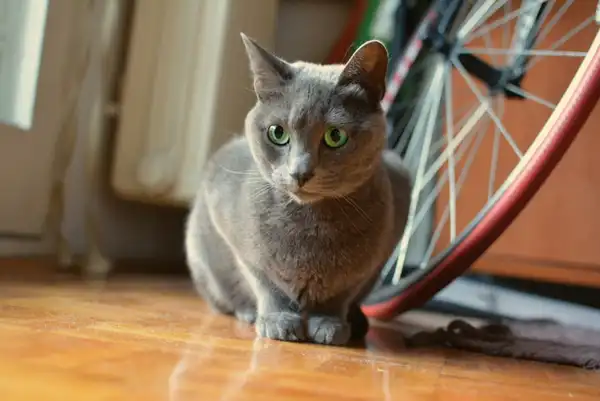
The Chartreux (沙特尔猫) is a medium-sized cat breed weighing 3–7.5 kg with a 12–16-year lifespan. A French national treasure and one of the oldest natural cat breeds, the Chartreux has a wool-like blue-gray double coat, copper-gold round eyes and a signature upturned 'smile'. Quiet, gentle, loyal and almost silent — nicknamed the 'monk of cats'. Excellent for apartments and first-time owners.
Feeding
Prone to weight gain as an adult — feed 2 measured meals of weight-management food.
Exercise
Moderate needs (level 3): 15-20 minutes of daily interactive play plus free access to a cat tree.
Grooming
The wool-like double coat needs metal-tooth combing twice a week; daily during seasonal shedding.
Health
Watch for HCM, patellar luxation and obesity; overall a long-lived, healthy breed.
Gallery
A closer look at the Chartreux
From origins and personality to daily care and health — helping you judge whether this little companion is really the one for you.
Origin & history
Origin & history
The **Chartreux** is a **French national-treasure cat breed** whose history reaches back at least to the **16th century**, making it **one of the oldest natural domestic cat breeds in the world** — alongside the Russian Blue, Burmese and Siamese as one of the 'four ancient shorthairs'.
**Origin legends**: 1. **Crusader theory**: medieval Crusaders brought blue-gray mountain cats back from the Middle East (Syria / Persian Plateau); the **Carthusian monks** of the **Grande Chartreuse monastery** kept them, giving the breed its name and the 'monk of cats' nickname. 2. **Spanish wool theory**: the 18th-century French lexicographer Emile Littre recorded that 'Chartreux' referred to a type of **Spanish wool (laine des Chartreux)** — the coarse, thick texture matches the breed's wool-like double coat.
**Key timeline**: - **1558**: French poet Joachim du Bellay described his blue-gray cat Belaud in the poem 'Vers Francais sur la mort d'un petit chat' — the earliest written record - **1723**: Buffon's 'Histoire Naturelle' lists Chartreux as an independent domestic cat type - **1928**: French breeders **Marcelle and Suzanne Leger** found a self-sustaining blue-gray colony on **Belle-Ile-en-Mer**, starting the modern breeding program - **1931**: the first Chartreux club is founded in France - **World War II**: the breed was nearly wiped out during European food shortages - **1970s**: Helene Gamon imported Chartreux from Europe to the United States, restarting American breeding - **1987**: the **CFA** formally recognized the Chartreux - **1988**: the **TICA** recognized the breed
**Genetics**: the Chartreux's blue-gray coat is produced by **homozygous recessive d/d at the MLPH gene** (Dilute) — the same mechanism used by Russian Blue and British Shorthair Blue. Unlike the British Shorthair, however, the Chartreux **has not been intensively line-bred**, so it retains a comparatively healthy gene pool.
Looks & breed standard
Looks & breed standard
The Chartreux looks like **a monk wrapped in blue-gray wool**. The CFA breed standard emphasises *rustic, sturdy, blue-gray, potato head with smile*:
- **Head**: a **large, round 'potato head'** with broad cheeks and a rounded chin - **Muzzle**: a distinctive **narrow muzzle** — from the front it looks like the cat is 'holding a small potato', and the upturned corners create the famous **'Chartreux smile'** - **Nose**: medium-long, straight, with a slate-gray leather - **Ears**: medium, **high-set and upright** (a sharp contrast with the low-set British Shorthair), tips slightly rounded - **Eyes**: **large and round**, in **copper to orange** (green or yellow eyes are disqualifying — an important distinguishing point) - **Body**: a **primitive/robust build** — deep chest, thick shoulders, strong bone but relatively short legs; resembles a small bear - **Legs**: **relatively short** (shorter than the British Shorthair), heavy bone - **Paw pads**: rose to dark gray - **Tail**: medium length, wide at the base, rounded tip - **Coat**: a unique **wool-like double coat** — long fine guard hairs plus a dense water-resistant undercoat; the feel is closer to felted wool than to velvet - **Color**: **only blue-gray (ash blue) is accepted**, from pale to steel-blue, with obligatory **silver tipping**
**Sexual dimorphism**: **males are much larger than females** — males 6-7.5 kg, females 3-4.5 kg. **British Shorthair Blue vs Chartreux**: Chartreux has high-set ears, a narrow muzzle, short legs and a wool-textured coat; BSH has low-set ears, a round face, medium legs and a plushy coat. **Russian Blue vs Chartreux**: Chartreux is heavy-boned with copper eyes; Russian Blue is fine-boned with vivid green eyes.
Personality in depth
Personality in depth
The Chartreux is described by CFA, TICA and GCCF as a **'silent observer'** — one of **the quietest domestic cat breeds**, almost never vocalizing beyond an occasional soft chirp when very excited or hungry.
**Key behavioral traits**: 1. **Almost silent**: **some Chartreux never vocalize in their entire lives** — the CFA profile literally says 'nearly silent' 2. **Gentle and loyal**: a **'one-person cat'** — usually bonds strongest to a single family member while remaining friendly to everyone else 3. **Intelligent observer**: unlike the chatty Siamese, the Chartreux **watches its family in silence**, then delivers a precise, well-timed social response 4. **Dog-like following**: follows the owner from room to room and settles quietly nearby 5. **Extremely patient with children**: **one of the best breeds for households with kids** — tolerates handling without scratching or biting 6. **Strong hunting drive**: traditionally a French farm mouser; retains a strong prey drive even indoors 7. **Excellent adaptability**: handles moves, travel and change with minimal stress 8. **Dislikes chaos**: not a fan of parties, loud music or frequent visitors
**Watch out for**: - **Reserved emotionally**: does not roll around begging for attention like a Ragdoll — the owner must **initiate contact** - **Moderate attachment**: fine alone for up to 8 hours, but expects focused attention when you return - **Not great with dogs** unless raised together - **Adult activity drops**: after age 3 the Chartreux becomes noticeably calmer and less playful
The Chartreux is the **top pick for a first-time cat owner** — gentle, quiet, healthy, intelligent, easy to care for and virtually free of personality problems.
Daily care
Daily care
The Chartreux is a **low-difficulty, long-lived** breed. Daily care is simple, but the coat and weight need specific attention.
1. **Coat grooming**: - The **wool-like double coat** is the main care task — long guard hairs on top plus a dense water-resistant undercoat that mats easily - **Twice-weekly metal-tooth combing** (a soft brush alone will not reach the undercoat) - **Daily during spring/autumn shedding**, plus a de-shedding tool - **Do NOT shave** — once the coat structure is disturbed, it takes 2-3 years to grow back and the color often fades
2. **Diet**: - **Highly prone to weight gain after adulthood** — obesity is one of the breed's top health issues - **Two measured meals per day of a weight-management diet** (fat <15%, fiber >5%) - Target weight: **females 3.5-4.5 kg, males 5.5-6.5 kg**
3. **Exercise**: - **Moderate needs (level 3)**: **15-20 minutes of daily interactive play** - Enjoys low-intensity 'prey' games (dragging a feather for it to pounce on) - One 1.5 m cat tree is enough
4. **Dental care**: - Generally healthy — **brush 2-3 times per week + a dental cleaning every 1-2 years**
5. **Companionship**: - **Relatively independent** — can be alone for up to 8 hours - Give it **20-30 minutes of focused interaction** when you return home
6. **Annual check-ups**: - The Chartreux is a **long-lived breed (15-20 years is possible)** - **Yearly full check-up + echocardiogram every 2 years**
7. **Room temperature**: - The wool double coat is **cold-tolerant but heat-sensitive** — keep the home below 28°C in summer
8. **Nail care**: - **Trim front nails every 3-4 weeks** - Provide a sisal scratching post to protect furniture
Health & lifespan
Common health issues
Health & lifespan
Common health issues
The Chartreux is a **relatively healthy and long-lived ancient natural breed**, with a lower genetic disease load than modern engineered breeds. **Average lifespan 12-16 years**, with healthy individuals reaching **18-20**. Still, watch for the following breed-specific issues:
1. **Patellar luxation**: the Chartreux has a **higher-than-average rate**. Observe hind-limb gait in kittens; early detection allows conservative management. Severe cases require surgery.
2. **Polydactyly**: the breed **carries the polydactyly allele at a slightly elevated rate**. Most cases are a single extra thumb (harmless) but disqualify a cat from CFA showing.
3. **HCM (Hypertrophic Cardiomyopathy)**: low-to-moderate risk. **Echocardiogram every 2 years**.
4. **Obesity**: **adult metabolism drops while appetite stays high** — obesity is common and triggers diabetes, arthritis and fatty liver. **Strict weight control is the single most important health measure**.
5. **Gingivitis**: moderate risk — regular brushing controls it well.
6. **PKD1 (Polycystic Kidney Disease)**: rare. Historical outcrosses to Persians created a small carrier risk in some lines — reputable catteries **DNA-test for PKD1**.
7. **Anesthesia risk**: **robust breed** with good anesthetic tolerance, better than Oriental breeds. Obese adult males, however, carry higher anesthesia risk.
**Buyer's checklist**: after multiple near-extinctions in the 20th century, any legitimate Chartreux must have **a three-generation pedigree**. 'British Shorthair Blue mix' cats are commonly passed off as Chartreux in the Chinese market — verify **high-set ears, narrow muzzle, short legs, wool-textured coat and copper-gold round eyes**. A reputable cattery will provide **HCM echo + patellar grading + PKD1 DNA** proactively.
Fit for your space
Environment fit
Fit for your space
Environment fit
The Chartreux is an **all-purpose breed** that suits almost any household.
**Good match for**: - **First-time cat owners** — quiet, gentle, healthy, long-lived, easy to care for - **Apartment or small-home living** — moderate exercise needs; a 1.5 m tree is enough - **Households with children** — patient, tolerant, hard to stress - **Multi-person homes** — does not stress from multiple humans - **9-to-5 workers home-alone up to 8 hours** — no need for round-the-clock companionship - **Elderly / semi-retired owners** — a quiet, gentle companion cat - **Households that dislike vocal cats** — the Chartreux is essentially silent
**Poor match for**: - Owners wanting a **high-interaction, super-clingy cat** (choose a Ragdoll or Maine Coon) - **Multi-dog households** (not great with dogs) - **Hot climates above 28°C** — the wool coat cannot handle it - **Free-roaming outdoor** homes — the ancient hunter drive means it will wander and can be lost - Households unable to commit to **15-20 years of care**
**Special notes**: - **Beware market confusion**: **around 90% of 'Chartreux' cats in the Chinese market are British Shorthair Blue mixes**. A true Chartreux needs **a CFA / GCCF / LOOF (France) three-generation pedigree plus high ears, narrow muzzle, short legs and copper eyes** - **French origin**: genuine LOOF-registered Chartreux are extremely rare in China; most are European imports - **Price**: legitimate Chartreux run 12,000-25,000 RMB - **Consider rescue**: French rescue groups occasionally have Chartreux mixes, far cheaper than buying - **Indoor-first**: while adaptable, indoor-only living extends lifespan by 3-5 years - **Pairing**: if you want a second cat, pair with a **British Shorthair, Russian Blue or another Chartreux** — avoid pairing with a high-energy Siamese or Maine Coon
References
This is an educational overview — for specific health and care advice, please consult the authoritative sources below and your veterinarian.
- CFA — Chartreux Breed Article国际猫协标准
- TICA — Chartreux Breed国际猫协标准
- GCCF — Chartreux Breed Standard of Points国际猫协标准
- FIFe — Chartreux Breed Standard (CHA)国际猫协标准
- LOOF (Livre Officiel des Origines Felines) — Chartreux Standard国际猫协标准
- Ishida et al. 2006 J Hered — MLPH dilute mutation in cats学术研究
- Lyons et al. 2004 Genomics — PKD1 mutation in Persian-related cat breeds学术研究
- ICatCare — Chartreux breed profile综合科普
- UC Davis VGL — Coat color testing (Dilute MLPH)基因检测
- Wikipedia — Chartreux综合科普