Felidae · CAT
Korat
🌟 You may have met one
In Thai tradition the Korat is called Si-Sawat ('good luck') and is given only as a gift — typically to honoured guests or new brides — because selling one for money is believed to nullify its power to bring fortune.
Overview
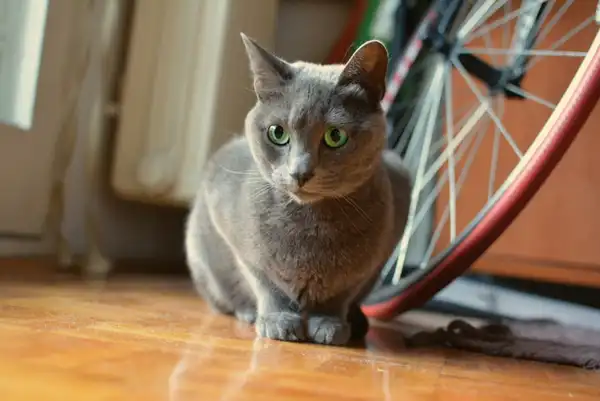
The Korat (柯拉特猫) is a small cat breed weighing 2.5–4.5 kg with a 15–19-year lifespan. One of Thailand's oldest native breeds. Silver-tipped blue coat, heart-shaped face and vivid peridot-green eyes. Documented in the Tamra Maew cat poems around 1350, the Korat is regarded as a luck cat in Thai culture, traditionally given only as a gift, never sold. Deeply devoted, quiet and one-person by nature.
Feeding
Standard high-protein cat food; sensitive stomach — change diets gradually.
Exercise
Moderate energy; enjoys puzzle feeders and interactive toys over frantic play.
Grooming
Single short coat sheds very little; comb once weekly is enough.
Health
Mandatory screening for GM1 and GM2 gangliosidosis (UC Davis genetic test) — the breed's signature lethal disease.
Gallery
A closer look at the Korat
From origins and personality to daily care and health — helping you judge whether this little companion is really the one for you.
Origin & history
The silver-blue luck cat of the Tamra Maew
Origin & history
The silver-blue luck cat of the Tamra Maew
The Korat, known in Thailand as **Si-Sawat**, is one of the very few cat breeds with **documentary evidence stretching back more than 600 years**. Its Western name comes from the **Korat (Nakhon Ratchasima) province** in northeastern Thailand — the story is that King Rama V, on seeing one at a cat show, asked where it came from and was told 'Korat', and the name stuck.
**The Tamra Maew** (Cat-Book Poems), a treatise from the Ayutthaya period (1350-1767), describes 17 'good-luck cats' and 6 'bad-luck cats'. The very first entry is **Si-Sawat** — 'coat like clouds, eyes like the dew on a lotus leaf, paws the colour of the lotus'. That is our earliest written record of the Korat, roughly 670 years old.
**Cultural role in Thailand**: - 'Si-Sawat' means good luck or good fortune, and Korats are traditional **wedding gifts**, presented to brides in pairs - They are **given as gifts, never sold**, because paying money for one is believed to nullify their power to bring luck - Even today the Thai Korat clubs place strict conditions on export lines
**Coming to the West**: In 1959, breeder Jean Johnson (Cedar Glen Cattery) brought a breeding pair (Nara and Darra) from Bangkok to the United States, marking the beginning of the Korat's international career.
- **CFA** recognition: 1966 - **TICA** recognition: 1979 - **FIFe** recognition: 1972 - **GCCF** recognition: 1975
CFA and TICA both maintain that a modern Korat's pedigree **must trace to Thai foundation stock**, and outcrossing (particularly to the Russian Blue or Nebelung) is not permitted — a key rule for preserving its purity.
Looks & breed standard
Heart-shaped face, peridot eyes and silver-tipped blue
Looks & breed standard
Heart-shaped face, peridot eyes and silver-tipped blue
The Korat is one of the easiest shorthaired cats to identify at a glance. The CFA breed standard hinges on three details: the **heart-shaped face**, the **one-and-only silver-tipped blue coat**, and **eyes that only turn green in adulthood**.
- **Head**: **heart-shaped from the front** — wide at the top (broad ear base + prominent brows) and narrow at the bottom (tapered chin). It is the **only breed** in the CFA standard whose head is described as 'heart' - **Ears**: large, set high, wide at the base with rounded tips - **Eyes**: **large, round and prominent**; in adults a luminous **peridot green**. Kittens are amber-gold and typically reach final green colour only at **2-4 years of age** - **Nose**: 'lion-nose' — short bridge with a downward-curving tip - **Body**: small to medium and **semi-cobby** — short, firm, muscular but not heavy-boned; adults 2.5-4.5 kg - **Legs**: front legs slightly shorter than the rear, giving the chest a subtle forward tilt
**Colour**: the Korat has **only one accepted colour** — **silver-tipped blue**: - Each hair is blue at the base with a silver tip - Under strong light this produces the trademark 'silvery haze' shimmer - Kittens may show ghost tabby markings that vanish in adulthood - Many are born with a small white patch (the 'lucky spot') that usually fades
**Easily confused with**: - **Russian Blue**: more elongated body, double coat, deeper emerald eyes, no heart-shaped face - **Chartreux**: heavier build, round face, copper eyes, French origin
The three are the 'blue cat triplets', but the Korat's heart-face, semi-cobby body and Thai lineage are unique.
Personality in depth
Devoted, focused and a classic one-person cat
Personality in depth
Devoted, focused and a classic one-person cat
The Korat has a classic **Thai-cat temperament** — as intelligent and focused as the Siamese, but **noticeably quieter**. It bonds intensely with family and is the textbook 'one-person cat'.
**Key traits**: 1. **Deep attachment**: it will follow you, climb into your lap, headbutt for attention and demand to sleep with you. Its attachment to a **primary caregiver** is much stronger than to other household members 2. **Cautious with strangers**: on hearing a doorbell, a Korat is more likely to observe from a hiding spot before deciding whether to appear — not fearful, just evaluative 3. **Bright but not manic**: intelligence comparable to a Siamese but energy noticeably lower. It happily learns cues, plays fetch or opens drawers, yet also enjoys just sitting quietly by you 4. **Soft voice**: the polar opposite of a loud Siamese; the Korat mutters at low volume in a very conversational tone 5. **Territorial**: it can be strongly possessive of its owner, its space and its favourite toys, so **avoid pairing it with another strong-willed cat**
**Social fit**: - **Ideal for single-owner homes** with a steady routine and time for deep one-cat attention - **In multi-cat households**: mix carefully. Korats can coexist peacefully with gentle breeds (Burmese, Ragdoll) but often clash with pushy, high-drive breeds (Bengal, Devon Rex, Siamese) - **Children**: fine with older children (>6 years), less tolerant of toddler handling - **Dogs**: coexists calmly with a gentle dog but rarely befriends one
It is a poor match for households wanting a boisterous multi-pet dynamic or a cat that will bond equally with every family member — the Korat picks its person.
Daily care
Low-maintenance grooming with high environmental sensitivity
Daily care
Low-maintenance grooming with high environmental sensitivity
Daily care of the Korat is quite simple. The theme is **stability plus respect for its sensitivities**:
**1. Grooming**: - Single-layer short coat sheds very little; **combing once a week** with a metal comb is plenty - No routine bathing needed (unless soiled); over-bathing dulls the silver tipping - Use a soft rubber grooming glove during seasonal shed
**2. Diet**: - Medium-protein cat food is fine; metabolic rate is moderate - **Somewhat sensitive stomach** — introduce any new food across 7-10 days - **Scheduled meals** (2-3 per day) suit Korats better than free-feeding, as they thrive on predictability
**3. Environmental stability**: - **Environment-sensitive** by nature — house moves, renovations, new pets and busy visitors can trigger appetite loss or extended hiding - Provide a dedicated **safe zone** (low bed, spot under the couch, top of a bookshelf) - Not the right cat for a nomadic household
**4. Exercise**: - Moderate needs, much lower than a Siamese - **15-20 minutes** of interactive play daily is sufficient - Prefers **puzzle toys** (puzzle feeders, treat balls) over frantic chase games
**5. Claws, ears, teeth**: standard care. Korat dental health is actually **among the best in feline breeds**; with modest brushing, most stay problem-free lifelong.
**6. Alone-time tolerance**: moderate — better than a Somali or Abyssinian, but worse than a British Shorthair or Persian. Do not leave a Korat alone more than about 6 hours a day.
Health & lifespan
GM1 / GM2 gangliosidosis, longevity and low overall disease burden
Health & lifespan
GM1 / GM2 gangliosidosis, longevity and low overall disease burden
The Korat is overall an **exceptionally healthy breed** — the CFA and GCCF both list it in the 'long-lived group' with a typical lifespan of 15-19 years and well-bred individuals reaching 20+. There is, however, **one signature lethal genetic disease** to be aware of:
**1. GM1 / GM2 gangliosidosis**: - **The Korat's most famous inherited disease** - **Autosomal recessive** - **GM1** (β-galactosidase deficiency): mutation in *GLB1* (Muldoon 1994) - **GM2 variant II (Sandhoff disease)**, β-hexosaminidase β-subunit: mutation in *HEXB* (Muldoon 1994) - Onset around 4-6 months with neurological signs — ataxia, intention tremor, blindness, seizures — and death usually before 8-12 months - **UC Davis VGL offers GM1 and GM2 genetic tests**, which are effectively mandatory for Korat breeders - After 30 years of strict screening, clinical cases in registered Korats are now rare, but a 5-8% carrier frequency persists
**2. Contrast with the Russian Blue**: Russian Blues do not carry the GM mutations, and the two breeds should never be considered interchangeable in genetic risk despite their similar look.
**3. Other concerns**: - **HCM**: rare, lower incidence than Ragdoll / Maine Coon - **Dental health**: relatively excellent — Korats have fewer chronic dental problems than most pedigreed cats - **Food sensitivities**: some individuals show protein allergies
**4. Longevity factors**: - Small gene pool but **little inbreeding depression** because Thai foundation stock still contributes - Moderate metabolic rate and moderate activity keep stress hormones low - A single colour line simplifies genetic management
**Buyer checklist**: - Ask the breeder for **GM1 & GM2 negative certificates** for both parents (UC Davis or equivalent lab) - Prefer CFA / TICA / GCCF-registered breeders - Refuse any 'Thai-imported Korat' without genetic testing — a real Thai bloodline does not guarantee zero genetic risk
Fit for your space
Best for quiet, one-person homes
Fit for your space
Best for quiet, one-person homes
**A Korat fits well with**: - **Single owners or two-person, no-child homes** where it can bond deeply with one or two people - Households with a **steady daily rhythm** and a generally calm atmosphere - Owners who value a culturally storied, long-lived and devoted cat - Buyers prepared to pay for GM1/GM2 genetic screening - Long-term stable homes (owners not planning frequent moves in the next 10-20 years) - Predominantly **single-cat households**, or homes with a single gentle, non-territorial older cat
**Not a good fit for**: - Owners looking for a boisterous multi-cat, multi-dog dynamic - Households with babies or a constant stream of visitors — the Korat will hide long-term and stress - Buyers wanting a photogenic, playful, endlessly social cat (look at the Bengal, Somali or Devon Rex) - Anyone unwilling to fund GM1/GM2 testing - Frequent-traveller single owners whose cats will be alone many hours a day
**Special notes**: - **Strict indoor housing only** — the Korat is a Thai national treasure and losing one is costly - At purchase, insist on **GM1 + GM2 double-negative certificates** and CFA/TICA-registered parents - **Do not confuse the Korat with a Russian Blue** — check for the heart-shaped face, semi-cobby build and pedigree paperwork - If your home already includes a strong-willed cat (Bengal, Siamese, Devon Rex), **seriously consider a different breed** — territorial friction will make the Korat chronically anxious
References
This is an educational overview — for specific health and care advice, please consult the authoritative sources below and your veterinarian.
- CFA — Korat Breed Article国际猫协标准
- TICA — Korat Breed Standard国际猫协标准
- FIFe — Korat Breed Standard (KOR)国际猫协标准
- GCCF — Korat Breed Standard of Points国际猫协标准
- Korat Cat Fanciers Association (Thailand)俱乐部官网
- Muldoon et al. 1994 — GM1 & GM2 gangliosidosis in Korat cats学术研究
- UC Davis VGL — Korat GM1 & GM2 gangliosidosis testing基因检测
- De Maria et al. 1998 — β-hexosaminidase deficiency (Sandhoff) in Korat学术研究
- ICatCare — Korat breed profile综合科普
- Wikipedia — Korat (cat) & Tamra Maew reference综合科普