Felidae · CAT
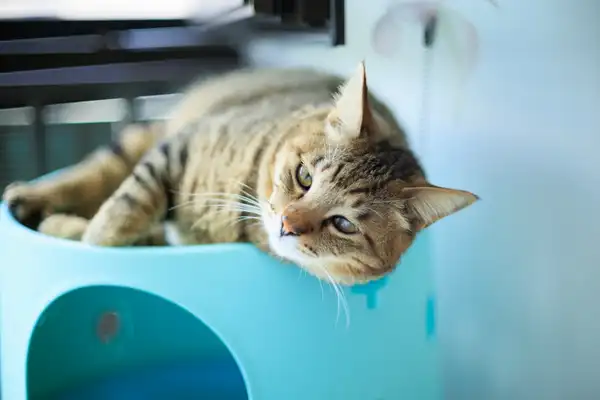
Chinese Domestic Cat
🌟 You may have met one
China's most common native domestic cat. Millennia of natural selection have produced a robust body and strong disease resistance — netizens jokingly call them "free but SSR-tier".
Overview
The Chinese Domestic Cat (中华田园猫) is a medium-sized cat breed weighing 3–5.5 kg with a 12–18-year lifespan. A general term for native Chinese domestic cats — including tabbies, tuxedos, orange cats, and more. Wide gene pool, strong disease resistance, varied personalities — the perfect companion for the "adopt, don't shop" approach.
Feeding
Very tolerant of different foods; a regular quality cat food is fine, with wet food added as appropriate.
Exercise
Retain strong hunting instincts — interactive toys plus space to roam are all they need.
Grooming
Short coat is very easy to maintain; brush once a week.
Health
Overall very healthy — the main concerns are urinary tract issues and obesity, so watch spaying/neutering timing and weight management.
Gallery
A closer look at the Chinese Domestic Cat
From origins and personality to daily care and health — helping you judge whether this little companion is really the one for you.
Origin & history
Origin & history
"Chinese Domestic Cat" (CDC) is not a breed registered by any international cat association — it is a **general term for all non-pedigree, naturally reproducing native domestic cats in mainland China**. It covers tabbies, tuxedos (bicolor), orange cats, tortoiseshells, solid black, solid white, calicoes, and every other coat colour and pattern.
**Origins**: - The domestic cat (Felis catus) was domesticated from the **Near Eastern African wildcat (Felis silvestris lybica)** in the Near East (in what is now the Turkey-Iraq Fertile Crescent) around 10,000 years ago. Driscoll et al.'s 2007 Science paper on the global genetic origins of domestic cats confirmed this. - The earliest record of cats in China comes from the **Neolithic Yangshao culture** (Quanhucun site in Shaanxi, ~5,300 years ago). Hu et al. 2014 PNAS used stable isotope analysis of bones to confirm the cats ate grain (indicating symbiosis with agricultural communities), but those individuals were **leopard cats (Prionailurus bengalensis) rather than F. lybica** — an independent, ultimately non-mainstream domestication attempt. - Modern Chinese domestic cats' **mainstream genes came in along the western Silk Road**: Persian and Central Asian F. lybica domestic cats spread east along trade routes during the Tang and Song dynasties, and cats appear frequently in Tang and Song poetry. - Kurushima et al.'s 2013 Anim Genet global cat gene analysis placed Chinese domestic cats in the **East Asian domestic cat haplogroup**, sharing a branch with cats from Southeast Asia, Japan, and Korea.
The name "tianyuan mao" (rural cat) took off on the early Chinese internet as a self-identifier in contrast to "foreign pedigree cats," and gradually solidified into everyday usage. The China Aficionados Association (CAA) has recently attempted to formally register some sub-populations of Chinese Domestic Cats with stable phenotypes (such as Dragon Li tabbies, tortoiseshells, and calicoes), though the umbrella "Chinese Domestic Cat" term still dominates.
Looks & breed standard
Looks & breed standard
Chinese Domestic Cats have **no strict conformation standard** because they are a "population" rather than a breed. But by coat colour and pattern, they are commonly grouped into several categories:
1. **Tabby (Mackerel / Classic Tabby)**: Golden base with black mackerel or classic swirled markings — China's oldest coat pattern. Tabbies have been separately registered by CAA (see the dragon-li entry) 2. **Tuxedo / Bicolor / Van pattern**: Black-and-white distribution, typically white belly / feet with black head and back; lively and mischievous — the "tuxedo cat syndrome" is a popular internet meme 3. **Orange (Red tabby)**: Red-yellow tones, almost all male (the orange gene is on the X chromosome, and males have only one X). Gentle personalities and love food 4. **Tortoiseshell**: A speckled mix of black and orange, almost all female (as above — two Xs are needed for the two colours) 5. **Calico**: White + black + orange three-colour, almost all female. Traditionally regarded as "lucky cats" 6. **Solid colours**: Solid black, solid white, solid grey, etc.
Medium build: adult males 4-6 kg, females 3-4.5 kg. Frame moderately sturdy, muscles firm — leaner than a British Shorthair, more robust than a Siamese. The head is a **modified round shape**, with a natural curve to the nose bridge — no flat face, no extreme elongation. It is the most "balanced" phenotype of the domestic cat. Eye colours are mostly gold, green, or amber; blue eyes are rare (blue-eyed white Chinese domestic cats have an elevated risk of congenital deafness, sharing the same W gene mechanism as white cats abroad).
Personality in depth
Personality in depth
Chinese Domestic Cats have **no unified personality template** — because they aren't the product of selective breeding, individual variation is huge. But as a group, some statistical commonalities remain:
1. **Independent**: Chinese Domestic Cats retain strong wild instincts and don't rely on humans the way Ragdolls or Burmese do. They prefer "me time" and will actively seek out corners or high perches to be alone 2. **Highly alert**: Wary of strangers, sudden sounds, and new environments. This is a survival instinct preserved through millennia of natural selection 3. **Moderately affectionate**: They can form deep bonds with the family they've been with since kittenhood, but express it in a restrained way (they don't jump on your lap or demand attention for hours, but they'll always be "nearby") 4. **Strong hunting instincts**: Chinese Domestic Cats are among **the most capable ratters** of any domestic cat, as long-term natural reproduction has never bred out their hunting drive. This is why rural China has long relied on them for rodent control 5. **Personality by colour (folklore)**: Orange cats are said to be gentle and food-motivated, tortoiseshells and calicoes stubborn ("tortitude" in the English-speaking world), tuxedoes energetic, solid blacks reserved, and tabbies independent and alert. **These claims have some statistical support** (particularly tortitude, which was confirmed in a 2015 J Appl Anim Welf Sci survey), but **individual variation still dominates**
Overall, the Chinese Domestic Cat suits owners who **respect a cat's independence, don't demand high clinginess, and are willing to build trust over time**.
Daily care
Daily care
The Chinese Domestic Cat is one of the **lowest-maintenance** cat groups:
1. **Diet**: - Highly food-tolerant, rarely picky - A regular quality cat food (protein >32% + fat 15-20%) is fine — no special formula needed - Recommended 2-3 meals a day; avoid free-feeding to prevent obesity - After middle age (8+), lower calories and add wet food to prevent urinary crystals
2. **Grooming**: - Mostly short-haired — once a week is enough - During shedding season (spring/autumn), increase to 2-3 times a week - Long-haired Chinese Domestic Cats (rare) follow long-haired standards — brush twice a week
3. **Spay / Neuter**: - **Strongly recommended to spay/neuter early** (8-12 months) - China has a serious stray cat problem — any un-fixed pet cat contributes to breeding pressure - Spaying females sharply reduces mammary cancer risk; neutering males cuts urinary disease and territorial fighting
4. **Deworming + Vaccines**: - Same as any domestic cat: 3-in-1 vaccine (annually), rabies (annually), internal + external deworming (every 1-3 months) - Rescued strays **must be tested before entering your home** — a rapid panel for feline panleukopenia / FIV / FeLV is essential
5. **Exercise + Toys**: Moderate exercise needs; a wand toy + cat tree + puzzle feeder combo is enough. Chinese Domestic Cats are of moderate-to-high intelligence and enjoy challenging puzzle food toys.
Health & lifespan
Health & lifespan
The Chinese Domestic Cat is **one of the healthiest domestic cat groups**. The reason is heterosis — a diverse gene pool from millennia of natural reproduction has diluted almost any recessive disease-causing mutation.
**Almost never affected by** (compared with pedigree cats): - HCM (hypertrophic cardiomyopathy) — high in Ragdolls and Maine Coons - PKD (polycystic kidney disease) — high in Persians and Himalayans - Patellar luxation — high in Devon Rex and Munchkin - Cartilage dysplasia — Scottish Fold, Munchkin - rdAc PRA (retinal atrophy) — Abyssinian lineage - DRMD myopathy — Devon Rex
**Common issues (shared with all domestic cats)**: 1. **Feline lower urinary tract disease (FLUTD)**: Male cats have a higher rate of urinary crystals and blockage. Plenty of water + wet food + a clean litter box is central 2. **Obesity**: Middle-aged Chinese Domestic Cats have a high obesity rate — post-neuter metabolism drops combined with low exercise from indoor life 3. **Periodontal disease**: Gingivitis and FORL are common in middle age; annual oral check-ups recommended 4. **Chronic kidney disease (CKD)**: The number one killer of senior domestic cats (10+); estimated 30-50% of the population develops it at some point. Regular urinalysis + blood SDMA is key to early detection 5. **Diabetes**: Caused by obesity, especially high in neutered males 6. **Congenital deafness in W-gene white individuals**: All-white blue-eyed Chinese Domestic Cats have 65-85% unilateral or bilateral deafness (Strain 2011 Vet J review)
**Average lifespan is 15-18 years**, significantly longer than most pedigree cats (10-14). With proper care, 20-year-old Chinese Domestic Cats are not uncommon.
Fit for your space
Fit for your space
The most important line about Chinese Domestic Cats: **"Adopt, don't shop" is grounded in the reality of stray cat overpopulation in China, and the Chinese Domestic Cat is exactly the group that should be adopted first**.
**Stray cat situation in China**: - Data from the Ministry of Agriculture and Rural Affairs and local CDCs estimate that **50-100 million stray cats** live in major Chinese cities (high non-neutered rate + high abandonment rate + no systematic TNR policy) - Animal welfare groups in Shanghai, Beijing, Shenzhen, and elsewhere rescue tens of thousands each year — the vast majority Chinese Domestic Cats
**Good fit for**: - First-time cat owners on a budget who want to "bond with a cat" rather than "buy a breed" - Homes with children, dogs, or multiple people (Chinese Domestic Cats vary widely in social tolerance individually, but the group as a whole beats most pedigree cats) - High-rise apartments + fully indoor + properly screened windows - Patient owners willing to "give the cat time to build trust" - Households aligned with the "adopt, don't shop" ethos
**Not a fit for**: - Owners wanting a dog-like clingy cat (choose Burmese / Devon Rex / Sphynx) - Short-term cohabitants unable to commit to 15-20 years of care
**Legitimate adoption channels**: - City-run animal rescue centres (e.g., Shanghai Qingpu Stray Animal Protection Centre, Beijing Cat Alliance CFCA, Shenzhen "It Foundation," etc.) - Individual rescuers with good records on Weibo / Xiaohongshu / adoption groups (adoption agreement + home visit required) - **Do not** buy "tianyuan mao" from bird-and-flower markets or informal channels — most are pipelined from strays or backyard breeders and pose severe health risks
**If you decide to buy a pedigree cat, please note**: China's current pedigree cat market (especially some e-commerce / backyard breeders) presents far higher health risks than adopting a Chinese Domestic Cat.
References
This is an educational overview — for specific health and care advice, please consult the authoritative sources below and your veterinarian.
- Driscoll et al. 2007 Science — Near Eastern origin of domestic cats学术研究
- Hu et al. 2014 PNAS — Earliest evidence for cat–agriculture co-existence in China (Prionailurus bengalensis)学术研究
- Kurushima et al. 2013 Anim Genet — East Asian cat population structure学术研究
- Ottoni et al. 2017 Nat Ecol Evol — Ancient DNA & global cat dispersal along Silk Road学术研究
- Strain 2011 Vet J — Deafness in white cats with blue eyes (W gene)学术研究
- Delgado et al. 2015 J Appl Anim Welf Sci — Tortitude / cat colour & behaviour学术研究
- CAA 中国爱猫者协会 — 本土猫种登记与保育项目综合科普
- ICatCare — Domestic shorthair & mixed-breed cats health guide综合科普
- AVMA — Feline lower urinary tract disease (FLUTD)综合科普