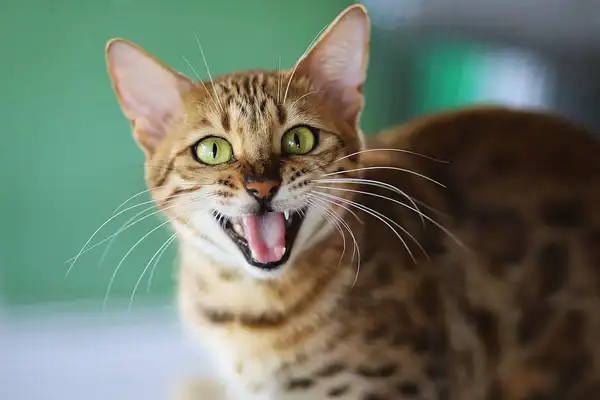
Felidae · CAT
Dragon Li
🌟 You may have met one
One of the earliest documented native cat breeds in China. The "cat" mentioned in the Book of Songs's "Han Yi" chapter ("There are bears, there are cats, there are tigers") is thought to refer to the Dragon Li. It was only formally certified as a native breed by China's CAA in 2003.
Overview
The Dragon Li (狸花猫) is a medium-sized cat breed weighing 3.5–6 kg with a 12–18-year lifespan. One of the few native Chinese cats internationally certified. Golden mackerel tabby markings and jade-green almond eyes are its classic look. Independent and alert, with a whiff of the wild.
Feeding
High-protein cat food, supplemented with moderate wet food and meat.
Exercise
High exercise needs — loves climbing and jumping, needs vertical space.
Grooming
Short coat is low-maintenance; brush once a week.
Health
Very healthy genetically; the main concerns are gastrointestinal and urinary tract issues.
Gallery
A closer look at the Dragon Li
From origins and personality to daily care and health — helping you judge whether this little companion is really the one for you.
Origin & history
Origin & history
The Dragon Li ("lihua" or "Chinese Lihua" in written Chinese) is the **only native Chinese cat breed formally registered with both CFA and CAA**. Genetically it is the **most stable-phenotype subgroup of the Chinese Domestic Cat** — golden base coat with black mackerel tabby markings — the archetypal cat image found in Chinese traditional painting, poetry, and folklore.
**Historical context**: - The word "cat" in the Book of Songs's "Da Ya · Han Yi" chapter ("There are bears, there are cats, there are tigers") is generally interpreted by classical scholars as referring to Dragon Li–type domestic cats. In the Song poet Lu You's "Ode to a Cat," the "linu" (badger-slave) is another poetic name for the Dragon Li. - "Dragon Li catches mice" was the most common combination in Ming and Qing agrarian society; farming villages in Jiangsu, Zhejiang, and Shandong have preserved Dragon Li lineages for centuries
**Modern registration timeline**: - **2003**: CAA (China Aficionados Association) formally recognised "Chinese Lihua" as a registered breed at the Beijing International Cat Show — the first native breed registered in mainland China - **2010**: CFA placed Dragon Li in the **Miscellaneous Class (experimental)**, allowing display but not competition at CFA shows - **2019**: Dragon Li entered CFA's **Miscellaneous Class as a formally registered breed**, though still short of Championship - **TICA, FIFe, GCCF** so far have not recognised it (each association sets a different bar for "native regional groups")
The Dragon Li's **gene pool is very wide** (because it is a branch of the Chinese Domestic Cat), giving it strong hybrid vigour. In recent years CAA has been advancing both a "Dragon Li pedigree certificate" and "responsible breeding" — trying to stabilise the breed **without shrinking the gene pool**.
Looks & breed standard
Looks & breed standard
The **CFA / CAA joint breed standard** has clear requirements for the Dragon Li (this is the key difference from the umbrella Chinese Domestic Cat):
- **Base colour**: **Warm golden to brown-yellow (brilliant hot brown)**; grey base, pure orange, or pure black are not accepted - **Pattern**: **Mackerel tabby predominantly**, dense vertical fine stripes; a small amount of classic (swirled) tabby and spotted tabby are also accepted - **Forehead M**: All tabby cats bear the "M" marking on the forehead — very clear on Dragon Li - **Eyes**: **Jade green to amber** is the core feature; blue eyes are non-standard - **Head**: Modified wedge, moderate width, natural curve to the nose bridge - **Ears**: Medium-large, upright, tips slightly rounded - **Body**: **Medium-large, muscular**; males 4.5-6.5 kg, females 3.5-5 kg. Long-loined and long-legged — leaner than a British Shorthair, sturdier than a Siamese - **Coat**: Short, dense, double-layered, slightly coarse to the touch (retaining a hint of wildness); moderate shedding - **Tail**: Medium length, thick at the base, with a distinct black ring pattern at the tip
**Compared with the American Shorthair Silver Tabby**: The American's base is silver-grey, the Dragon Li's is **warm golden**; the American's head is rounder, the Dragon Li's is a wedge. **Compared with the Bengal**: Bengal patterns are more three-dimensional with rosettes and a short glossy leopard-like coat; the Dragon Li's is a flat mackerel and its coat texture is closer to a regular domestic cat's.
Personality in depth
Personality in depth
The Dragon Li retains many instinctive behaviours **closer to its wildcat ancestor (F. lybica)**, in stark contrast to highly domesticated pedigree cats such as the Ragdoll, Persian, or Scottish Fold. The CFA breed description sums it up as alert, independent, active, and a powerful hunter.
**Core personality traits**: 1. **Extremely alert**: Highly aware of strangers, unusual noises, and new environments. **Long adjustment period to a new home** (usually 1-2 weeks before fully relaxing) — much longer than a British Shorthair or Ragdoll 2. **Highly independent**: Not clingy like a Burmese or Sphynx — likes alone time, its own routes, and its own "schedule" 3. **High energy**: **Among the highest exercise needs of any domestic cat**, on par with Bengals and Abyssinians. Needs 30-60 minutes of high-intensity play a day, or it will trash the house 4. **Extremely strong hunting instinct**: Among the **best mousers** of any domestic cat. Give one a toy mouse and it will faithfully replay the full hunting sequence (stalk → pounce → kill bite → carry) 5. **Strong territoriality**: **Not recommended for multi-cat homes** (unless raised together from kittenhood); adult Dragon Li cats have low tolerance for same-sex conspecifics. In multi-pet homes, opposite-sex pairs and slow separated introductions are advised 6. **Very high intelligence**: Learns to open doors, drawers, and even taps (one of the most "tool-using" domestic cat breeds)
It is very loyal to **family it knows** — once trust is built, it will follow its owner around, but its expression is restrained (no lap-jumping or sustained meowing).
Daily care
Daily care
Dragon Li care overlaps largely with "high-energy shorthair" care but is stricter than a British / American Shorthair:
1. **Diet**: - **High protein**: Protein >38%, closer to the diet of wild F. lybica - **Small, frequent meals**: 3-4 meals a day, no free-feeding - **Moderate wet food**: 1-2 canned meals or home-cooked meat per day for hydration (Dragon Li urinary crystal rates in males are similar to domestic cats overall, still higher than most short-hair pedigree breeds)
2. **Exercise + Environment**: - **Must have a >180 cm cat tree** (Dragon Li is one of the top climbers) - At least one dedicated activity space, ideally a bay window with security screen (watching the outside world is the Dragon Li's daily ritual) - **Daily interactive play, 30-60 minutes**: wand toys + laser pointer (with a physical target at the end) + puzzle feeders
3. **Multi-pet management**: - **Best kept as an only cat** - If multiple cats: opposite-sex, raised together as kittens, separate space, separate feeding - Compatibility with dogs is moderate: pairs much better with a gentle large breed (Golden Retriever, Labrador) than with a small active breed (Schnauzer, Poodle)
4. **Grooming**: - Short coat is low-maintenance — once a week is enough - During shedding season, 2-3 times a week
5. **Indoor vs semi-free-range**: - Urban homes **must be fully indoor** (prevent escape + traffic + infectious disease) - Rural homes / detached with yards may consider controlled semi-free-range (GPS collar + return home nightly + full vaccinations)
6. **Mental health**: - Dragon Li tolerance for **prolonged solitude** is below average; consider a companion cat or dog if alone more than 8 hours - Respect its need for independence — **do not force cuddles** or over-disturb its alone time
Health & lifespan
Health & lifespan
The Dragon Li is **one of the healthiest pedigree cats**, virtually free of the major pedigree genetic diseases.
**Almost never affected**: - HCM (rate similar to a common domestic cat, far below Ragdoll/Maine Coon) - PKD (polycystic kidney disease) - rdAc PRA - Patellar luxation - Cartilage dysplasia
**Reason**: The Dragon Li's **gene pool remains broad** — responsible domestic breeders actively introduce cats from different regions (Jiangsu-Zhejiang, Shandong, Southwest China) for outcrossing, avoiding inbreeding buildup. The CAA breed standard explicitly **discourages closed-breeding**.
**Common issues (shared with domestic cats generally)**: 1. **FLUTD**: Similar to all domestic cats; males need close attention to hydration 2. **Middle-age obesity**: Post-neuter metabolic slowdown means calories must be tightly controlled 3. **Periodontal disease + FORL**: Common after middle age; annual oral check-ups 4. **Senior CKD**: The universal old-age killer for domestic cats — Dragon Li is no exception; annual SDMA testing recommended from age 10 5. **Trauma + infection** (outdoor / semi-free-range individuals): Territorial nature means fighting-related injuries and infections are more frequent. Semi-free-range must have full vaccinations
**Average lifespan**: **15-18 years**, up to 20 with responsible care. This is a major advantage over other pedigrees.
Fit for your space
Fit for your space
Dragon Li ownership **does not suit complete beginners** — it is closer to a "mini wildcat" than a plush pet.
**Good fit for**: - Intermediate / experienced pet owners who have kept other cats or dogs and understand "a cat's need for independence" - Homes with generous vertical space and room for a tall cat tree, cat wall, or bay window - Households drawn to a "mouser + high-energy + high-IQ" pet - Single-cat or opposite-sex-pair-raised-from-kittens homes - Buyers who value "native cultural identity + high health + long lifespan" - Rural or detached-with-yard homes (controlled semi-free-range)
**Not a fit for**: - Beginners wanting a "clingy" pet (choose Burmese / Ragdoll / Devon Rex) - Purely floor-plan small apartments without vertical activity space - Homes that already have a same-sex adult cat and cannot manage long-term zone separation - Busy office workers unable to invest 30+ minutes of daily interaction (Dragon Li has high separation anxiety) - Elderly owners wanting a "quiet couch cat" (Dragon Li is very active at night and may disrupt sleep)
**Adoption advice**: - First-line: a CAA-registered responsible breeder able to provide a three-generation pedigree and parental health documentation - Alternatively, adopt a "Dragon Li–looking Chinese Domestic Cat" from a rescue — the gene pool, temperament, and lifespan are essentially identical to a registered Dragon Li, minus the pedigree paper - **Note**: For everyday pet owners, the practical difference between a golden-tabby Chinese Domestic Cat and a CFA/CAA-registered "Dragon Li" is minimal — do not agonise over the paperwork
References
This is an educational overview — for specific health and care advice, please consult the authoritative sources below and your veterinarian.
- CFA — Dragon Li Breed Article & Miscellaneous status国际猫协标准
- CAA 中国爱猫者协会 — 中华狸花猫品种标准国际猫协标准
- Kurushima et al. 2013 Anim Genet — East Asian cat lineage & Chinese tabbies学术研究
- Driscoll et al. 2007 Science — Origin of domestic cats学术研究
- Kaelin et al. 2012 Science — Tabby pattern genetics (Taqpep gene)学术研究
- Lipinski et al. 2008 Genomics — Origin of cat breeds & regional lineages学术研究
- ICatCare — Understanding cat behaviour & environmental needs综合科普
- AVMA — Feline lower urinary tract disease (FLUTD)综合科普