Felidae · CAT
Cornish Rex
🌟 You may have met one
On 21 July 1950 at Ege Boslah farm in Bodmin Moor, Cornwall, a tabby house cat named Serena delivered a litter that included a cream-colored curly male, Kallibunker — the single founder of every Cornish Rex alive today.
Overview
The Cornish Rex (康沃尔卷毛猫) is a small cat breed weighing 2.5–4.5 kg with an 11–15-year lifespan. With a wavy down-only coat, arched back and oversized ears, the Cornish Rex is called the 'Greyhound of cats'. Extremely active, athletic and social — a top pick for owners who love interactive play. Sheds very little and is relatively hypoallergenic.
Feeding
High metabolism — feed 3-4 high-protein meals daily with slightly higher fat content.
Exercise
Level-5 exercise needs; requires a running track space, feather wands and 30+ minutes of daily interaction.
Grooming
Only the down layer is present, so it is cold-sensitive. Avoid frequent brushing; use a soft rubber grooming glove. Keep warm in winter.
Health
Watch for HCM, patellar luxation and hereditary alopecia. Thin coat means sun burns and cold sensitivity — keep indoors and warm.
Gallery
A closer look at the Cornish Rex
From origins and personality to daily care and health — helping you judge whether this little companion is really the one for you.
Origin & history
Origin & history
The Cornish Rex was the **world's first recognized curly-coated cat breed**, born on **21 July 1950** at Ege Boslah farm in Bodmin Moor, Cornwall, England. Owner Nina Ennismore's tabby house cat Serena delivered a litter that included a cream-white curly male kitten, **Kallibunker**, the **single founder** of the breed.
On the advice of geneticist A.C. Jude, Ennismore back-crossed Kallibunker to his mother Serena, producing more curly kittens — confirming the curl as an **autosomal recessive** trait. To widen the gene pool, early breeders outcrossed to **Siamese, Burmese and Oriental Shorthair**, and to this day the Cornish Rex retains the slender skeleton and wedge head of the Siamese type.
In 1957 Kallibunker's descendants Diamond Lil and LaMorna Cove were shipped to the United States, where crosses with a separate American Rex mutation (Marcella, California) established the American line. **In 1963 A.G. Searle and A.C. Jude ran a Cornish x Kirlee (Devon Rex) test mating** whose kittens were all straight-coated — proving that the Cornish and Devon carry **two independent recessive mutations**.
Molecular work in the 2010s (Gandolfi et al.) mapped the Cornish Rex curl to the **LPAR6 gene** (Lysophosphatidic Acid Receptor 6), while the Devon Rex maps to **KRT71** — genetically unrelated.
The **CFA** recognized the Cornish Rex in 1964, the **GCCF** in 1967 and **FIFe** in 1983. It is the earliest of the 'four curly and hairless siblings' (Cornish, Devon, Selkirk and Sphynx) and the reference breed for every later Rex development.
Looks & breed standard
Looks & breed standard
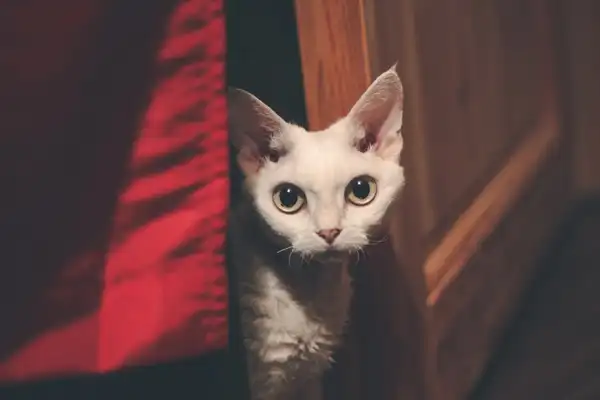
The Cornish Rex looks like no other domestic cat and is nicknamed the **'Greyhound of Cats'**. The CFA breed standard emphasises *racy, arched back, tucked flank, egghead*:
- **Head**: an **egg-shaped** long oval seen from the front, high cheekbones, Roman-line nose and forehead - **Ears**: **very large and set high** (a sharp contrast with the low-set Devon Rex ears), wide-based, round-to-slightly-pointed tips, sitting at the top of the head - **Eyes**: medium-large, oval, slightly oblique, in vivid colors (gold, green, blue) - **Body**: **arched back and tucked flank** are mandatory in the standard; in profile it looks like a small greyhound. Legs are **exceptionally long and slender**, longer in proportion than a Siamese - **Coat**: the Cornish Rex is **the only domestic cat with a down-only coat** — **no awn hairs and no guard hairs** - **Texture**: like **wavy velvet or baby wool**, tight to the body, with regular waves from neck to tail - **Whiskers and eyebrows**: also curly (but sturdier and less brittle than in the Devon Rex)
All colors and patterns are accepted. Adults weigh 2.5-4.5 kg, males slightly larger. **Watch for confusion with the Devon Rex**: the Devon has 'short curls with all three layers present' (suede feel), while the Cornish has 'only the down layer but full waves' (velvet feel); Devon ears sit very low, Cornish ears sit very high; the Devon has a mild arch, the Cornish has a dramatic one.
Personality in depth
Personality in depth
The Cornish Rex has a personality summed up in four words: **perpetual motion machine plus social butterfly**. It is **one of the most active domestic cat breeds**, tied with the Abyssinian, Bengal and Siamese as one of the 'top four athletic breeds'. The CFA profile uses *acrobat, kitten-like their entire lives, athletic*.
**Key behavioral traits**: 1. **Sprinting**: a Cornish Rex can reach roughly 30 km/h on a short sprint — faster than most house cats on a straightaway. It needs a long runway (a hallway or open living room) to burn off energy 2. **Jumping and climbing**: vertical jumps of 1.5 m or more are routine; it can leap onto a refrigerator, bookcase or door frame. **Cat trees must be over 2 m tall** 3. **Fetch**: like the Devon Rex, many individuals happily fetch and return, making it **one of the most trainable cat breeds for retrieving** 4. **Vocal but soft**: a fine, high-pitched voice, quieter than a Siamese, that loves to 'converse' with its owner 5. **Door-greeting and shadowing**: follows the owner from room to room and slips under the covers at night to keep warm 6. **Intense curiosity**: will open drawers, dig through handbags and investigate every new object
Excellent tolerance for children, dogs and other cats. **Watch out for**: - >8 hours alone daily leads to visible anxiety - Its energy may overwhelm the elderly or households seeking a very quiet pet - Needs **intelligence toys plus physical exercise** — under-stimulated Cornish Rex cats become destructive
The Cornish Rex is **a top interactive athletic cat**, ideal for families who love training and playing.
Daily care
Daily care
With only a **single down-layer coat**, the Cornish Rex has several distinctive care needs:
1. **Warmth (top priority)**: - No awn or guard hair means fast heat loss; **below 22°C it visibly shivers** - Provide a **heated cat bed, warm clothing** and sealed windows against drafts - Like the Devon Rex, it is one of the few cats that **can wear sweaters comfortably**
2. **Wipe, do not brush**: - The wavy coat is fragile — frequent brushing **breaks and flattens the waves** - Use a **soft rubber grooming glove** once a week to smooth the coat - Bathe every 3-4 weeks with warm water or a low-irritation pet shampoo (skin oil is moderate — less than a Devon Rex)
3. **Ear and eye care**: - Large ears collect wax; clean every 2 weeks - Large eyes: wipe corners daily
4. **Diet**: - **High metabolism, 3-4 meals a day**, small portions - Protein >36%, fat 15-20% (compensates for heat loss) - Ensure adequate water to prevent urinary crystals
5. **Exercise supply**: - **30+ minutes of high-intensity daily interaction** (wand toys, laser pointers, thrown balls) - At least one cat tree >2 m tall plus a runway-style space - **Keep in pairs or with a dog** — alone-time overload leads to destruction
6. **Sun protection**: - The thin coat **sunburns easily on the ear tips and nose** - Sunbathing near a bright window: draw a sheer curtain
Health & lifespan
Health & lifespan
With a very narrow founder gene pool (single-founder Kallibunker plus early Siamese, Burmese and Oriental crosses), the Cornish Rex has several breed-specific health risks:
1. **Hypertrophic cardiomyopathy (HCM)**: **a moderate-to-high risk breed**. No breed-specific mutation is yet defined, but Meurs et al. studied MYBPC3 R820W across many breeds. **Annual echocardiogram is recommended.**
2. **Patellar luxation**: like the Devon Rex, incidence is above the average domestic cat. Mild cases can be observed; moderate to severe cases require surgery.
3. **Hereditary hypotrichosis (Rex alopecia)**: - Some individuals develop **localized hair loss** in adulthood (belly, inner thigh, behind the ears) - Associated with skin keratin defects — cosmetic rather than pathological
4. **Umbilical hernia**: incidence is higher than average in Cornish Rex kittens; most cases are mild and self-resolving.
5. **Hypoglycemia and anesthesia risk**: - **Low body fat and high metabolism** — fasting over 12 hours triggers hypoglycemia - IV glucose is required before anesthesia - Post-surgery recovery needs warming blankets and high-protein liquid feed
6. **Coagulopathy (rare)**: like the Devon Rex, occasional vitamin K-dependent factor deficiencies are reported — run a coagulation panel before surgery.
7. **Dental health**: the Cornish Rex has a higher rate of **gingivitis and feline odontoclastic resorptive lesions (FORL)** — **weekly brushing plus annual dental scaling** is essential.
**Before you buy**: request from the breeder **parental HCM ultrasound, patellar grading and a three-generation pedigree** — reputable catteries will provide these unprompted.
Fit for your space
Fit for your space
Living with a Cornish Rex is unlike keeping an ordinary cat — it is closer to owning a **small wall-climbing greyhound**.
**A good match for**: - Warm, temperature-stable indoor apartments or houses (>22°C) - Owners with plenty of time at home (remote workers, retirees, large households) - Families that enjoy training — fetch, clicker training - Multi-pet homes with a Devon Rex, Sphynx, Siamese or dog - Cat lovers seeking an athletic, low-shed, highly interactive pet - Homes that can offer a >2 m cat tree and a runway of open space
**Not a match for**: - Owners who live alone and are away >8 hours a day - Homes without heating or with cold drafts - Households wanting a quiet, independent pet (see Persian, Russian Blue, Chartreux) - Buyers unwilling to fund HCM, patella and annual dental care - Very small apartments with no room to run and climb
**Special notes**: - **Strict indoor housing**: thin coat + escape-prone + high curiosity = high outdoor risk - **Do not buy the Cornish Rex 'because it is hypoallergenic'**: its Fel d 1 production is normal — only the low fur volume means less allergen distribution. **Always visit and do a skin contact test before buying** - **Market confusion**: in China, mixed-lineage curly cats without pedigrees are often sold as Cornish Rex; a legitimate breed requires a three-generation pedigree plus LPAR6 confirmation - **Consider adoption first**: shelters occasionally have curly-coated mixes at a fraction of the breeder price
References
This is an educational overview — for specific health and care advice, please consult the authoritative sources below and your veterinarian.
- CFA — Cornish Rex Breed Article国际猫协标准
- TICA — Cornish Rex Breed国际猫协标准
- GCCF — Cornish Rex Breed Standard of Points国际猫协标准
- FIFe — Cornish Rex Breed Standard (CRX)国际猫协标准
- Gandolfi et al. 2013 Sci Rep — LPAR6 mutation in Cornish Rex学术研究
- Meurs et al. 2007 J Vet Intern Med — MYBPC3 & HCM in cats学术研究
- ICatCare — Cornish Rex breed profile综合科普
- UC Davis VGL — Cornish Rex genetic testing panel基因检测
- Wikipedia — Cornish Rex综合科普
- Cornish Rex Breeders Club (UK)俱乐部官网