Felidae · CAT
Ocicat
🌟 You may have met one
The Ocicat exists by accident — in 1964 Virginia Daly was trying to breed 'Aby-point Siamese' from Siamese × Abyssinian, and instead produced a golden kitten covered in dark spots. Her 12-year-old daughter said 'It looks like an ocelot!' — and the breed name Ocicat was born.
Overview
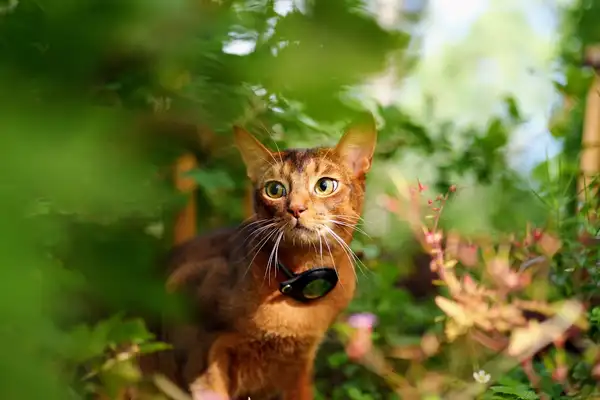
The Ocicat (奥西猫) is a medium-sized cat breed weighing 3–7 kg with a 12–18-year lifespan. A breed created by accident in 1964 by Virginia Daly — a cat that looks like a leopard but is 100% domestic. Ancestry is Siamese × Abyssinian × American Shorthair, with **no wild-cat blood at all**. Its body is covered in crisp thumbprint spots, yet the personality is pure Siamese affection plus Abyssinian energy. The Ocicat is the best balance of 'wild looks and family temperament'.
Feeding
A quality premium adult cat food works; 36-42% protein is ideal.
Exercise
Moderate-to-high activity; 30-40 minutes of interactive play daily plus cat trees and puzzle toys.
Grooming
Short coat, low-maintenance — weekly brushing; light shedding.
Health
Overall very healthy; watch for HCM, PK-Def and dental disease.
Gallery
A closer look at the Ocicat
From origins and personality to daily care and health — helping you judge whether this little companion is really the one for you.
Origin & history
Origin & history
The Ocicat is one of **the most famous 'accident breeds' in cat history**, dated to **Michigan, USA, 1964**, by breeder **Virginia Daly**.
**How the accident happened**: - Virginia's actual goal was to create the **Aby-point Siamese** — by crossing Abyssinian to Siamese she hoped to add Abyssinian ticked color to Siamese points - After a first-generation (F1) Siamese × Abyssinian cross, she picked an F1 female (Dalai She) and backcrossed to a chocolate-point Siamese - In 1964 that litter produced a golden-yellow kitten covered in dark brown spots, named **Tonga** - Virginia's 12-year-old daughter, **Virginia Ann Daly**, saw Tonga and said: 'It looks like an ocelot!' — and the breed name **Ocicat** (ocelot + cat) was born
**Tonga was originally sold as a pet**, but geneticist Clyde Keeler at Harvard, seeing the photos, urged Virginia to develop this 'wild-looking, fully domestic' cat systematically. Virginia then began deliberate breeding.
**Key milestones**: - **1966**: Virginia introduced **American Shorthair** blood to reinforce bone structure and spotting - **CFA** granted experimental status in 1966 and **championship status in 1987** - **TICA** granted championship status in 1986 - **FIFe and GCCF** followed with their own recognition
**Crucial distinction** (versus Bengal and Savannah): - **The Ocicat carries no wild-cat ancestry** — it is a pure hybrid of **Siamese × Abyssinian × American Shorthair**, three domestic breeds - Its **temperament is fully domestic**, with none of the wild-behavior issues seen in Bengals or Savannahs - The Ocicat is **the answer for buyers who want the leopard look without the wild personality**
**Ancestry ratio** (modern Ocicat): - Approximately **50% Siamese** (body type, affectionate character) - 25% Abyssinian (spotting base and energy) - 25% American Shorthair (bone structure and color diversity)
Looks & breed standard
Looks & breed standard
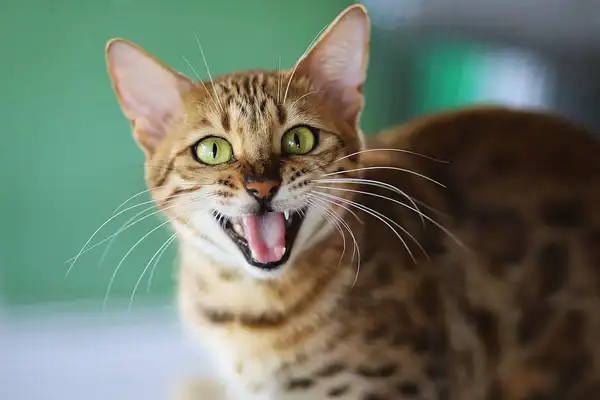
The Ocicat has **one of the strongest spotted-tabby looks of any domestic breed**:
- **Body**: **medium-large, muscular, athletic**, long-bodied and long-legged, sturdier than an Abyssinian. Adult males 5-7 kg, females 3-4.5 kg. - **Head**: modified wedge, slightly rounder than a Siamese, with well-developed cheeks - **Ears**: medium-large with slightly pointed tips; some individuals show **lynx-tip tufts** - **Eyes**: large, almond-shaped, slanted. **All colors except blue are accepted** (gold, green, amber, copper) — **the Ocicat does not permit blue eyes** - **Legs**: long and powerful - **Paws**: oval and firm - **Tail**: medium-long, tapered - **Coat**: **short, close-lying and lustrous** - **Spotted Tabby pattern**: - **Every hair is agouti-banded** (Abyssinian heritage) - Spots are **'thumbprint' shape** — smaller and more regular than Bengal rosettes - Spots align in **broken horizontal streaks** - Face bears a clear **'M' tabby mark** and eyeliner - Tail tip has **dark ringing**
**CFA-accepted 12 colors**: - **Tawny** (classic) - **Chocolate** - **Cinnamon** - **Blue** - **Lavender / Lilac** - **Fawn** - Plus the **Silver** variants of all six (Silver Tawny, Silver Chocolate, etc.)
**Spotting standard** (TICA / CFA): - Spots must be **clear, evenly distributed and darker than the ground color** - Foreleg and chest spotting is a key scoring point - **Belly spotting is mandatory** (distinguishing Ocicat from Abyssinian's clear belly)
Personality in depth
Personality in depth
The Ocicat has **the easiest temperament among leopard-look breeds** — it inherits the best of all three ancestral breeds:
1. **Dog-like loyalty**: - The Siamese-inherited deep attachment — greets the door, follows you, sits on laps - Distributes affection evenly across the family (unlike the one-person Siamese) - Rarely hides from visitors; often greets them proactively
2. **High intelligence and trainability**: - **Can be trained like a dog** — sit, shake, come, fetch, open doors and drawers - **One of the most reliable feline fetchers** - Tolerates leash training - Learns to respond to name and simple cues
3. **No wild behavior**: - **This is the Ocicat's largest advantage over Bengal and Savannah** - No spraying, no deep nighttime vocalizations, no aggression toward strangers - Pure domestic-cat temperament — only the appearance is 'wild'
4. **Energetic but manageable**: - Much more active than a Persian or British Shorthair - Calmer than a Bengal or Savannah - 30-40 minutes of interactive play a day is enough
5. **With children and other pets**: - **Five-star tolerance** — ideal for households with children - Coexists happily with dogs and often plays with them - Stable in multi-cat homes
6. **Social needs**: - **Moderate-to-high** — less clingy than a Bengal, more social than a British Shorthair - Can tolerate 8 hours alone (more than a Siamese or Savannah) - A companion pet or busy household is still recommended
7. **Voice**: moderate — quieter than a Siamese, chattier than a British Shorthair
**Summary**: the Ocicat is **the perfect balance of wild looks and domestic personality** — if you want a cat that looks like a leopard but behaves like a golden retriever, the answer is the Ocicat.
Daily care
Daily care
Ocicat care is **very manageable** — nowhere near the demands of a Bengal:
**Grooming**: - Short, close-lying coat - **Weekly steel-comb brushing** is enough - Shedding is low-to-moderate for a cat - 2 sessions weekly during spring/autumn shedding - **No professional grooming needed**
**Bathing**: - Every 2-3 months - Most Ocicats tolerate baths well (likely thanks to Abyssinian/Siamese heritage) - Use a gentle cat shampoo
**Diet**: - Standard premium adult cat food - **36-42% protein** is ideal - Mix of wet and dry food; encourage hydration - Manage weight — post-neuter metabolism drops and Ocicats can chunk up
**Exercise**: - **30-40 minutes** of active interactive play daily - Cat trees (medium-high is fine — Ocicat jumps less than a Savannah) - Puzzle feeders and treat-dispensers - Wand toys, feather chasers, balls - **Leash training works** — the Ocicat is one of the few cat breeds that walks on a harness
**Companionship**: - Can tolerate 8 hours alone, but chronic solo (>10 hours/day) is not recommended - Keep in pairs or with a dog - Kids in the home are a plus — Ocicats love active play
**Ears, claws, teeth**: - Weekly ear check - Weekly gum check - Regular claw trimming
**Special note**: - **Kitten spots are subtle** — Ocicat spotting typically becomes clear only at 4-6 months - Adult spot intensity can shift seasonally (darker in winter, lighter in summer)
Health & lifespan
Health & lifespan
Because the Ocicat gene pool blends **Siamese, Abyssinian and American Shorthair** — three domestic breeds — hybrid vigor is real and the breed is **broadly healthy**. Lifespans of 12-18 years are common. Concerns:
**1. Hypertrophic cardiomyopathy (HCM)**: - Ocicats have reported cases - **Annual echocardiogram** in adults, every 1-2 years for breeding cats
**2. PK-Def (Pyruvate Kinase Deficiency)**: - Inherited from **Abyssinian ancestry** — Abyssinian, Somali and Bengal are the three highest-risk breeds - Presents as episodic hemolytic anemia, usually appearing between 6 months and adulthood - **UC Davis VGL offers genetic testing** - Breeders should screen and avoid mating two carriers
**3. PRA (Progressive Retinal Atrophy)**: - The **rdAc (Ocular)** mutation from Abyssinian ancestry - Vision loss begins between 4 and 8 years - UC Davis VGL provides a genetic test
**4. Periodontal disease**: - As with all Siamese-line cats, dental issues are common in older cats - Annual oral exams recommended
**5. Amyloidosis**: - The Abyssinian-associated **AA amyloidosis** occasionally shows up in Ocicat lines - Manifests as kidney or liver failure in middle age - No genetic test yet — responsible breeders avoid affected lines
**6. Obesity and diabetes risk**: - Activity drops with age; strict calorie control matters
**Recommended screening**: - **PK-Def genetic test** (request before purchase) - **PRA-rdAc genetic test** - Annual echocardiogram - Annual oral exam
**Overall**: the Ocicat is a **notably low genetic-burden breed**, far healthier than Bengal or Savannah, and beginner-friendly.
Fit for your space
Fit for your space
**A good match for**: - **Medium to large homes** — apartments also work if cat trees and play space are provided - **Large families, homes with children, homes with other pets** — the Ocicat is **the most family-friendly of the leopard-look breeds** - Buyers who want 'wild looks with a domestic soul' (the Ocicat is the only breed that truly fits this description) - Owners with 30-60 minutes daily for interactive play - People who want a trainable, affectionate, leash-friendly active cat - First-time to intermediate cat owners (Ocicat is far easier than Bengal) - Households that cannot have a dog but want 'a cat that acts like a dog'
**Not a match for**: - Solo full-time workers with zero home presence (>10 hours/day) - Households that want a decorative silent cat (Ocicat is too active) - Very small homes with no play space - Buyers chasing **maximum wild appearance** (Bengal rosettes are more dramatic)
**Special notes**: - **Do not confuse with Bengal or Savannah** — the Ocicat is the **only leopard-look breed with no wild ancestry** - **Request PK-Def and PRA-rdAc genetic tests** before buying — the two Abyssinian-derived diseases are mandatory checks - **Parental echocardiogram report** is a must - Kitten spots are faint before 4-6 months — do not judge on faint spots - **Price**: legitimate Ocicat kittens run $800-$2,500, cheaper than Bengal and far cheaper than Savannah - Ocicats are still rare in China; most come from overseas imports or a handful of responsible domestic breeders
**Summary**: the Ocicat is **the easiest of the wild-look breeds** — it proves that 'looks like a leopard' and 'behaves like a golden retriever' can coexist in a single cat.
References
This is an educational overview — for specific health and care advice, please consult the authoritative sources below and your veterinarian.
- CFA — Ocicat Breed Article国际猫协标准
- TICA — Ocicat Breed Standard国际猫协标准
- GCCF — Ocicat Breed Standard of Points国际猫协标准
- FIFe — Ocicat Breed Standard (OCI)国际猫协标准
- Ocicats International (breed club)俱乐部官网
- Grahn et al. 2012 BMC Genet — Feline PK deficiency in Abyssinian-derived breeds学术研究
- Menotti-Raymond et al. 2007 — rdAc PRA mutation in Abyssinian/Ocicat学术研究
- UC Davis VGL — Ocicat / Abyssinian PK & PRA panel基因检测
- ICatCare — Ocicat breed profile综合科普
- Wikipedia — Ocicat综合科普