Felidae · CAT
Ragamuffin
🌟 You may have met one
The name 'Ragamuffin' means 'a scruffy, raggedy child' — the 1994 splinter breeders chose it deliberately, keeping the 'Rag-' from Ragdoll and adding 'muffin' for the breed's fluffy, huggable feel. The split from Ragdoll was driven by disagreement with founder Ann Baker over trademark control and breeding restrictions.
Overview
The Ragamuffin (襤褸猫) is a large cat breed weighing 5–9 kg with a 12–18-year lifespan. The Ragamuffin split off from the Ragdoll in 1994. It keeps the same go-limp, gentle, lap-cat temperament, but — unlike the Ragdoll — accepts **all coat colours, all patterns and all eye colours**. Large-bodied, silky-coated and famously cuddly, it's a top-tier beginner cat.
Feeding
Large-breed / urinary-support formula; strict portion control to prevent obesity; 3 measured meals per day.
Exercise
Low exercise needs; passive play; 15-20 minutes of interactive play a day is enough — but strict portion control is essential.
Grooming
Semi-long to long coat, less dense than a Persian; comb 2-3 times a week; brush daily during moulting; rarely mats.
Health
Screen for HCM (shared with Ragdoll lineage), PKD, and manage weight to spare joints.
Gallery
A closer look at the Ragamuffin
From origins and personality to daily care and health — helping you judge whether this little companion is really the one for you.
Origin & history
1994: the trademark split that created a new breed
Origin & history
1994: the trademark split that created a new breed
To understand the Ragamuffin you must start with the Ragdoll. In the 1960s, California breeder **Ann Baker** used a white long-haired queen named Josephine to develop the Ragdoll and set up the **IRCA (International Ragdoll Cat Association)**, imposing near-total trademark control over the Ragdoll name and its bloodlines. Every IRCA breeder had to sign strict contracts and pay royalties.
By the early 1990s a group of IRCA breeders had grown deeply unhappy with Baker's **commercial terms and closed-breeding rules**, especially her ban on registering Ragdolls with mainstream associations like CFA and TICA. In 1994, breeders led by **Curt Gehm** and **Kim Clark** collectively **left IRCA**, renamed their Ragdolls **Ragamuffin**, and registered the new breed independently.
To widen the gene pool and further separate it from the Ragdoll genetically, early Ragamuffin breeding permitted outcrosses to **Persians, Himalayans and Domestic Longhairs**. As a result the Ragamuffin allows a **much broader palette of colours and patterns** than the Ragdoll.
**Registry recognition**: - **ACFA** (American Cat Fanciers Association): first to recognise in **1994** - **UFO** (United Feline Organization): 1998 - **CFA** (Cat Fanciers' Association): **Miscellaneous 2003, full championship 2011** - **GCCF** (UK): registered 2009 - **TICA**: still not recognised (TICA treats Ragamuffin as a Ragdoll variant) - **FIFe**: not recognised
The Ragamuffin is thus a **quintessential American breed** — well established in the CFA / ACFA world in the US, but with limited recognition in Europe and TICA circles.
Looks & breed standard
All colours allowed — an alternative to the Ragdoll template
Looks & breed standard
All colours allowed — an alternative to the Ragdoll template
The Ragamuffin's build closely matches the Ragdoll's, but the **colour and pattern range is much wider**:
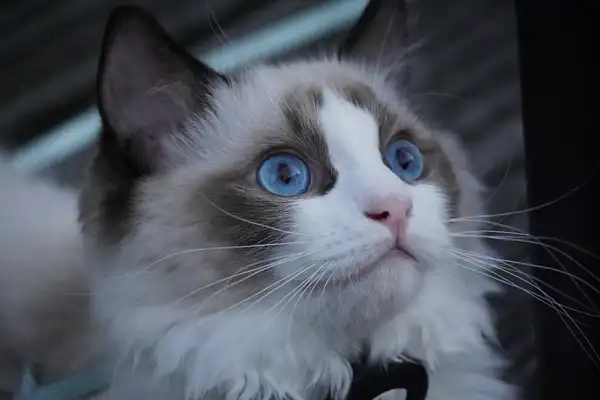
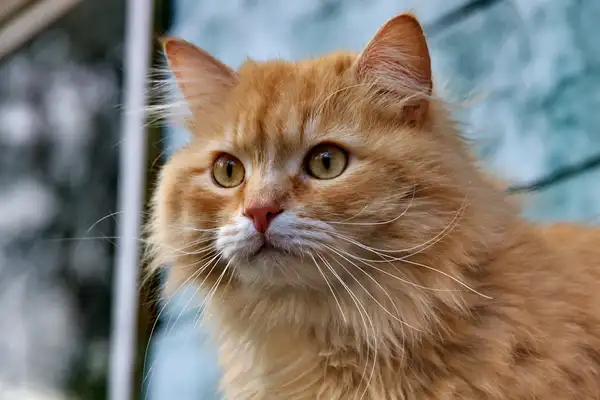
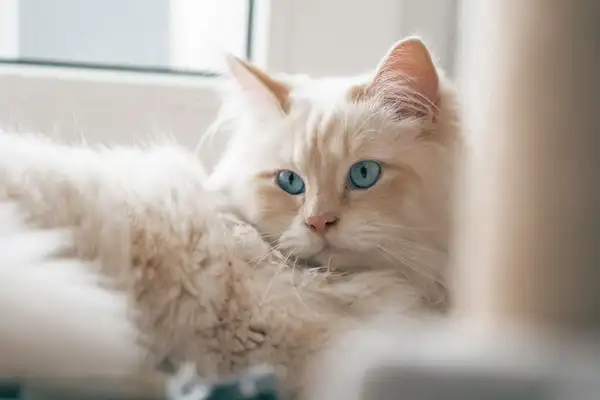
- **Body**: large and substantial, adults 5-9 kg (females 5-7 kg, males up to 9 kg) — one of the bigger domestic breeds - **Head**: **modified wedge, gently rounded**; full forehead; well-padded cheeks; adult males often develop pronounced jowls - **Ears**: medium-small, slightly forward-tilted, gently rounded tips - **Eyes**: large and **walnut-shaped** (Ragdoll: almond/oval); **any eye colour is allowed** — green, gold, blue, odd-eyed - **Torso**: long and solid, broad chest, heavy legs, well-muscled - **Tail**: medium-long to long, plumed like a feather - **Coat**: **semi-long to long**, dense yet soft (rabbit-like), dual-layer with a thinner undercoat than a Persian; obvious ruff at the neck; breeches on the back legs
**Key differences vs Ragdoll**: - Ragdoll: only **6 base colours × 3 pattern types (Colorpoint / Mitted / Bicolor) × blue eyes** - Ragamuffin: **all colours, all patterns, all eye colours**: - Solids: white, black, blue, red, cream, chocolate, lilac - Bicolor, tortoiseshell, smoke, tabby, mink, sepia - Any eye colour, including green, gold and odd-eyed
This makes the Ragamuffin **visually far more varied** than the Ragdoll — a 'big-scale, unstandardised Ragdoll' in look.
Personality in depth
Even more cuddly than a Ragdoll — the 'living blanket'
Personality in depth
Even more cuddly than a Ragdoll — the 'living blanket'
The Ragamuffin's personality is essentially a **Ragdoll turned up a notch**: gentle, clingy, non-aggressive, and when picked up the body **goes completely limp** ('go-limp'), draping in your arms like a warm blanket.
**Core traits**: - **Extremely clingy**: follows you from room to room, jumps on your lap the moment you sit, sleeps on your pillow at night - **Soft-voiced**: prefers gentle chirps to loud meows - **Friendly with strangers**: doesn't hide from guests - **Exceptionally patient with children**: tolerates being held, stroked and carried — one of the **best family cats** - **Great with other pets**: coexists happily with Ragdolls, Persians, Birmans, Golden Retrievers, Labradors - **Low exercise needs**: enjoys passive play, does not zoom around - **Intelligence moderate-to-high**: can learn to fetch, shake paws, hit poses on cue
**Personality differences vs Ragdoll**: - **Ragamuffin is clingier**: a Ragdoll follows *nearby*, a Ragamuffin lies *on top of you* - **Ragamuffin vocalises more**: but always softly - **Ragamuffin is more forward with strangers**: Ragdolls observe for a few seconds first - **Both trust humans unconditionally**: never let them roam free — they cannot defend themselves
**Alone-time tolerance**: below average. Ragamuffins are **highly social** and become anxious if left alone for long stretches — families who cannot provide 8+ hours of company should keep two.
Daily care
Long-coat grooming + weight management
Daily care
Long-coat grooming + weight management
The Ragamuffin is a large long-haired cat, but its rabbit-fur coat is **less prone to matting than a Persian's**, so day-to-day care is comparatively easy:
**1. Coat care**: - **Comb 2-3 times a week**, daily during spring/autumn moult - Use a **wide-tooth comb + slicker brush** combo: comb to detangle, brush to remove loose undercoat - Priority spots: ruff, armpits, inner thighs, breeches, base of tail - Bath every 2-3 months (self-cleaning long coat — unlike a Persian, no frequent bathing needed)
**2. Weight management (most important)**: - The Ragamuffin combines **big frame + hearty appetite** - Adult males easily hit 10 kg+ and become 'meat loafs', driving diabetes, arthritis, hepatic lipidosis - **Portion feed**: 3 meals a day, ~60-90 g dry kibble equivalent for adults (adjust for activity) - **No free-feeding** - Weigh monthly; if creeping up, cut portions by 10% immediately - Prefer high-protein, low-carb formulas
**3. Eye and ear care**: - Mild tear staining possible — wipe under eyes weekly - Long coat traps ear wax; clean ears every 2 weeks
**4. Nail / hair trim**: - Trim front claws every 3-4 weeks - Trim hair around the rear to prevent 'poop stuck to fur'
**5. Exercise**: - 15-20 min interactive play a day is plenty - Fishing-pole toys, slow toys — no need for the Bengal/Somali-level workout - **Cat trees and window perches are essential** to prevent boredom-driven over-grooming
**6. Alone time**: - If you're out 8+ hours a day as a single-cat household, strongly recommend **keeping two** - Or pair with a gentle dog (Golden Retriever, Labrador)
Health & lifespan
HCM, PKD and obesity — three risks shared with the Ragdoll
Health & lifespan
HCM, PKD and obesity — three risks shared with the Ragdoll
Because Ragamuffins **share an ancestral gene pool** with Ragdolls, their health risks overlap heavily:
**1. Hypertrophic Cardiomyopathy (HCM)**: - The Ragdoll lineage carries the identified **MYBPC3 R820W mutation** (Meurs 2007) - Ragamuffins theoretically share the same risk - Recommend **echocardiogram screening at 1, 3, 5 and 8 years** - Breeding cats must be gene-tested (UC Davis VGL and Langford Vets both offer Ragdoll MYBPC3 tests); do not breed homozygotes - Symptoms: dyspnoea, hind-leg weakness, sudden syncope
**2. Polycystic Kidney Disease (PKD1)**: - Comes from the **Persian outcrossing** in early Ragamuffin history - Recommend **PKD1 gene test** (UC Davis VGL offers a Persian PKD1 test) - Do not breed positives; ultrasound the kidneys yearly
**3. Obesity + metabolic disease**: - Big frame + big appetite makes this **one of the most easily obese breeds** - Obesity drives: diabetes, hepatic lipidosis, hip arthritis, feline lower urinary tract disease (FLUTD)
**4. Lower urinary tract stones (FLUTD / struvite)**: - Larger male cats have longer urethras and more stone risk - Prescription urinary formulas + hydration (wet food, water fountains)
**5. Arthritis**: - Big body + long life = elevated hip/elbow arthritis risk in old age - Add **glucosamine + Omega-3** from age 6
**6. Aortic thromboembolism**: - Beyond HCM, the Ragdoll family occasionally reports aortic thromboembolism - Include the aorta in cardiac ultrasounds
**Buyer checklist**: - Ask for **HCM gene test + echocardiogram** on both parents - Ask for **PKD1 gene test** on both parents - If family history includes aortic thromboembolism, think twice - Buy only from **CFA / ACFA / GCCF registered** catteries - Take kittens home at 12-16 weeks or older
**Average lifespan 12-18 years**, with healthy individuals reaching 18-20.
Fit for your space
Best for quiet homes with children or multiple pets — a 'super-sized Ragdoll'
Fit for your space
Best for quiet homes with children or multiple pets — a 'super-sized Ragdoll'
**A Ragamuffin fits well with**: - **Households with children** — extremely tolerant of being picked up, stroked and played with, even carried around - **Older or retired owners** — low exercise needs, gentle temperament, no sudden zoomies - **Multi-pet homes** — great with Ragdolls, Persians, Birmans, Maine Coons, Golden Retrievers, Labradors - **Apartments and urban dwellers** — space is not critical, an indoor home is plenty - **New cat owners who want a 'big cat' experience** — big body + long coat + gentle temperament - **Buyers who want more colour variety than the Ragdoll's three pattern classes**
**Not a good fit for**: - **Single professionals out of the home 10+ hours a day** — separation anxiety is a serious risk - **Owners who want an independent cat** — a Ragamuffin will be on you 24/7 - **Allergy-prone people** — shedding is moderate but dander levels are still significant on a long-haired cat - **Households that want to let cats outdoors** — Ragamuffins are far too trusting and will disappear - **Buyers unwilling to fund HCM / PKD screening**
**Special notes**: - **Strict indoor housing** — poor sense of direction, no defensive instincts, easily stolen - **Do not cross with a Ragdoll and declare it a 'blend'** — the breeds are related but registration rules differ completely - **Ragamuffin and Ragdoll are visually hard to tell apart** — if you care which one you have, look at the **registration certificate**, not the appearance - **Weight management is a lifelong project** — establish portion feeding from kittenhood - **Note: TICA and FIFe still do not recognise the Ragamuffin** — if you want to show in TICA, choose a Ragdoll instead
References
This is an educational overview — for specific health and care advice, please consult the authoritative sources below and your veterinarian.
- CFA Ragamuffin Breed Profile
- ACFA Ragamuffin Breed Standard
- GCCF Ragamuffin Breed Info
- Ragamuffin Associated Cat Fanciers (RACF)
- UC Davis VGL — Ragdoll HCM (MYBPC3) & PKD1 Panel
- Meurs KM et al. — A cardiac myosin binding protein C mutation in the Ragdoll (2007)
- International Cat Care — Ragamuffin
- Langford Vets — Feline Inherited Disease Testing
- The Cat Fanciers' Association — 2011 Ragamuffin Championship Announcement