Canidae · DOG
Rough Collie
🌟 You may have met one
The 1943 MGM film 'Lassie Come Home' turned the Rough Collie into one of the most famous breeds in the world — and Lassie herself was played by a male dog named Pal, whose male descendants filled the role for another nine sequels.
Overview
The Rough Collie (长毛柯利牧羊犬) is a large dog breed weighing 22–34 kg with a 12–14-year lifespan. The real-world Lassie: a 19th-century Scottish highland herder with a long, fine wedge head, silky double coat, and famously sweet expression. Extremely patient with children and devoted to family — but be ready for heavy shedding, weekly deep grooming, and MDR1 drug sensitivity.
Feeding
Feed a standard medium-to-large-breed formula in two meals a day; watch carbs and fat, and always confirm MDR1 status before dosing sensitive drugs.
Exercise
60-90 minutes of daily activity plus mental work. The Rough Collie loves purpose-driven tasks — retrieval, heelwork, scent games, herding trials.
Grooming
Deep-brush the long silky coat 2-3 times a week (daily during coat blows); bathe every 4-6 weeks and never shave — you'll wreck the double coat.
Health
Watch MDR1 (over 70% of Collies carry it), Collie Eye Anomaly (CEA), progressive retinal atrophy, hip dysplasia, and skin issues.
Gallery
A closer look at the Rough Collie
From origins and personality to daily care and health — helping you judge whether this little companion is really the one for you.
Origin & history
Origin & history
The Rough Collie was shaped in the highland and lowland sheep pastures of 18th- and 19th-century Scotland. Its ancestors share a common origin with today's Border Collie — the 'Scottish Herding Dog', a working landrace built by shepherds crossing local herders with imported dogs from Iceland, Rome, and elsewhere. From the 18th century highland shepherds gradually selected for elegant lines and long, dense coats able to shed the cold Scottish rain — the seed of the Rough Collie type. [1][2][5]
Queen Victoria pushed the breed into aristocracy. Her 1860 visit to Balmoral Castle produced an instant infatuation with local Collies; she brought them back to Windsor and bred them widely, transforming the working sheepdog into a companion for nobility and the middle class within twenty years — one of the most popular breeds in the British Empire. [1][3][5]
The UK Kennel Club registered Rough Collie as a distinct breed in 1877; the split from Smooth Collie began around the same time. AKC officially recognized the Rough Collie in 1885, one of its earliest recognitions. [1][3][4]
Global fame in the 20th century belongs to two people. First, novelist Eric Knight, who published 'Lassie Come-Home' in the *Saturday Evening Post* in 1938 and expanded it into a novel in 1940. Second, MGM, which turned the story into film in 1943; Lassie was played by a male named Pal, and Pal's male descendants filled the role across nine sequels and the 1954-1973 CBS television series that ran 591 episodes over 19 years — arguably making the Rough Collie the most famous single dog in the world. [3][5][6]
Looks & breed standard
Looks & breed standard
AKC lists males 24-26 inches (61-66 cm) at the shoulder and 60-75 lb (27-34 kg); females 22-24 inches (56-61 cm) and 50-65 lb (22-29 kg) — a genuine large breed. Several traits are high-signature. [4][5]
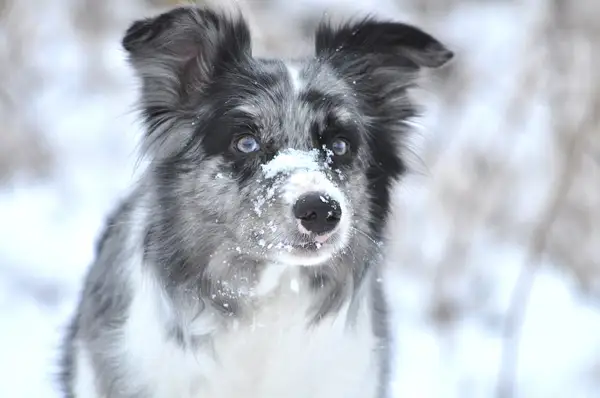
The head is the most iconic — 'a well-blunted lean wedge', with a flat top skull, long clean muzzle, and near-parallel planes; this fine head is the historic breed hallmark. Almond-shaped, dark eyes (blue or blue-flecked in blue merle dogs) carry what AKC calls the 'sweet expression'. Ears are medium and semi-erect with the top third folding forward — a required aesthetic. [4]
The coat is a double structure: long, silky, straight, and profuse outer coat over a soft dense undercoat, with a full ruff and 'petticoat' feathering on legs and tail. AKC recognizes 4 colors: Sable & White (Lassie's classic), Tri-color, Blue Merle, and White. Merle × merle breeding is prohibited — the double merle genotype produces deafness and vision defects. [4][5]
Rough Collie (long) and Smooth Collie (short) are separate AKC breeds; The Kennel Club (UK) treats them as separate breeds too, while FCI treats them as coat varieties. Size, temperament, and health risks are almost identical — the difference is coat length. [1][5]
Personality in depth
Personality in depth
The AKC sums the temperament as 'graceful, devoted, proud'. Ancestors independently managed large flocks in the Scottish highlands, so the Rough Collie combines 'thinks for itself' and 'wants to please' — a rare mix among herders, more biddable than a Border Collie and more independent than a Golden. [1][6]
With family: intensely devoted, gentle, and famously patient with children. The herder's built-in 'gathering' instinct treats the family kids like a tiny flock — the biological reality behind Lassie repeatedly rescuing Timmy. It reads emotions closely and quietly stays near owners who are sick or upset. [1][5]
With strangers: cautious, not aggressive — an alert bark and steady watching, rarely an attack. So it makes a poor pure guardian. With other dogs and pets: excellent when socialized early, though it may 'herd' the household cat or a smaller dog, gathering them into corners. [6]
Trainability: Coren's *The Intelligence of Dogs* ranks the Collie 16th, in the 'excellent working dog' tier. It responds well to positive reinforcement, and it is unusually voice-sensitive — harsh scolding can flatten mood for hours, so heavy-handed training is off the table. [6]
Barking is worth a note: the Rough Collie is a moderate-to-heavy barker, especially triggered by unfamiliar noises, doorbells, or deliveries; teach a 'quiet' cue early. The herding instinct also occasionally emerges as circle-and-chase around running kids or bicycles — worth redirecting. [1][6]
Daily care
Daily care
Exercise: a moderate-to-high energy dog needing 60-90 minutes of daily activity plus mental work. A great mix looks like a walk plus fetch plus obedience drill plus scent games. It naturally suits Agility, Herding, Rally Obedience, and Nose Work — a good match for family and active owners alike. [1][6]
Grooming is the single largest time sink. The double coat needs 2-3 deep sessions per week, 20-40 minutes each. Toolkit: slicker brush, pin brush, undercoat rake, comb. During the twice-yearly coat blow, brush daily — the shedding volume rivals a Golden's. Bathe every 4-6 weeks after brushing out any mats first (water locks knots). Behind ears, armpits, inner thighs, and rump feathering are the four mat hotspots. Never shave: the double coat is thermoregulatory insulation; shaving raises heat-stroke risk and often permanently damages coat texture. [1][5][6]
Diet: adults need about 3-4 cups (350-450 g) of medium/large-breed kibble split into two meals. Rough Collies aren't especially prone to obesity but portion control still matters. Any dog with an MDR1-affected genotype (~70% carrier frequency in the breed) is sensitive to certain drugs — ivermectin, loperamide, clozapine, and others — always disclose the breed and MDR1 status before medications. [7][8]
Dental / nails / ears: the long muzzle collects tartar; brush teeth 2-3 times a week. Feathering hides nail wear; trim every 3-4 weeks. Semi-erect ears breathe well but check every two weeks. [1]
Environment: cold-tolerant, heat-averse; the double coat suits temperate climates. In summer, provide AC, shade, and skip the noon walks. Apartments work if daily outings and mental activities are steady.
Health & lifespan
Health & lifespan
Average lifespan is 12-14 years — long-lived for a large breed. The main health themes are inherited eye disease, MDR1 drug sensitivity, and skin issues. [6][7][8]
MDR1 (Multi-Drug Resistance 1) is the single most important breed issue. The MDR1 gene encodes P-glycoprotein, which pumps toxins out of the brain; the mutant allele can't do the job, letting certain drugs accumulate to toxic levels. Washington State University data put mutation frequency in Rough/Smooth Collies near 70% (allele frequency ~55%) — the highest of any breed. Affected drugs include ivermectin, moxidectin, doramectin, loperamide, vincristine, and clozapine, among others. Every Collie puppy should be MDR1-tested (about $50); the result is useful for life. [7][8]
Collie Eye Anomaly (CEA) is another breed-defining condition — congenital retinal and choroidal maldevelopment. Collie Health Foundation data estimate 70-97% of the breed carries CEA-related alleles, though only 5-10% show serious visual impairment. Screen with CAER at 6-8 weeks and NHEJ1 genetic testing. [6][7]
Other inherited issues: progressive retinal atrophy (PRA), Grey Collie syndrome (cyclic neutropenia), hip dysplasia (~5% in OFA), skin allergies and dermatitis (nasal solar dermatitis in white-nosed dogs), epilepsy, and gallbladder mucocele. [6][7]
Recommendations: from a breeder, insist on MDR1 genotype, CEA/PRA eye and gene results, and OFA or PennHIP hips on both parents. For adults, run annual physicals and ophthalmology exams, and confirm MDR1 status before medication.
Common myths & adoption tips
Common myths & adoption tips
Myth 1: the Rough Collie is a fluffy Border Collie. — Same origin story, different modern breeds today. Border Collie: medium (14-20 kg), extreme energy, extreme work drive, requires daily heavy work or turns destructive. Rough Collie: large (22-34 kg), moderate-to-high energy, calm temperament, better suited to family life. Confusing the two is a classic reason people regret their choice. [1][5]
Myth 2: Lassie was a female. — On screen yes; in real life no. From 1943 onward every 'Lassie' has been played by a male descendant of the original Pal. Males are bigger, more photogenic, and don't blow coat around each of the twice-yearly cycles a female does — critical for continuous filming. [3][5]
Myth 3: the coat is long, so shave it in summer. — Absolutely wrong. The double coat is thermoregulatory; shaving destroys temperature control, raises heat-stroke risk, and can permanently ruin coat quality. In summer: brush hard, use AC, and skip the noon walk. [6]
Myth 4: it's smart, so training is easy and casual. — Smart isn't the same as low-maintenance. Rough Collies are emotionally sensitive; harsh handling or long neglect produces timid or anxious dogs. What they need is patient positive reinforcement and a stable household. [6]
Adoption: consider Collie Rescue Foundation and its regional partners first. From breeders, insist on MDR1, CAER (both parents), and OFA hips — no exceptions. Reputable breeders never do merle × merle pairings. [3][7]
References
This is an educational overview — for specific health and care advice, please consult the authoritative sources below and your veterinarian.
- [1] Collie (Rough) - American Kennel Club (AKC)Official
- [2] Rough Collie / Smooth Collie - FCI Standard No. 156Official
- [3] Collie Club of America - Breed HistoryOfficial
- [4] AKC Official Standard for the CollieOfficial
- [5] Rough Collie - WikipediaEncyclopedia
- [6] Collie - VCA Animal Hospitals Breed ProfileVeterinary
- [7] MDR1 (Multidrug Sensitivity in Dogs) - Washington State University Veterinary Clinical Pharmacology LabStudy
- [8] Neff MW et al. Breed distribution and history of canine mdr1-1Delta (PNAS 2004)Study