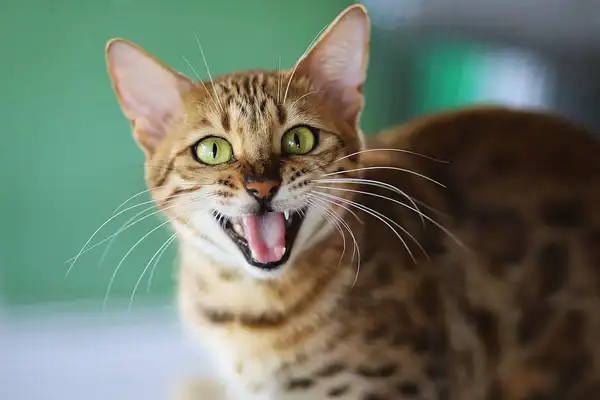
Felidae · CAT
Savannah
🌟 You may have met one
An F1 Savannah holds the Guinness World Record for tallest living domestic cat, with a shoulder height over 48 cm — taller than most Corgis. Owning an F1 Savannah has legal, dietary and housing requirements comparable to keeping a small wild animal.
Overview
The Savannah (萨凡纳猫) is a large cat breed weighing 4–14 kg with a 12–20-year lifespan. A hybrid breed created by crossing the African serval (Leptailurus serval) with domestic cats — one of the largest domestic cat breeds in the world. F1 individuals can reach 60 cm at the shoulder and 12-14 kg, retaining strong wild behavior; from F5 onward the temperament settles into more typical domestic-cat form. Spotted like a leopard, prodigiously athletic and leash-trainable. A serious specialist breed, not a starter cat.
Feeding
F1-F3 need raw diets or a high proportion of wet food; F4-F5 can eat premium commercial cat food; protein requirements are high.
Exercise
Extremely high exercise needs — large spaces, cat wheels, hunting play; leash-walks are welcome and long.
Grooming
Short coat is low-maintenance — weekly brushing. F1-F3 individuals may not tolerate strangers grooming them.
Health
Watch HCM, anesthesia risk (serval-related metabolic differences), and the legal status of your F-generation.
Gallery
A closer look at the Savannah
From origins and personality to daily care and health — helping you judge whether this little companion is really the one for you.
Origin & history
Origin & history
The Savannah is an **extremely young hybrid breed** whose origin can be dated to **April 7, 1986**, when Pennsylvania breeder **Judee Frank** crossed a male African serval (*Leptailurus serval*) with a Siamese queen and produced the first recorded Savannah kitten, named **Miracle** (later renamed 'Savannah'). The breed took its name from that first kitten.
**Key figures**: - **Patrick Kelley** and **Joyce Sroufe** submitted the first breed standard to **TICA** in 1996 - **TICA** granted 'New Breed Registration' status in 2001 - **TICA** granted **Championship** status in 2012 - **CFA, FIFe and GCCF do not recognize the Savannah as an independent breed** (owing to ethical concerns about wild-cat hybrids)
**F-generation system** (defined by TICA — the single most important concept): - **F1 (first generation)**: 50% serval; a 100% serval × domestic pairing. **45-55 cm at the shoulder, 10-14 kg**, retaining most wild behaviors - **F2**: 25% serval - **F3**: ~12.5% - **F4**: ~6% - **F5**: ~3% — considered **the start of 'stable domestic' Savannahs**, with temperaments similar to a Bengal - **Only F4 and later males are fertile** — F1-F3 males are sterile because of serval-vs-domestic chromosomal differences; the breed is carried through the maternal line
**Legality** (critical): - **USA**: state laws vary — New York, Georgia, Hawaii and Massachusetts **prohibit outright**; most other states require F4 or lower for pet keeping - **EU**: many countries classify F1-F4 under special permits with zoo-grade housing standards - **China, Japan, Australia**: F1-F4 are illegal or require special wildlife-keeping licences - **F5 and later** fall within ordinary pet regulations in most jurisdictions
**Genetic and lineage basis**: - Servals have 2n=36 chromosomes; domestic cats 2n=38 — **this chromosomal mismatch is the reason F1-F3 males are sterile** - Common maternal lines: Egyptian Mau, Bengal, Oriental Shorthair, or Savannah-to-Savannah backcross
Looks & breed standard
Looks & breed standard
The Savannah is **the height and body-size record holder among domestic cats**; its visual traits come almost entirely from its serval ancestry:
- **Body**: **long, lean and muscular**, deep-chested and slim-waisted - F1 males: **45-55 cm shoulder height**, 60-80 cm long, **10-14 kg** - F2 males: 35-45 cm shoulder height, 8-11 kg - F5 and later: closer to a large domestic cat, 5-7 kg - **Head**: **small and triangular** (small relative to the body), with a sloping forehead and defined muzzle. **A distinct black tear-line runs from the inner eye down the cheek** — the serval signature. - **Ears**: **very large, upright, wide-based and set close together**, with characteristic serval **ocelli** on the back (white spots ringed in dark, used as social/mating signals in the wild) - **Eyes**: medium, almond-shaped, usually green or golden - **Legs**: **exceptionally long**, especially the hind legs — the reason Savannahs can jump 2.5-3 meters vertically - **Paws**: **long-toed**, oval-shaped - **Tail**: medium length, shorter than an average cat's - **Coat**: **short, single-layered**, coarse and springy to the touch, in a **spotted tabby pattern** — solid black or dark brown spots on gold, brown or silver background
**Accepted colors (TICA)**: - **Brown Spotted Tabby** (classic, closest to serval) - **Silver Spotted Tabby** - **Black** (solid; spots barely visible) - **Black Smoke**
**Generation differences**: - F1-F2 retain the strongest serval appearance (huge ears, very long legs, tall build) - F3 tapers down in size - F5+ approaches a large spotted domestic cat
Personality in depth
Personality in depth
Savannah temperament is **heavily generation-dependent** — F1 and F5 are almost different animals:
**F1 (50% serval)**: - Retains extensive **wild behaviors**: territorial spraying, deep nighttime vocalizations, strong wariness of strangers - Requires an **outdoor catio** or professional enclosure - **Cannot live safely with small children or small pets** — serval hunting drive can activate - Needs **several hours a day** of interaction, hunting play and exercise - Only suitable for owners with **previous large-cat or wildlife experience**
**F2-F3**: - Clearly more tractable than F1 but **still retains 60-70% of the wild behavioral repertoire** - Can live indoors, but only with **large space and very heavy owner presence** - Wary but not aggressive toward strangers - Coexists with pre-existing pets, but introducing new animals is difficult
**F4**: - Temperament approaches a **very-high-energy domestic cat** - Can bond deeply with family members; friendly to strangers over time - Coexistence with children, dogs and other cats requires early socialization
**F5 and later**: - **Stable domestic-cat temperament**, sitting between a Bengal and an Egyptian Mau - Extraordinarily intelligent, energetic and affectionate - Trainable like a dog — leash, fetch, sit, targeting - Most 'family Savannahs' on the market are F5-F7
**Common traits across generations**: - **Exceptional intelligence** — all F-generations are among the top 3 for feline IQ - **Water affinity** — actively plays in water and often accepts baths - **Powerful jumping and climbing** — floor-to-ceiling cat trees are mandatory - **Loyal, often bonded to one person** - **Possible aggression** when threatened — not a fit for households with small children or allergy-sensitive visitors
Daily care
Daily care
Care requirements go **far beyond ordinary cats** and vary sharply by generation:
**F1-F3 (specialist level)**: - **Must have an outdoor catio** or a **dedicated large room** (8-10 m² and up) - **Diet**: - **Raw feeding primarily** — chicken, rabbit, quail - Whole prey ratios with bone, organ and muscle - Standard commercial cat food does not meet nutritional needs - **Socialization**: intensive human contact before 8 weeks of age or the cat remains wild-behaved for life - **Vet**: only work with **vets experienced beyond ordinary domestic cats** — general clinics may refuse
**F4-F5**: - Large room + floor-to-ceiling cat trees + a cat wheel - Diet: **high-protein (>45%) kibble + wet food mix**, optionally supplemented with raw - **1-2 hours** of daily interactive play - Leash-training welcome
**F6 and later**: - Care similar to a Bengal or Egyptian Mau - 38-42% protein premium cat food - 30-45 minutes of daily play
**Universal essentials**: - **Floor-to-ceiling cat trees** (Savannahs jump extremely high) - **Cat wheels** (excellent energy sink) - **Puzzle feeders and hunt-toys** - **Warmth**: short single coat means keep indoor temperature ≥ 20°C - **No free-roaming outdoors** — even F5+ animals will devastate local wildlife
**Grooming**: - Short coat, once-weekly comb - F1-F3 will not tolerate unfamiliar hands — owners must do it themselves
**Ears, claws, teeth**: - Large ears trap debris; check weekly - Long, sharp claws — needs **oversized scratchers** - Dental health is generally strong; annual check-ups suffice
Health & lifespan
Health & lifespan
Savannah health issues split into **medical** and **legal** layers:
**1. Hypertrophic cardiomyopathy (HCM)**: - The Savannah's maternal breeds (Siamese, Bengal, Egyptian Mau) all have reported HCM cases, and Savannahs have too - **Annual echocardiogram** is recommended
**2. Anesthesia risk**: - **Serval metabolism and drug tolerance differ from domestic cats** — F1-F3 anesthesia mortality is **significantly higher than in ordinary cats** - Discuss dosing thoroughly before any surgery - Only operate at clinics with **non-domestic cat anesthesia experience**
**3. Protein and taurine needs**: - F1-F3 have **very high animal-protein dependence**; standard kibble may fall short - Chronic protein deficiency leads to cardiac and retinal issues
**4. Genital/urinary issues**: - Some F1-F2 males spray heavily; early neutering helps but carries the anesthesia risk above
**5. PK-Def (Pyruvate Kinase Deficiency)**: - Can be inherited from Bengal / Egyptian Mau lineage — **pyruvate kinase deficiency** causes hemolytic anemia - UC Davis VGL offers a test - Breeding parents should be PK-Def screened
**6. Legal risk** (not medical but equally serious): - **Illegal generation purchases can lead to confiscation and fines** - Insurers **routinely refuse** F1-F3 - Travel/relocation: F1-F3 cannot be flown as standard pets - **Emergency vet care is hard** — many clinics decline F1-F3
**Recommended screening**: - Annual echocardiogram - PK-Def genetic test - Confirm vet willingness before adopting
**Lifespan**: healthy F4+ individuals 12-20 years; F1-F3 lifespans are more variable due to wild lineage vs captive husbandry mismatches.
Fit for your space
Fit for your space
**F1-F3 only for**: - Experienced keepers of **large cats or wild-type animals** - Owners with an **outdoor catio** and a dedicated room in a detached home - **Confirmed-legal jurisdictions** (many states/countries forbid these!) - Owners prepared for **spraying, aggression and property destruction** - Access to reliable **exotic-experienced vets** - No small children, no small pets (rabbits, birds, hamsters are prey) - Comfort with being uninsurable
**F4 still requires**: - Large indoor space + a cat wheel + heavy owner presence - No small children - Prior experience with large or working dogs helps
**F5 and later suits**: - **Medium to large homes** - Intermediate cat owners with Bengal/Egyptian Mau experience - At least 1 hour of daily interaction - Owners willing to leash-walk - Buyers who can afford the price tag (F5 typically $1,500-$5,000; F1 $20,000+)
**Absolutely not for**: - Apartments or small homes - Solo full-time workers - Families with infants or toddlers - Households with rabbits, birds, hamsters or other small pets - First-time cat owners **regardless of generation**
**Special notes**: - **Check local laws before buying** - Buy only from **TICA-registered breeders** — backyard operations forge 'F-generation' paperwork - Ask for **parents and three-generation pedigree** - Request **HCM and PK-Def screening** - **Do not impulse-buy on 'looks like a leopard' appeal** — this is a serious animal, not a toy
References
This is an educational overview — for specific health and care advice, please consult the authoritative sources below and your veterinarian.
- TICA — Savannah Breed Standard国际猫协标准
- TICA — Savannah Breed Committee国际猫协标准
- Savannah Cat Association (USA)俱乐部官网
- ICatCare — Concerns about hybrid cats (Savannah / Bengal)综合科普
- Wikipedia — Savannah cat综合科普
- IUCN Red List — Leptailurus serval (African serval)学术研究
- US Department of Agriculture / APHIS — Wild-hybrid animal regulations综合科普
- UC Davis VGL — Feline PK deficiency (PK-Def) genetic test基因检测
- Guinness World Records — Tallest domestic cat (Savannah F1)综合科普