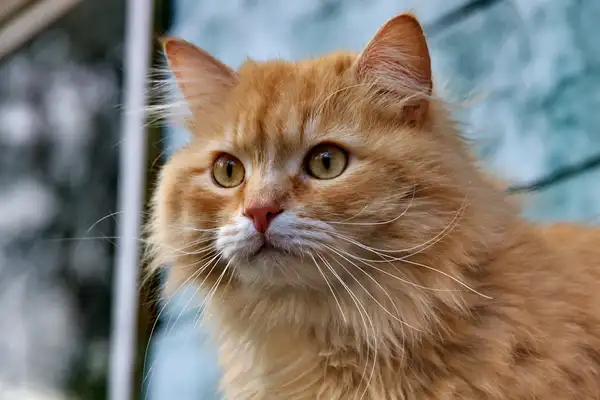
Felidae · CAT
Selkirk Rex
🌟 You may have met one
In 1987 in a Montana shelter, Persian breeder Jeri Newman spotted a fluffy curly-coated female she named Miss DePesto — the single founder of the Selkirk Rex and the first curly-coated cat breed with dominant inheritance.
Overview
The Selkirk Rex (塞尔凯克卷毛猫) is a medium-sized cat breed weighing 3.5–7 kg with a 14–16-year lifespan. Nicknamed the 'sheep in cat's clothing', the Selkirk Rex is a plush, curly-coated cat with a round face and full body. Its temperament matches the British Shorthair and Persian — calm, sweet and easy to handle — making it the most beginner-friendly curly cat.
Feeding
Standard high-quality cat food is fine; watch portions to prevent obesity.
Exercise
Medium exercise needs; enjoys slow-paced play — 15-20 minutes of daily interaction is enough.
Grooming
Curly fur mats easily; brush 2-3 times weekly with a wide-tooth and steel comb. Avoid over-bathing, which flattens the curls.
Health
Watch for HCM, PKD and hip dysplasia carried from the Persian and British Shorthair lineage.
Gallery
A closer look at the Selkirk Rex
From origins and personality to daily care and health — helping you judge whether this little companion is really the one for you.
Origin & history
Origin & history
The Selkirk Rex originated in **Montana, USA in 1987**. Local Persian breeder **Jeri Newman** adopted a fluffy, curly blue-cream-and-tortoiseshell female kitten from a Bozeman shelter, naming her **Miss DePesto of NoFace** (after the DiPesto secretary in the *Moonlighting* TV series) — the **single founder** of the entire Selkirk Rex breed.
Newman bred Miss DePesto to her black Persian male **PhotoFinish of NoFace**; three of six offspring inherited the curl, **proving that the Selkirk Rex curl is dominantly inherited (Se)** — completely different from the Cornish Rex (recessive LPAR6) or Devon Rex (recessive KRT71). This was **the first dominant curly mutation in domestic cats**.
Newman named the breed 'Selkirk Rex' after her stepfather Selkirk — **the only cat breed named after a person**. To broaden the gene pool and body type, early breeders introduced **Persian, Exotic Shorthair, British Shorthair and American Shorthair** — which is why the Selkirk Rex still shows the Persian/British Shorthair 'round face and round body'.
Post-2000 molecular work (Gandolfi et al.) mapped the Selkirk Rex curl to the **KRT71 gene** — **the same gene as the Devon Rex** but a different mutation! Devon carries a recessive loss-of-function mutation; Selkirk carries a **dominant gain-of-function mutation**, and though they can be crossed the offspring behave differently.
**TICA** recognized the Selkirk Rex in 1990, **CFA** in 2000 and **FIFe** in 2015. Both **Shorthair (Selkirk Rex Shorthair) and Longhair (Selkirk Rex Longhair)** varieties are recognized.
Looks & breed standard
Looks & breed standard
Nicknamed **'Sheep in Cat's Clothing'**, the Selkirk Rex combines a **thick, plush, sheep-like curly coat with the round face and round body of Persian/British Shorthair heritage**. The CFA standard reads *heavy-boned, muscular, rounded, plush, teddy-bear look*.
- **Head**: **round head, round eyes, round cheeks, short muzzle** — like a British Shorthair with a slightly longer nose, more three-dimensional than a Persian - **Ears**: medium-sized, medium-set, blending smoothly with the round head - **Eyes**: **large and round**, in vivid colors - **Body**: **medium-large, heavy-boned, muscular** (adult males reach 7 kg) — much larger than a Cornish or Devon Rex - **Coat**: **all three coat layers present, all curly** (guard, awn, down), with the feel of **thick plush or wool** - **Curl progression**: kittens are born clearly curly, go through a 'straight phase' at 8-10 months (temporarily straight), and settle into full curl at 16-24 months - **Whiskers and eyebrows**: **curly and noticeably long** — one of the breed's most iconic traits
All colors and patterns are accepted (inherited from Persian/British Shorthair). Two official divisions: - **Shorthair**: tight, wavy wool - **Longhair**: looser 'popcorn' curls with more volume
**Distinguishing from other Rex breeds**: Cornish Rex = slim greyhound; Devon Rex = petite pixie; Selkirk Rex = round, chunky sheep — the three look completely different at a glance.
Personality in depth
Personality in depth
The Selkirk Rex's temperament comes deep from its **Persian, British Shorthair and Exotic Shorthair heritage** — **calm, gentle, cuddly, low-energy**. It is **the easiest-to-keep and most beginner-friendly member of the Rex family**, the exact opposite of the 'monkey-like' Devon and Cornish.
**Key behavioral traits**: 1. **Calm and even-tempered**: does not run wild, and — like a British Shorthair — can nap on the sofa for hours 2. **Loves being held**: tolerates long holding, stroking and grooming — **the most cuddle-friendly curly cat** 3. **Middle-of-the-road social**: enjoys human company without being clingy; will greet you at the door but does not leap onto shoulders 4. **Moderate playfulness**: energetic as a kitten, less so as an adult — 15-20 minutes of daily play is enough 5. **Soft voice**: moderate volume, low frequency — a quiet companion 6. **Great with children, dogs and other cats**: extremely family-friendly
**Watch out for**: - Because it is mostly sedentary, **portion control is critical to avoid obesity** (thanks to the British Shorthair genes) - Curls look sturdy but **mat very easily**; boisterous play can create tangles - Tolerates 6-8 hours alone, but **chronic long-term isolation leads to mild depression**, especially in the longhair variety
The Selkirk Rex combines **'unique look plus zen personality'** — ideal for households wanting a cat 'as easy as a British Shorthair, as pretty as a Persian, as unusual as a Rex'.
Daily care
Daily care
Unlike the other Rex breeds, **the Selkirk Rex needs brushing** — it has a full three-layer coat that is entirely curly.
1. **Brushing (top priority)**: - **2-3 times a week** with a **wide-tooth comb plus a steel comb**, from root to tip - **Do not use a fine-tooth comb** — it straightens the curls and ruins the look - **Focus areas**: armpits, belly, inner thighs, behind ears — the fastest to mat - **Longhair variety**: 4-5 times a week to prevent hairballs
2. **Bathing**: - **Every 6-8 weeks** with a low-allergen pet shampoo - **Do not blow-dry straight** — use a low-temperature cool setting and finger-scrunch the curls - **Over-bathing breaks down the curl structure**
3. **Diet (weight control)**: - The Selkirk Rex gains weight easily (Persian/British Shorthair genes plus a sedentary lifestyle) - **Measured portions 2-3 times a day**, no free feeding - Protein >32%, fat 12-15% - Weigh regularly, keeping adults between 3.5 and 7 kg
4. **Eyes**: some individuals inherit Persian tear staining — wipe daily
5. **Ears**: clean every 2-3 weeks (moderate wax)
6. **Exercise**: 15-20 minutes of daily wand or ball play; a 1-1.5 m cat tree is enough — no need for extreme height
7. **Teeth and claws**: standard care, annual dental cleaning
**Seasonal shedding**: shedding during spring and autumn moults is comparable to a British Shorthair — Selkirk Rex is **not low-shed** like the Cornish or Devon; allergy sufferers should note this.
Health & lifespan
Health & lifespan
Because the Selkirk Rex used **Persian, Exotic Shorthair and British Shorthair** as gene-pool outcrosses, it inherits those breeds' hereditary risks:
1. **Polycystic Kidney Disease (PKD)**: - **The primary genetic disease of the Persian lineage** — dominant mutation in PKD1 - About 5-10% of Selkirk Rex carry it (lower than 30%+ in pure Persian) - **PKD genetic testing (UC Davis VGL) is strongly recommended** - Symptoms: kidney failure in middle age (>7 years), polyuria and polydipsia
2. **Hypertrophic Cardiomyopathy (HCM)**: - Inherited from the Persian/British Shorthair lineage - **Annual cardiac ultrasound is standard**
3. **Hip Dysplasia**: - Because of the **heavy skeletal build**, hip dysplasia incidence is above average - Symptoms: reduced jumping, hindlimb weakness, wobbly gait
4. **Patellar luxation**: like other Rex breeds, moderate incidence
5. **Gingivitis and FORL**: - Persian inheritance - Weekly brushing plus annual dental cleaning
6. **Hairballs and impaction**: - The longhair variety is prone to **trichobezoar-related intestinal obstruction** - Regular hairball paste plus high-fiber diet
7. **Anesthesia risk**: - **Short-muzzle Persian inheritance narrows the airway slightly** - Airway assessment before anesthesia
8. **Odd-eye and deafness (rare)**: some white Selkirk Rex individuals carry the W gene linked to congenital deafness — hearing screening is recommended.
**Before you buy**: request from the breeder a **PKD genetic test, HCM ultrasound, hip evaluation and three-generation pedigree**.
Fit for your space
Fit for your space
The Selkirk Rex is **the most approachable member of the Rex family** and has almost no ownership barrier.
**A good match for**: - **First-time cat owners** (calm, non-chaotic temperament) - **Homes with young children or elderly members** (cuddle-friendly, non-bitey, non-running) - Medium-sized apartments or houses (no need for tall cat trees) - Cat lovers wanting a 'British Shorthair face + Persian look + Rex curl' - Owners with enough time to brush 2-3 times a week - Anyone who has kept a British Shorthair, Persian or Exotic Shorthair and wants to try **the same body type in a different coat**
**Not a match for**: - Owners seeking **highly interactive or trainable cats** (see Devon, Cornish, Siamese) - Very busy owners who cannot brush at all (curls self-mat if left alone) - Households with cat-hair allergies (the Selkirk Rex is **not low-allergen** — it has a full triple coat and sheds like a British Shorthair) - Buyers unable to fund PKD testing, HCM ultrasound and hip evaluation
**Special notes**: - **Always require the PKD genetic test report** — the most serious Persian-line inherited disease - **Curly but not hypoallergenic**: the market often mislabels the Selkirk Rex as low-allergen — **this is simply wrong**; shedding is normal, and allergy sufferers should not buy for looks alone - **Consider adoption first**: the Selkirk Rex is fairly rare in shelters, but **curly-coated British/Exotic mixes** occasionally appear - **Market confusion**: authentic Selkirk Rex is uncommon in China — beware of 'permed Exotic Shorthair' fakes
References
This is an educational overview — for specific health and care advice, please consult the authoritative sources below and your veterinarian.
- CFA — Selkirk Rex Breed Article国际猫协标准
- TICA — Selkirk Rex Breed国际猫协标准
- GCCF — Selkirk Rex Breed Standard of Points国际猫协标准
- FIFe — Selkirk Rex Breed Standard (SRX)国际猫协标准
- Gandolfi et al. 2013 Sci Rep — KRT71 dominant mutation in Selkirk Rex学术研究
- Lyons et al. 2004 Mamm Genome — Feline PKD1 mutation学术研究
- ICatCare — Selkirk Rex breed profile综合科普
- UC Davis VGL — Selkirk Rex genetic testing panel基因检测
- Wikipedia — Selkirk Rex综合科普
- Selkirk Rex Breed Club俱乐部官网