Canidae · DOG
Shetland Sheepdog
🌟 You may have met one
Shelties rank 6th on Coren's intelligence list - nearly tied with Golden Retrievers (4th) and German Shepherds (3rd). What separates them isn't brains, it's a few kilos of muscle. And they bark - because for centuries on the Shetland Islands they herded sheep by voice, not by eye like Border Collies.
Overview
The Shetland Sheepdog (设得兰牧羊犬 / Sheltie) is a small dog breed weighing 6.5–12 kg with a 12–14-year lifespan. Often mistaken for a miniature Rough Collie, the Sheltie actually evolved independently on Scotland's Shetland Islands. Ranked 6th on Coren's intelligence list, Shelties are among the fastest-learning and most obedient dogs of any breed - devoted to family, reserved with strangers, and famously vocal. They make outstanding apartment companions and top-tier canine athletes for owners who invest in training and grooming.
Feeding
Small-breed food, roughly 3/4 to 1.5 cups per day split into two meals; treats must be strictly measured because they gain weight easily.
Exercise
60 minutes of moderate exercise plus mental games daily; excels at agility, obedience and disc.
Grooming
Double coat needs brushing 2-3 times per week and daily during coat blow; do NOT shave - it destroys coat structure and thermoregulation.
Health
Screen for MDR1/ABCB1 mutation, Collie Eye Anomaly, hip dysplasia, sebaceous adenitis and hypothyroidism.
Gallery
A closer look at the Shetland Sheepdog
From origins and personality to daily care and health — helping you judge whether this little companion is really the one for you.
Origin & history
Origin & history
The Shetland Sheepdog (Sheltie) originated on Scotland's Shetland Islands north-east of the Scottish mainland - like the Shetland pony and Shetland sheep, it is a classic example of the islands' small-scale evolutionary pattern, in which harsh climate and limited feed drove domestic species toward smaller size over centuries. In the 19th century the local farmers kept a small herding dog they called the *Toonie dog* ("toon" meaning farm), whose ancestors likely included Nordic Yakki dogs (probably a spitz type), local small collies, King Charles Spaniels, and later Pomeranians.[1][2]
When the British Navy visited the islands in the late 1800s, sailors began taking these small dogs home. To appeal to the mainland market, early breeders deliberately crossed them further with Rough Collies to produce a more Collie-like appearance - which is why so many people still confuse the two breeds today. The two are indeed genetically close, but are recognised as separate breeds.[1][2]
**Key milestones**: the first Sheltie club (then called Shetland Collie) was founded on the Shetland Islands in 1908; because the Rough Collie Club objected strenuously to the use of "Collie", the Kennel Club renamed the breed **Shetland Sheepdog** on recognition in 1914; the AKC first registered the breed with a male named Lord Scott in **1911**; the American Shetland Sheepdog Association (ASSA) was founded and recognised by the AKC in **1929**; the FCI number is 88, Group 1 (Sheepdogs and Cattle Dogs). The breed standard stabilised in the 1930s and Shelties have since been bred primarily as companions and sport dogs.[1][2][3]
Looks & breed standard
Looks & breed standard
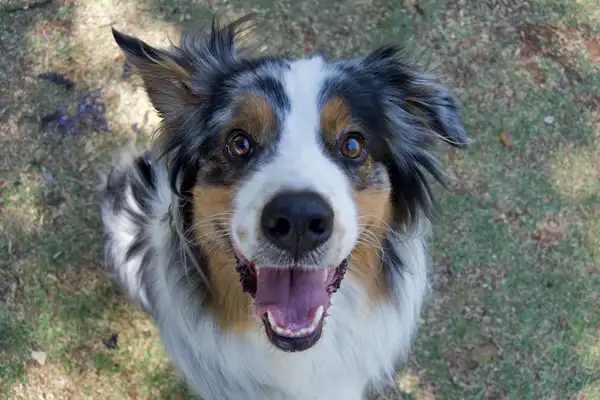
AKC standard: **13-16 in (33-41 cm) at the withers** - a **strict** height range, dogs outside it are disqualified - and 6.5-12 kg (weight is not fixed by the standard, only that it must be proportional to height). The overall silhouette is described as "a Rough Collie in miniature" - but the standard also insists that the Sheltie is a distinct breed and not a downsized Collie.[3][4]
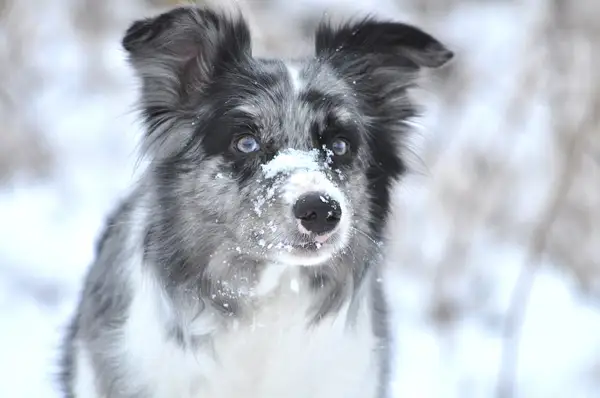
**Head**: a blunt wedge with the same profile viewed from top or side; **muzzle** flat and blunt; **almond-shaped dark eyes** (blue eyes only permitted in Blue Merle); **ears** high-set, three-quarters erect with tips folded forward - a signature Sheltie feature that AKC allows moderate ear-taping to shape.[3][4]
**Coat**: **double coat** - outer coat long, straight, harsh and water-resistant; undercoat dense and soft; heavy mane on the neck and chest (more pronounced in males), feathering on the front legs and rear hocks. **Three AKC-approved colour groups**: - **Sable** - from gold to deep red-brown, may be tipped with black; the classic look - **Black-based** - including Bi-Black (black and white) and Tri-Colour (black, white and tan) - **Blue Merle** - silver-blue with black patches
**Disqualifying colours**: faded "grey-blue", excessive white (White factored, over 50 percent), brindle.[3][4]
**Body**: compact and muscular but not stocky; chest deep to the elbow; back level and sloping slightly to the croup; tail reaching the hock, hanging down at rest and slightly raised in motion.[3][4]
Personality in depth
Personality in depth
**Ranked 6th on Coren's Intelligence of Dogs list**, the Sheltie is among the fastest learners and most obedient dogs of any breed. The ASSA describes them as "intelligent, loyal and eager to please"; a Sheltie will typically master a new basic command within five repetitions and obeys the first-time cue over 95 percent of the time. That is unmatched among small breeds.[1][3][5]
**Sensitivity and empathy**: Shelties are extraordinarily sensitive, picking up family emotional shifts almost instantly - they will remove themselves or actively soothe when tension rises. That means **harsh corrections destroy trust immediately** and reward-based training is the only sensible approach.[5][6]
**Barking**: the most-discussed "flaw", but in reality **barking is the breed's job description** - the sheep of the Shetland Islands were scattered and skittish, and shepherds used voice-driven Shelties (rather than eye-driven Border Collies) to move them. So doorbells, delivery drivers, joggers, squirrels and even falling leaves will trigger the alarm. A "quiet" cue can bring frequency down to a livable level, but **expecting an all-day silent Sheltie is asking the breed to override its instincts**.[5][6]
**With strangers and family**: **very reserved, sometimes shy, with strangers** - under-socialised puppies can become skittish or fear-biters as adults. The 8-16-week window matters: expose to many people, dogs and environments and adult confidence rises noticeably. **Excellent with children** (a Sheltie may try to herd toddlers by circling them - the herding instinct at work); low same-sex conflict, generally friendly with cats and other small pets.[5][6]
Daily care
Daily care
**Exercise**: AKC classifies Shelties as medium-to-high energy. Plan for **60 minutes of moderate activity plus at least 15-20 minutes of mental exercise daily** - obedience drills, scent work, puzzle feeders. In agility, obedience, disc, Rally and herding trials, Shelties are consistent title winners; they have long dominated AKC agility rankings among small breeds. Without mental stimulation they self-medicate with compulsive tail-chasing, shadow-chasing, or light-chasing.[3][5]
**Diet**: small-to-medium-breed food, puppy formula until 12 months; adults 3/4-1.5 cups (100-200 g) per day split into two meals. **Metabolism is only moderate and Shelties gain weight easily** - the AKC warns explicitly that they are among the medium breeds most prone to obesity; ASSA recommends spine and ribs be palpable but not visible (BCS 4-5/9).[5][6]
**Grooming**: the double coat needs **thorough brushing 2-3 times weekly** - a pin brush plus a comb, focusing on behind the ears, armpits and groin. **Daily 15-minute brushing during the spring and autumn coat blows** is essential, otherwise the coat mats within a week. **Warning: do NOT shave for summer** - ASSA's official position is that shaving destroys the double-coat structure, causing the outer coat to regrow coarse and faded and reducing both summer insulation and winter warmth. Keep them cool with adjusted walk times, water and air conditioning - not with clippers.[5][6]
**Consistency in training**: Shelties actively look for rules; the whole family must use the same cues. They are more sensitive to tone than most breeds - a calm, clear command is far more effective than a raised voice.[5][6]
Health & lifespan
Health & lifespan
Shelties live **12-14 years** on average, with a median around 13. Overall health is above average for a small breed. CHIC certification requires the following screens.[7][8]
**1) MDR1 / ABCB1 mutation** - the classic problem in the collie family. In Shelties roughly **15% are homozygous mutants (M/M)** and **35% heterozygous (M/N)** - about half the breed carries at least one mutant allele. The mutation cripples the blood-brain barrier's ability to expel a range of drugs, so **ivermectin, loperamide (anti-diarrhoeal), several chemotherapeutics and some antiemetics** at normal doses can trigger neurotoxicity or death. **Every Sheltie should be tested for MDR1** and the report kept on file for veterinary visits. Washington State University's VCPL is the reference laboratory.[7][8][9]
**2) Collie Eye Anomaly (CEA)**: a congenital eye defect in the collie family; incidence in Shelties is around 10 percent, mostly Grade 1 (choroidal hypoplasia), rarely progressing to retinal detachment. DNA testing (NHEJ1 mutation) plus a 6-8-week puppy fundus exam are the standard screens.[7][8]
**3) Hip dysplasia**: not the highest incidence for a small breed but not zero; OFA or PennHIP evaluation is standard.[7]
**4) Hypothyroidism**: the AKC lists this as a breed with above-average incidence; annual T4/TSH bloodwork after adulthood is a good habit.[7][8]
**5) Sebaceous adenitis**: Shelties are a predisposed breed; presents as flakes, patchy alopecia and skin odour, diagnosed by biopsy and managed long-term with oil baths and immunomodulation.[7][8]
**6) Von Willebrand disease type III** (a coagulation disorder), and **Merle-to-Merle deafness/blindness**: two Blue Merle parents produce roughly 25% double-Merle offspring, most of them deaf or blind or eyeless. Ethical breeders never do Merle-to-Merle pairings.[7][10]
**CHIC required panel**: MDR1 DNA, CEA DNA plus fundus exam, hip OFA, thyroid, dermatology history, cardiac.[7][8]
Common myths & adoption tips
Common myths & adoption tips
**Myth 1: The Sheltie is a mini Rough Collie.** - The most common misconception. In fact Shelties evolved for centuries independently on the Shetland Islands, and only late-19th-century breeders crossed them back with Rough Collies to sell them on the mainland. When the KC recognised the breed in 1914 the Rough Collie Club insisted on a distinct name - hence Shetland Sheepdog, deliberately not Shetland Collie.[1][2]
**Myth 2: Excessive barking is a defect.** - Barking is the breed's **working legacy** - Shelties herded Shetland sheep with voice, not eye like the Border Collie. You can train frequency down but you cannot delete it; if you live in a thin-walled apartment and the household is noise-averse, evaluate the breed match honestly.[5]
**Myth 3: Shave in summer to keep them cool.** - ASSA's official position: **shaving destroys the double-coat structure, causing the new outer coat to regrow coarse and faded and reducing insulation**. Cool them with adjusted walk times, air conditioning and water - not clippers.[5]
**Myth 4: Blue Merles are pretty, so breed more of them.** - Merle-to-Merle produces roughly 25% double-Merle offspring, most of them deaf or blind or malformed. Refuse any Merle-to-Merle pairing (ask if both parents are Merle).[6][8]
**Adoption tips**: rescue Shelties are frequently surrendered as "too vocal, too much shedding, too much training needed" - labels that mostly reveal previous owners who didn't do their homework. If buying from a breeder, insist on parents' **MDR1 DNA, CEA DNA, hip OFA, ophthalmic CERF and thyroid** reports; refuse Merle-to-Merle pairings; ask to meet the dam and see the litter's environment (socialisation quality is visible on inspection).[7][8][10]
References
This is an educational overview — for specific health and care advice, please consult the authoritative sources below and your veterinarian.
- [1] Shetland Sheepdog History - American Shetland Sheepdog Association (ASSA)Official
- [2] Shetland Sheepdog - WikipediaEncyclopedia
- [3] Shetland Sheepdog Official Breed Standard - AKCOfficial
- [4] FCI Standard No. 88 - Shetland SheepdogOfficial
- [5] Shetland Sheepdog Breed Guide - VCA Animal HospitalsVeterinary
- [6] Coren, S. The Intelligence of Dogs (1994)Study
- [7] OFA CHIC Health Screening Recommendations - Shetland SheepdogStudy
- [8] Mealey KL et al. MDR1 mutation in canine breeds - Washington State University VCPLStudy