Felidae · CAT
Snowshoe
🌟 You may have met one
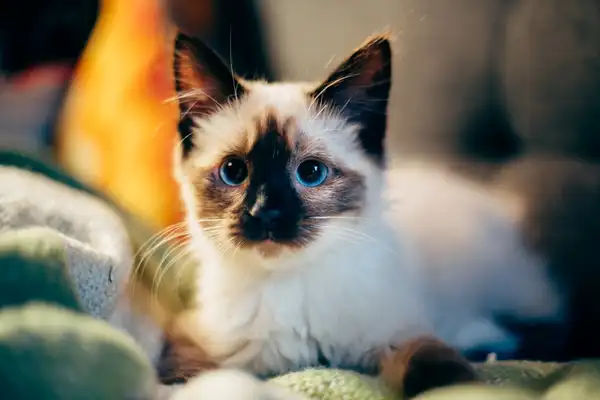
The white boots are the result of two genes working together — the S (white spotting) and cs (colorpoint) genes — which makes them notoriously hard to breed for. In a typical litter, only 1-2 kittens will show ideal symmetrical mitts.
Overview
The Snowshoe (雪鞋猫) is a medium-sized cat breed weighing 3–5.5 kg with a 12–19-year lifespan. An American breed created by crossing Siamese with American Shorthair. Its signature look is a colorpoint body with symmetrical white boots on all four feet and a bright Siamese-blue eye. Vocal, outgoing and affectionate — often described as 'a chattier American Shorthair'. The breed is genuinely rare and considered an underrated companion cat.
Feeding
A quality standard adult cat diet is fine; watch calories to avoid middle-age weight gain.
Exercise
Enjoys interactive play and chase toys; trains readily to cues and fetch.
Grooming
Short single coat is low-maintenance — brush weekly; shedding is light.
Health
Generally very healthy; watch for Siamese-line strabismus, kinked tails and standard HCM screening.
Gallery
A closer look at the Snowshoe
From origins and personality to daily care and health — helping you judge whether this little companion is really the one for you.
Origin & history
Origin & history
The Snowshoe was created in **1960s Philadelphia, Pennsylvania**, by a Siamese breeder named **Dorothy Hinds-Daugherty**. In one of her purebred Siamese litters she found three kittens with **white feet**, thought they were charming, and began breeding intentionally for the trait.
**Breeding approach**: - She initially crossed her white-footed Siamese with **bicolor American Shorthairs** to stabilize the pointed body + white feet combination - Small amounts of **Birman** blood were later introduced to improve mitt symmetry - The foundational cross, however, is **Siamese × American Shorthair**
**A bumpy road to recognition**: - Dorothy struggled to promote the breed, retired in the 1970s, and the breed nearly disappeared - **Vikki Olander** revived it, consolidated the pedigree records and drove the applications to registries - **CFA** granted experimental status in 1974 - **TICA** granted championship status in 1983 (the first registry to do so) - **CFA** did not grant championship recognition until 1994 - **FIFe** still does not recognize the Snowshoe as a separate breed
**Genuine rarity**: - Because the S (white spotting) and cs (colorpoint) genes segregate independently, an ideal Snowshoe (four symmetrical mitts + inverted V facial spot) is genetically hard to reproduce — most litters yield only 1-2 correctly-marked kittens - Worldwide, only a few hundred Snowshoes are registered per year — an authentically rare breed - Snowshoes are still uncommon in China; most come from overseas or from a handful of responsible domestic breeders
**Genetic basis**: - Colorpoint (Siamese pattern): **TYR gene, cs allele** — a temperature-sensitive tyrosinase that darkens the cool extremities - White mitts (American Shorthair bicolor): **KIT gene, S allele** — controls white spotting extent
Looks & breed standard
Looks & breed standard
The TICA and CFA Snowshoe standards revolve around three signature visual features:
1. **Colorpoint body**: - Light body (ivory, cream, pale fawn) - **Darker face, ears, legs and tail** (seal point, blue point, chocolate point, lilac point, etc.) - Same TYR-cs mechanism as Siamese, Birman and Himalayan
2. **White boots (Snowshoe pattern)**: - **Four symmetrical white mitts** — the source of the breed name - Front mitts reach the wrist; hind mitts reach the hock - Boot edges should be clean and even — 'half-white/half-color' feet are undesirable
3. **Inverted V facial blaze**: - **A white inverted-V or triangle from forehead to nose** - Symmetric with the boots — the visual detail that separates Snowshoe from Siamese
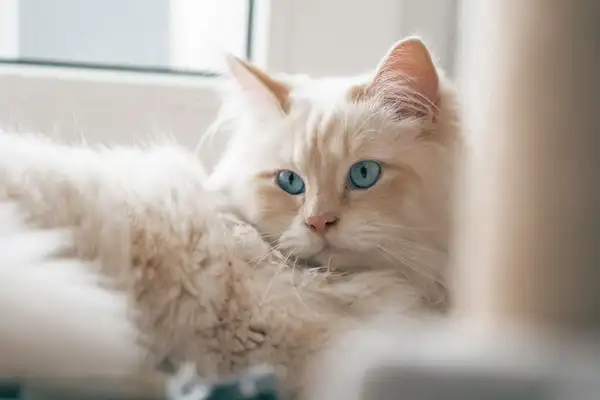
**Other standard traits**: - **Eyes**: **brilliant blue (Siamese blue)**, almond-shaped and slightly slanted - **Head**: **modified wedge** — rounder than a Siamese but slimmer than an American Shorthair - **Ears**: medium-large, wide at the base - **Body**: **medium boning, well-muscled without being bulky**, balanced in length and height. Adult males 4-5.5 kg, females 3-4 kg - **Coat**: **short, close-lying and satin-smooth**, with little to no undercoat — shedding is mild
**Accepted point colors**: seal (classic), blue, chocolate, lilac; some registries also accept red and tortie points.
Personality in depth
Personality in depth
Snowshoe personality is essentially **Siamese sociability + American Shorthair steadiness** — one of the most popular family-cat temperaments:
1. **Vocal**: - Inherits the Siamese 'running commentary' habit - But the voice is **softer than a Siamese** (thanks to the American Shorthair blend), less piercing - Some individuals produce a **dove-like cooing sound**, uniquely Snowshoe
2. **Extremely affectionate — with everyone**: - Bonds strongly to the household like a Siamese - But **spreads affection more evenly across family members** - Door-greeting, following you around and sleeping in bed are all typical
3. **Smart and trainable**: - Learns to respond to name, come when called, open doors and drawers - **One of the most reliable feline fetchers** - Adapts to leash walking with patience
4. **Enjoys water**: - Most Snowshoes tolerate or actively enjoy water - Bath tolerance is high
5. **With children and other pets**: - **Five-star tolerance** — excellent with kids - Great in multi-pet homes — one of the top choices for busy households
6. **Social needs**: - **Do not leave alone for long stretches** (8+ hours triggers anxiety) - Recommend keeping in pairs or with a dog
7. **Energy and activity**: - Moderate-to-high energy - 20-30 minutes of interactive play per day - Activity dips slightly with age but stays above Persian/British Shorthair baselines
**In short**: if you want 'a Siamese personality that isn't quite as loud, in a cat that looks like it's wearing white boots and a mask', the Snowshoe is the perfect choice.
Daily care
Daily care
**Grooming**: - Short coat with a thin undercoat — **once-weekly steel-comb brushing** is enough - 2 sessions weekly during spring and autumn shedding - Shedding is on the low-to-moderate end for cats - **No professional grooming needed** — a rubber grooming glove or ordinary cat comb is fine
**Bathing**: - Every 2-3 months - Most Snowshoes tolerate baths well - Use a gentle cat shampoo; the inverted-V facial blaze area can be sensitive
**Diet**: - Standard high-quality adult cat food - 32-38% protein is appropriate - **Snowshoes are prone to middle-age weight gain** (after 3-6 years); calorie control matters - A wet-and-dry food mix works well; encourage hydration
**Exercise and companionship**: - 20-30 minutes of active interactive play daily - **Social needs are the most important care item** — do not leave the cat alone for very long - Consider keeping two Snowshoes or a Snowshoe plus a dog/other friendly cat - Provide cat trees, perches and window seats
**Temperature**: - A colorpoint cat's coat color is **temperature-modulated** (TYR is temperature-sensitive) - In colder environments the whole coat darkens over time (not harmful, just visibly different from kittenhood) - In warmer environments the points fade - 20-26°C indoor is ideal
**Ears, claws, teeth**: - Weekly ear check, weekly gum check, regular nail trimming — same as any shorthair
**Special note**: - **Adult coat darkening is normal**, and boot edges may develop a smoky gradient - The facial V does not disappear but may subtly change shape
Health & lifespan
Health & lifespan
Because the Snowshoe's gene pool blends **Siamese, American Shorthair and Birman**, hybrid vigor is real and the breed is **broadly healthy**. Lifespans of 12-19 years are common, with many cats reaching 15+. Some things still warrant attention:
1. **Strabismus (crossed eyes)**: - Inherited from the Siamese background — a **congenital visual pathway anomaly** (see Guillery 1974 *Sci Am* for the classic paper) - Presents as inward-turning eyes - **Does not affect daily life** (the cat has adapted) but affects show scoring - Modern breeding has largely reduced its incidence
2. **Kinked tail**: - Also from the Siamese line - A small bend at the tail tip - **No health impact**, but a cosmetic show fault - Breeders typically cull for this
3. **Hypertrophic cardiomyopathy (HCM)**: - No breed-specific mutation reported in Snowshoe, but an **echocardiogram every 2-3 years** is prudent
4. **Periodontal disease**: - As with all Siamese-line cats, dental care matters in old age; schedule annual oral exams
5. **Middle-age weight gain and diabetes risk**: - Adult Snowshoes slow down and neutering further lowers metabolic rate - **Strict weight control in adulthood is the single most impactful preventive step** - Obesity dramatically raises diabetes risk
6. **UV sensitivity of dark points**: - Darker facial, ear and tail areas may darken or spot with prolonged summer sun - No special protection is needed but avoid long outdoor UV exposure
**Recommended screening**: - Annual physical and blood chemistry - Echocardiogram every 2-3 years - Annual oral exam
**Bottom line**: the Snowshoe is a genuinely low genetic-burden breed and a beginner-friendly choice.
Fit for your space
Fit for your space
**A good match for**: - **Large families, homes with children, and multi-pet households** — the Snowshoe's cross-species adaptability is among the best of any cat breed - Remote workers, retirees or homes with lots of daytime presence - People who want 'a Siamese personality without the volume' - Owners who want a beautiful cat but do not want to spend heavily on grooming - Buyers seeking a balanced blend of **longevity, health and interactivity** - First-time owners (Snowshoes are one of the **most beginner-friendly breeds**)
**Not a match for**: - **Owners who live alone and are gone for 10+ hours a day** — the cat will suffer severe anxiety - Households that want a completely silent cat (Snowshoes chatter all day) - Homes seeking a decorative statue-cat (Snowshoes are too active) - Apartments unable to offer cat trees or vertical space
**Special notes**: - **Snowshoes are rare and buyers frequently encounter scam operations** — insist on TICA/CFA-registered legitimate breeders - Ask for **parental echocardiogram reports** - **Beware of casual 'Siamese × American Shorthair' hybrids being sold as Snowshoes** — a true Snowshoe requires multiple generations of selective breeding for mitts and blaze, not a one-off cross - Mitt symmetry may not be perfect at 8 weeks and often improves as the cat grows - **Kitten blue eyes are temporary in most breeds**, but Siamese-line cats (including Snowshoes) retain blue eyes for life - Pricing: **a legitimate Snowshoe costs a bit more than a Siamese**, but less than a Ragdoll, Maine Coon or Bengal
**Summary**: the Snowshoe is 'the underrated perfect family cat' — Siamese interactivity, American Shorthair steadiness, Birman beauty, excellent health and an approachable price.
References
This is an educational overview — for specific health and care advice, please consult the authoritative sources below and your veterinarian.
- TICA — Snowshoe Breed Standard国际猫协标准
- CFA — Snowshoe Breed Profile国际猫协标准
- GCCF — Snowshoe Preliminary Breed Standard国际猫协标准
- ICatCare — Snowshoe breed profile综合科普
- Guillery 1974 Sci Am — Visual pathways in Siamese cats (strabismus)学术研究
- Lyons et al. 2005 — TYR gene mutations in point-restricted cats学术研究
- David et al. 2014 — KIT gene and white spotting in cats学术研究
- UC Davis VGL — Feline color and pattern testing基因检测
- Wikipedia — Snowshoe cat综合科普