Felidae · CAT
Toyger
🌟 You may have met one
The name 'Toyger' comes from 'Toy + Tiger'. The goal was a house cat with tiger-like circular vertical body stripes — extremely rare in natural tabbies. Judy Sugden famously traveled to India to bring back a street cat with distinctive ear-back 'thumbprint' markings to found the breed.
Overview
The Toyger (玩具虎斑猫) is a medium-sized cat breed weighing 3–7 kg with a 12–15-year lifespan. The 'toy tiger' — a domestic cat breed developed since the 1980s by Judy Sugden (daughter of Bengal founder Jean Mill) to visually recreate the vertical ringed stripes of a tiger. **Toygers are 100% domestic cats, with no wild ancestry**. The breed was built on domestic mackerel tabbies plus a street cat imported from India that carried the ear-back 'thumbprint' spots. TICA registered the breed in 1993 and granted championship status in 2007. Personality is gentle, affectionate, intelligent, and family-friendly.
Feeding
Standard premium adult cat food; 36-42% protein is ideal.
Exercise
Moderate exercise needs — about 30 minutes of daily play, plus a medium-height cat tree.
Grooming
Extremely easy short coat — comb once a week; low shedding.
Health
Generally healthy, but watch for HCM, functional kitten heart murmurs, and the narrow gene pool of a young breed.
Gallery
A closer look at the Toyger
From origins and personality to daily care and health — helping you judge whether this little companion is really the one for you.
Origin & history
Origin & history
The Toyger is one of the rare **openly designed domestic cat breeds** — not the product of natural evolution but a deliberate breeding project, a piece of living art.
**Founder Judy Sugden**: - Born into a breeding family — her mother is **Jean Mill, the mother of the Bengal breed**. - Judy is a trained architect and visual artist. In 1980 she noticed something unusual on one of her mother's domestic mackerel tabbies: **two crisp, discrete circular spots on the cat's temples**. - Such circular markings are extremely rare in natural tabbies — normal mackerel and classic tabby patterns are all elongated stripes. - She realized that **if this circular tendency could be strengthened, one might breed a domestic cat with tiger-like circular vertical body stripes**.
**Key foundation cats**: 1. **Millwood Sharp Shooter** — a female domestic mackerel tabby owned by Jean Mill, with an M forehead and clear temple spots. 2. **Scrapmetal** — a large-boned domestic black tabby male. 3. **Jammu Blue** — a male street cat that Judy imported from **Kashmir, India** in 1993. He carried **ear-back thumbprint spots** (the same white marking found behind wild tigers' ears), a trait almost lost in domestic cats. He is the key source of the Toyger's most distinctive markings.
**Breeding goals**: - A **domestic visual recreation of the Bengal tiger (Panthera tigris tigris)**. - **Absolutely no wild ancestry** — unlike the Bengal (with Asian leopard cat blood), the Toyger is **100% domestic**. - Reinforce **circular vertical body stripes** rather than the standard elongated stripes. - Reinforce **ear-back thumbprints and tiger-like facial patterns (bull's-eye markings on the temples)**.
**International recognition**: - **TICA** registered the breed as 'Experimental' in 1993. - **TICA** advanced it to 'Preliminary New Breed' in 2000. - **TICA** granted full **championship status** in 2007. - **CFA, FIFe and GCCF have not yet recognized the Toyger** — it is currently a TICA-only breed.
The Toyger is an **extremely young breed** (about 30 years old) and its gene pool is still expanding. Only about 40-60 certified Toyger catteries exist worldwide.
Looks & breed standard
Looks & breed standard
The TICA Toyger standard aims at 'a tiger on the coffee table':
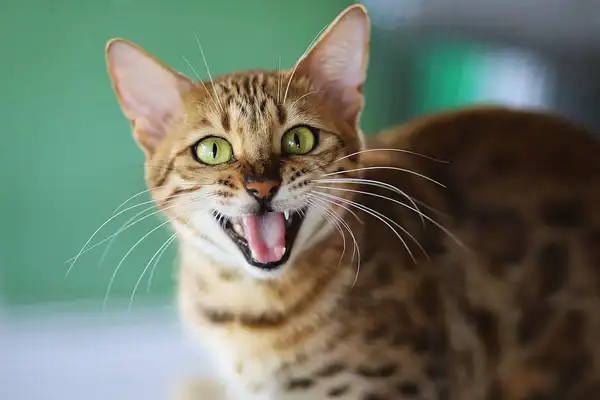
- **Body**: **medium-sized, muscular, solid without being coarse**. Adult males weigh 4-7 kg, females 3-5 kg. The **shoulders sit slightly higher than the hips**, giving a rolling 'tiger walk' — one of the clearest distinctions from other tabbies. - **Head**: **medium-large, longer than wide** — unlike the round or classic wedge of most domestic cats. TICA calls for a 'virtual tiger head' — long, softly diamond-shaped, with a flat top. - **Nose bridge**: **long and slightly curved**, with a wide brick-red nose leather. - **Ears**: **small, round, short and wide-based** — deliberately unlike a typical alert-erect house-cat ear, to match a tiger's rounded ears. **Ear-back thumbprints** are required. - **Eyes**: **medium to small, deep-set, slightly slanted downward** — to convey a tiger's gaze. Colors are **deep brown, gold or copper** (no green, no blue). - **Coat**: - Short, dense, glossy. - **Ground color from bright orange to light brown**, stripes deep brown to black. - Some individuals have white on cheeks, chin and belly. - **Glitter**: microscopic reflective crystals on the hair tips (as in Bengals) — the coat shimmers in sunlight. - **Pattern (the only TICA-recognized coloring)**: **Brown Mackerel Tabby** — but the goal is to transform elongated mackerel stripes into **vertical circular stripes**. - **Facial markings**: - Dark circles around the eyes. - **Symmetrical bull's-eye markings on the temples** — a Toyger specialty. - Long cheek stripes running back from the eyes to the jaw. - **Ear-back thumbprints** — white round dots. - **Tail**: medium-long, blunt-tipped, with continuous ringed dark bands (tiger-tail style).
**Note**: not every TICA-registered Toyger achieves the ideal — **championship-quality Toygers with fully circular striping are still rare**. Most individuals fall somewhere between mackerel and circular. Ongoing breeding work targets more consistent circularity.
Personality in depth
Personality in depth
The Toyger's personality is **the opposite of its wild look** — it is **the gentlest of the wild-looking domestic breeds**:
1. **Extremely affectionate**: Toygers rarely act aloof. They **follow their people around, sit on laps, and actively seek cuddles** — closer to a Ragdoll than to their cousin the Bengal. This is by design: Judy Sugden deliberately excluded aggressive lines. 2. **Friendly to strangers**: Unlike the Egyptian Mau, the Toyger is **welcoming to visitors** and often approaches them. 3. **Highly intelligent and trainable**: - Learns commands (sit, come, high-five). - **Accepts leash training** willingly. - Plays fetch — most Toygers will chase and return a small ball. - Can operate water dispensers and open doors. 4. **Soft voice**: Low-pitched and soft, far quieter than Siamese or Oriental Shorthairs. Not particularly chatty. 5. **With children**: **the Toyger is the best pick among wild-look breeds for families with kids** — gentle, affectionate, tolerant of handling. TICA breeding documents describe Toygers as textbook 'family cats'. 6. **With other cats**: A social individual — coexists peacefully with other cats without pushing for dominance. 7. **With dogs**: Gets on very well with gentle, mature dogs (Golden Retriever, Labrador, Cocker Spaniel). This complements the breed's 'domestic-tempered' goal. 8. **Moderate prey drive**: **Lower than Bengal or Egyptian Mau**. Interested but not obsessed. Can safely coexist with birds and small pets (with basic safeguards). 9. **Handles alone time**: Tolerates **8-10 hours of solitude** — the most independent-friendly of the wild-look breeds.
The Toyger was engineered to **look like a tiger and act like a Golden Retriever** — the friendliest wild-look cat for ordinary households.
Daily care
Daily care
The Toyger is a **beginner-friendly wild-look breed**:
**Grooming**: - Very short, close-lying coat, with no undercoat (or a very sparse one). - Comb weekly with a soft brush or rubber curry. - Slightly more often during spring and autumn shedding. - **No professional grooming needed.**
**Bathing**: - Every 2-3 months. - Most Toygers are **neutral to friendly toward water**, inherited from the Jean Mill lineages. - The coat looks brighter and the glitter more visible after a bath.
**Diet**: - Standard premium cat food, **36-42% protein**. - No need for the high-calorie formulas used for Bengals. - Mix of wet and dry food works well. - **Watch calorie intake** — moderate activity plus their sociable food-begging habit can lead to weight gain.
**Exercise**: - **Moderate needs** — 30 minutes of interactive play per day. - A medium-height cat tree and a window perch are enough. - Enjoys fetch, wand toys and puzzle feeders. - **Leash-friendly** — Toygers train easily on a harness. - No need for a Bengal-style 'runway' furniture layout.
**Alone time**: - Can handle **8-10 hours alone**. - Leave puzzle toys and an automatic feeder. - For long-term regular solitude, still consider a second cat or pet companion.
**Ears, claws, teeth**: - Check ears every two weeks. - Weekly gum checks. - Regular claw trimming.
**Special notes**: - **Kitten patterns develop slowly** — circular striping is not fully settled until adulthood (2 years+). - **Don't dismiss a Toyger kitten just because its stripes look ordinary at 6 months** — many champion Toygers looked like plain mackerel tabbies at that age. - Verify pedigree through the TICA registry.
**Socialization**: - Toyger kittens integrate exceptionally well — they can adapt to new homes, cats or dogs from 12 weeks.
Health & lifespan
Health & lifespan
As a **young breed** (about 30 years old), the Toyger has a **narrow gene pool** — only a few thousand pedigreed cats worldwide. Overall health is good, with lifespans of 12-15 years typical, but note the following:
1. **Hypertrophic Cardiomyopathy (HCM)**: - Present in all cats. - No breed-specific HCM mutation is currently known for the Toyger (unlike the Maine Coon MYBPC3 A31P). - Because the gene pool is narrow, breeding cats should have **annual echocardiograms**; pet cats every 1-2 years once adult.
2. **Kitten heart murmurs**: - Toyger kittens have **a higher rate of benign functional murmurs than average domestic cats**. - Most resolve by 6-12 months. - Any persistent murmur or one paired with symptoms deserves ultrasound.
3. **PK-Def**: - Because a few Toyger lines trace back to Bengal or Abyssinian-related cats, occasional PK-Def carriers are reported. - **UC Davis VGL screening is available**; breeders should test.
4. **Narrow-gene-pool risks**: - The global Toyger population is limited. - Recessive mutations may accumulate — favor breeders who still outcross (TICA permits mackerel-tabby domestic outcrosses in the Toyger program, with a planned closure after 2025). - **Request 3-generation coefficient of inbreeding (COI)** — ideally <10%.
5. **Hip dysplasia**: Rare, but occasional reports in the large-boned lines — hip scoring optional for breeding cats.
6. **Periodontal disease**: As with all cats, annual oral exams from middle age.
7. **Obesity**: Moderate exercise plus food-seeking behavior can lead to weight gain; strict portion control.
**Recommended screening**: - Annual echocardiogram in adults. - PK-Def genetic test. - Parents' heart-screening and COI reports. - Routine blood chemistry.
**Overall**: the Toyger is a **relatively low-risk wild-look breed** — healthier than Bengal or Savannah, arguably healthier than some longer-established European breeds (Persian, Maine Coon). It is one of the **beginner-safe wild-type cats**.
Fit for your space
Fit for your space
**A good match for**: - **Families with children and multi-pet households** — the Toyger is **the family-friendliest of the wild-look breeds**. - **First-time cat owners** (much easier than Bengal or Savannah). - Working households — the Toyger handles 8-10 hours alone. - Small to medium apartments (unlike Bengals, Toygers do not need runway-style furniture). - People who want a cat that **'looks like a tiger and behaves like a Golden Retriever'**. - Owners who want to play fetch and go for leash walks. - Buyers who want a unique appearance without Bengal/Savannah-level complications.
**Not a match for**: - Buyers chasing the **most extreme wild look** — Bengal and Savannah are visually more dramatic. - Households that want a completely silent, low-interaction cat — the Toyger is social. - Budget buyers — Toygers are expensive (see below). - Buyers who want to see the adult coat right away — full pattern development takes 1-2 years.
**Buying notes**: - **Only purchase from TICA-registered Toyger breeders** — there are only about 40-60 worldwide. - Request the parents' echocardiogram reports and PK-Def genetic test results. - Ask for a 3-generation pedigree with COI (coefficient of inbreeding); be cautious above 15%. - **Prices are high**: legitimate Toyger kittens are typically USD $3,000-$8,000, with elite show lines reaching $10,000+. - Toygers are **extremely rare in China** and almost all come from imports (USA, Russia, Australia). - Beware **low-priced 'Toygers'** — many are ordinary mackerel tabbies passed off as Toygers without TICA papers. - Kitten patterns are not settled before 6 months; evaluate the pattern by looking at the **parents and siblings**.
**Bottom line**: the Toyger is **the ideal choice for anyone who wants a tiger** — living proof that a wild appearance and a domestic personality can coexist in a single cat.
References
This is an educational overview — for specific health and care advice, please consult the authoritative sources below and your veterinarian.
- TICA — Toyger Breed Standard国际猫协标准
- TICA — Toyger Introduction国际猫协标准
- The Toyger Cat Society (TCS, UK)俱乐部官网
- Judy Sugden / EEYAA Cattery — the founder's cattery创始人档案
- UC Davis VGL — Pyruvate Kinase Deficiency (Feline) test基因检测
- PawPeds — Feline HCM screening guidelines健康筛查
- ICatCare — Toyger breed profile综合科普
- Kittler et al. 2012 — Ecology and genetics of tabby patterning (Taqpep gene)学术研究
- Wikipedia — Toyger综合科普