Felidae · CAT
Turkish Van
🌟 You may have met one
Turkish Vans are one of the few cat breeds that will voluntarily jump into a bath, sink or even a lake. Fishermen around Lake Van have long observed them wading into shallow water to chase fish.
Overview
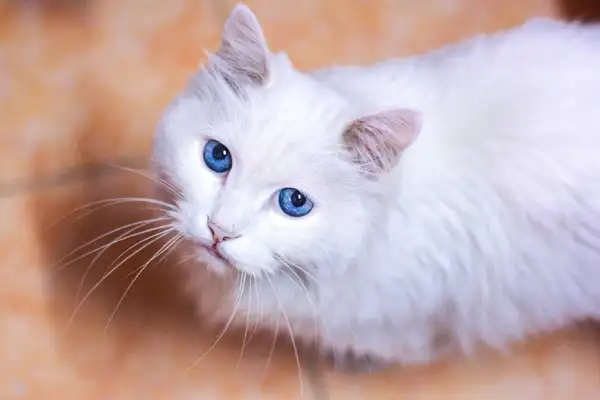
The Turkish Van (土耳其梵猫) is a medium-sized cat breed weighing 3–9 kg with a 12–17-year lifespan. A semi-longhair natural breed from Lake Van in eastern Turkey, with a large, athletic build. Its signature look is a mostly-white body with color confined to the head and tail — the classic 'Van pattern'. The single-layer coat lacks a downy undercoat and repels water, giving the breed its famous love of swimming. Independent yet affectionate, and remarkably strong.
Feeding
Very active — feed high-protein, high-energy cat food; adult males can eat 30% more than an average house cat.
Exercise
Extremely high energy needs. Provide tall cat trees, elevated perches and chase-toys; leash-training is possible.
Grooming
The single, undercoat-free semi-long coat rarely mats. Comb 1-2 times a week; increase during shedding. Tolerates baths well.
Health
Generally very healthy; watch for HCM, congenital deafness in blue-eyed white cats, and injuries from acrobatics.
Gallery
A closer look at the Turkish Van
From origins and personality to daily care and health — helping you judge whether this little companion is really the one for you.
Origin & history
Origin & history
The Turkish Van is an **ancient natural landrace breed from the Lake Van region of eastern Anatolia, Turkey**. For centuries villagers around the lake have kept these large, semi-longhair cats — white bodies with colored heads and tails — for rodent control and companionship, calling them **Van kedisi**.
In 1955, British women **Laura Lushington** and **Sonia Halliday** travelled through Turkey and were struck by these self-swimming white cats. They brought a breeding pair back to Britain and began a systematic breeding program. Their insistence on the **Van pattern (color only on head and tail)** and on retaining natural traits shaped today's breed standard.
**International recognition timeline**: - **GCCF (UK)** recognized the Turkish Van in 1969 - **FIFe (continental Europe)** recognized it in 1971 (breed code TUV) - **CFA (USA)** granted championship status in 1994 - **TICA** registered in 1979 and gave championship status in 1985
The **Turkish Van** and the **Turkish Angora** are both native Turkish breeds but from different gene pools — the Angora originated around Ankara and is a slim cat, while the Van comes from Lake Van, is much more heavily built, and carries the distinctive Van coat pattern (strong expression of the S-locus semi-white gene). The Turkish government has classified both breeds as **cultural heritage animals** since the 1930s, and Yüzüncü Yıl University near Lake Van runs a dedicated Van kedisi conservation research center.
Looks & breed standard
Looks & breed standard
The Turkish Van breed standard is defined by the CFA, TICA and FIFe with unmistakable visual traits:
- **Body**: **large semi-longhair** — long, broad-chested, muscular, with powerful legs. Adult males can reach **7-9 kg**, females 4-6 kg. This is one of the few genuinely large working cats. - **Head**: a medium-wide wedge, with a slightly curved nose bridge and well-developed cheeks (especially in adult males). - **Ears**: medium-large, wide-based, with slightly rounded tips and rich furnishings inside. - **Eyes**: large, almond-shaped and slanted. Amber, blue, or **odd-eyed** — the odd-eyed form is considered sacred in parts of Turkey. - **Coat**: **semi-long, single-layered, no downy undercoat**. The texture is famously **cashmere-like**. This structure is unique: **without a dense undercoat, the coat does not absorb water quickly**, which is the physiological basis for Vans' love of swimming. The coat sheds heavily in summer and grows back into a full ruff, belly frill and plumed tail in winter. - **Van pattern**: the body is **almost entirely white**, with color appearing **only on the head and the tail**. Up to about 20% incidental body spotting is permitted. Accepted colors include red (classic auburn), cream, black, blue, tortoiseshell and their tabby variants. - **Tail**: **full and plume-like**, always matching the head color — the breed's most recognizable feature.
Note: only cats descended from the Lake Van landrace are true Turkish Van pedigrees. Other breeds can carry a similar bicolor pattern without being Turkish Van.
Personality in depth
Personality in depth
The Turkish Van's temperament is as distinctive as its looks — it sits somewhere between the classic 'independent cat' and 'affectionate cat', with unusually high energy:
1. **Obsessed with water**: this is its most famous trait. Vans will **actively jump into bathtubs, sinks, aquariums and even swimming pools**, batting at the water and chasing droplets. Fishermen around Lake Van have long seen them wading after fish. The mechanism is simple: **without a downy undercoat, their coat does not saturate**, so water does not feel as unpleasant as it does to most cats. 2. **Powerful jumpers**: the Van is **one of the strongest-jumping domestic cats**, easily reaching the top of a fridge or bookshelf in one leap. It needs vertical space — a home with only flat furniture will bore it. 3. **Independent but selectively affectionate**: unlike a Ragdoll or a Burmese, the Van typically **bonds deeply with 1-2 people**, remaining polite but reserved with strangers. 4. **Does not like being held**: most Vans dislike being cradled or restrained. They prefer to approach you. Experienced owners say: 'Do not pick up a Van — let the Van come to you.' 5. **With dogs and other cats**: with early socialization, Vans coexist with dogs and other cats, but expect them to be **top of the household hierarchy** — their territoriality is above average. 6. **Intelligence and training**: highly intelligent; learns to open doors and drawers, fetches, and often tolerates leash training. 7. **Voice**: low-pitched and infrequent, far quieter than a Siamese.
The Van needs owners who respect its independence and can provide serious exercise and stimulation.
Daily care
Daily care
**Grooming**: - The Turkish Van is 'lots of fur, low grooming' incarnate. **No undercoat = no matting = no professional grooming needed.** - Comb 1-2 times weekly (steel or wide-tooth comb); daily during spring and autumn shedding to reduce loose hair around the house. - The plumed tail needs no special treatment and stays full naturally.
**Bathing**: - **Turkish Vans are one of the few cat breeds that do not resent baths**, and many actively enjoy water. - Bathe every 1-2 months with a gentle cat shampoo. - **Important**: always **dry thoroughly** afterwards — trapped moisture in the semi-long coat can still cause skin issues.
**Diet**: - Large body + high activity = high calorie, high-protein needs. **Adult males can eat 30% more than an average house cat.** - A mix of dry and wet food works well; raw diets can serve as a supplement. - Feed a large-breed kitten formula up to about 12 months, since maturing too quickly stresses skeletal development.
**Exercise and environment**: - Vertical space is essential: **floor-to-ceiling cat tree, jumps and window perches** are standard equipment. - Provide at least 30-45 minutes of interactive play daily (wand toys, laser pointer, balls). - Offer a **shallow water bowl or water toys** to satisfy the water instinct, but keep the water clean and warm. - Indoor-mainly with optional harness walks — the Van is one of the few cat breeds that adapts well to leash training.
**Ears, claws, teeth**: routine care; check ears every two weeks. If a blue-eyed individual proves deaf, use more visual cues when communicating.
Health & lifespan
Health & lifespan
The Turkish Van is a **generally very healthy natural breed** whose gene pool has not been overselected. Lifespans of 12-17 years are common, and some individuals live past 20. However, several concerns deserve attention:
1. **Congenital deafness in blue-eyed white cats (linked to the W gene)**: - As in all predominantly white cats, the Van's white coat is driven by the **dominant W gene** - **The W gene is linked to inner-ear development**, so approximately **65-85% of blue-eyed white cats show congenital deafness**, and in odd-eyed cats the **blue-eyed side ear** is usually the affected one - See Ryugo & Menotti-Raymond 2012 *Hear Res* for a review - Breeding programs should perform **BAER hearing tests** on kittens
2. **Hypertrophic cardiomyopathy (HCM)**: - Large cat breeds have generally elevated HCM risk, and the Van is no exception - An annual echocardiogram is recommended in adults; every 1-2 years for breeding cats
3. **Trauma and orthopedic risk**: - The Van's high activity level and dramatic jumps mean higher-than-average risk of falls or collisions - Balconies and open windows must be secured
4. **Hip dysplasia (HD)**: - HD has been reported in large cat breeds such as Maine Coons and Turkish Vans, though at much lower rates than in dogs - Breeding cats can be scored via PennHIP or OFA-style systems
5. **Periodontal disease and stones**: - Standard senior-cat concerns; schedule an annual oral exam
6. **Obesity after neutering**: - Especially in males; control calories tightly and encourage play
**Recommended screening**: BAER hearing test (especially for blue-eyed cats), annual echocardiogram, and routine blood chemistry.
Fit for your space
Fit for your space
**A good match for**: - **Medium to large homes** with vertical space and clear jumping routes (floor-to-ceiling cat tree, bookshelves, window perches) - Households that can tolerate a cat splashing water around the kitchen sink - Owners with plenty of time for daily play (30-45 minutes of interaction, minimum) - Homes with a stable daily rhythm — Vans thrive on routine - Owners drawn to a cat that combines **athleticism, natural beauty and independence** - Intermediate cat owners with some previous cat experience
**Not a match for**: - Small apartments with no vertical space - Families hoping for a lap-cuddler — the Van decides when to come to you - Neat-freak owners who cannot tolerate splashed water - Single owners who are away from home for very long hours (Vans get destructive when under-stimulated) - Those seeking a decorative, quiet cat (look at the Persian, British Shorthair or Ragdoll instead) - Owners flatly opposed to leash walks — fully suppressing a Van's athletic drive leads to anxiety
**Special notes**: - Ask breeders for **BAER hearing test reports** (especially for blue-eyed or odd-eyed cats) - Request parental HCM ultrasound reports - Avoid neutering too early (before 10 months) so skeletal development is protected - An adult male Turkish Van weighing 7-9 kg is normal — do not diet him just because 'the cat is so big'
References
This is an educational overview — for specific health and care advice, please consult the authoritative sources below and your veterinarian.
- CFA — Turkish Van Breed Article国际猫协标准
- TICA — Turkish Van Breed Standard国际猫协标准
- FIFe — Turkish Van Breed Standard (TUV)国际猫协标准
- GCCF — Turkish Van Breed Standard of Points国际猫协标准
- ICatCare — Turkish Van breed profile综合科普
- Turkish Van Cat Club (UK)俱乐部官网
- Ryugo & Menotti-Raymond 2012 Hear Res — Feline deafness genetics review学术研究
- Cvetnić et al. 2016 — Genetic diversity of Turkish Van cats学术研究
- Wikipedia — Turkish Van综合科普